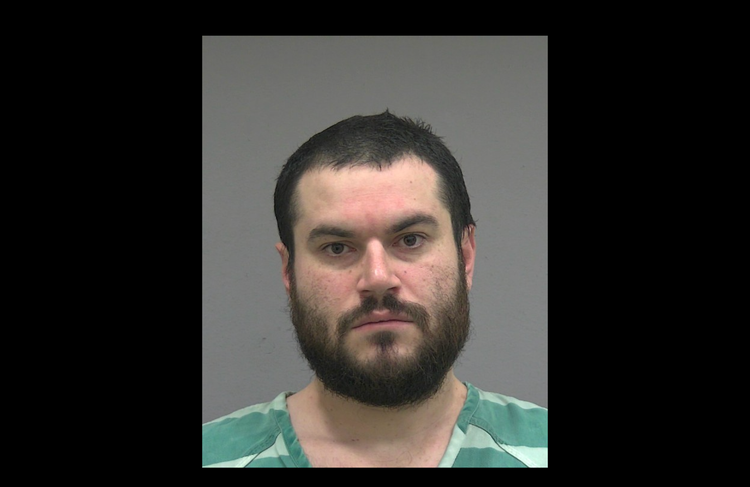
Art or Domestic Terrorism? The Trial of Julio Domínguez
Editor’s Notes: Some quotes have been edited slightly from the transcript or court docs for grammar and to remove filler words (e.g., “um,” “like”)
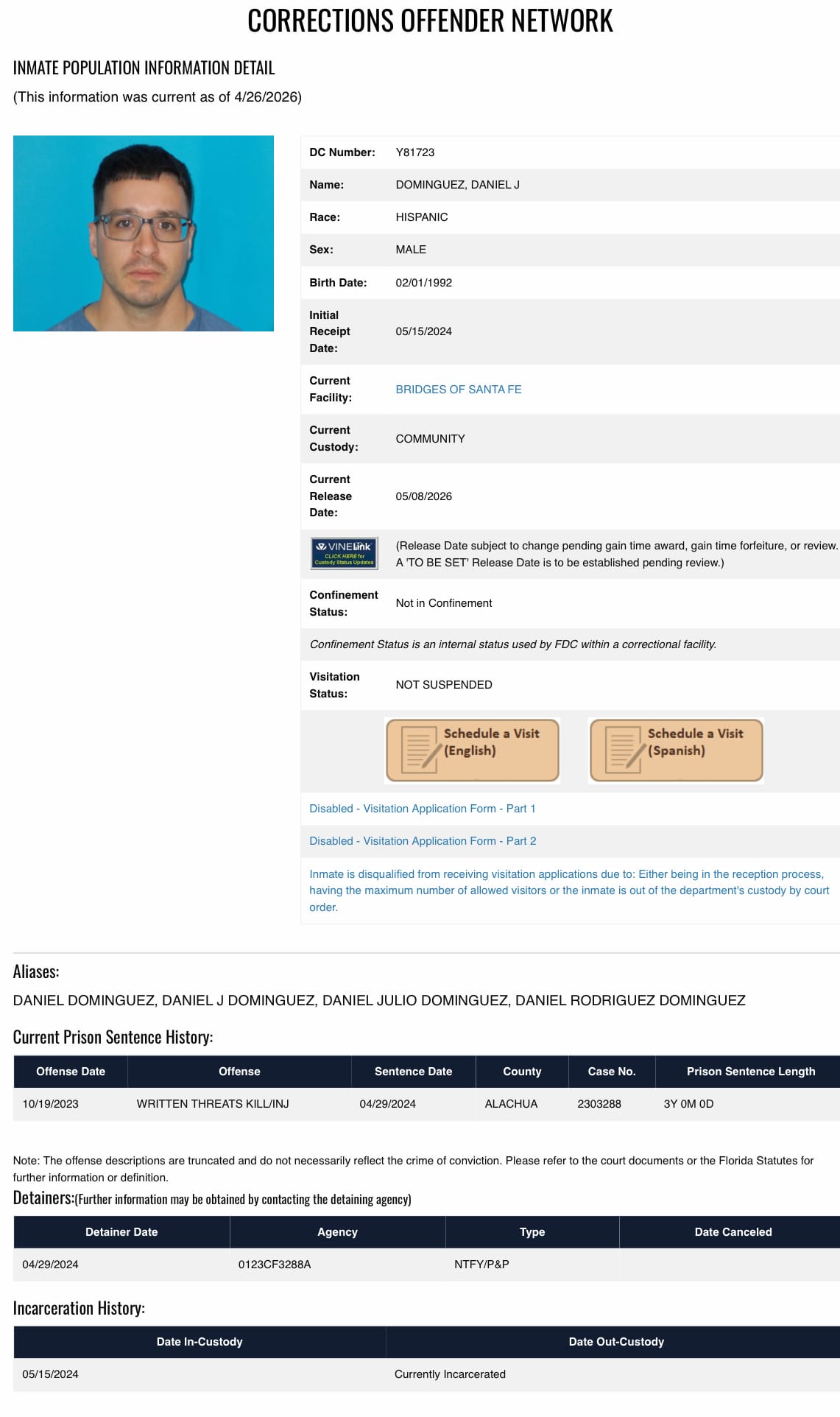
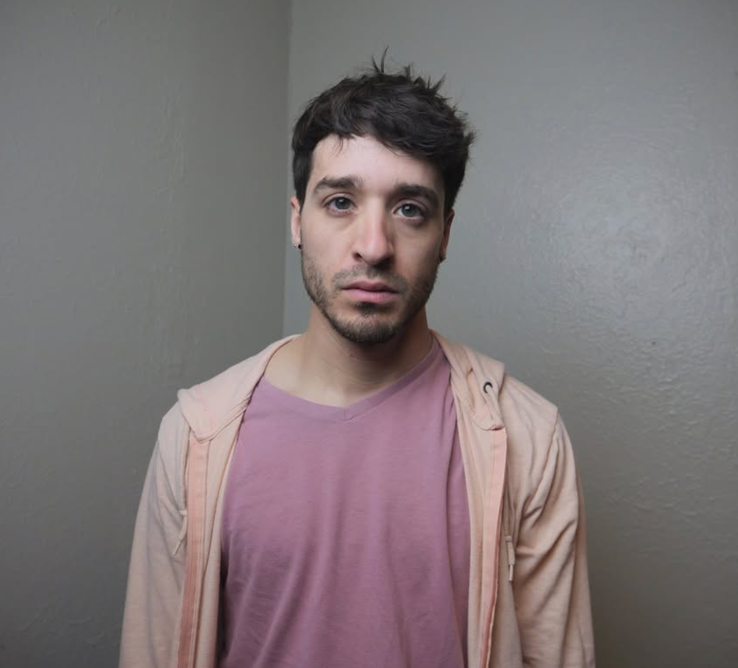
On October 19, 2023, Gainesville Police Department (GPD) officers and Alachua County Sheriff’s Office (ACSO) deputies arrested 31-year-old Daniel Julio Domínguez and charged him with intimidation and terrorism.
Domínguez was ultimately convicted and is wrapping up a three-year prison sentence at the Bridges of Santa Fe Community Release Center. His court-appointed attorney filed an appeal after losing at trial but Domínguez's conviction was upheld.
Arrest
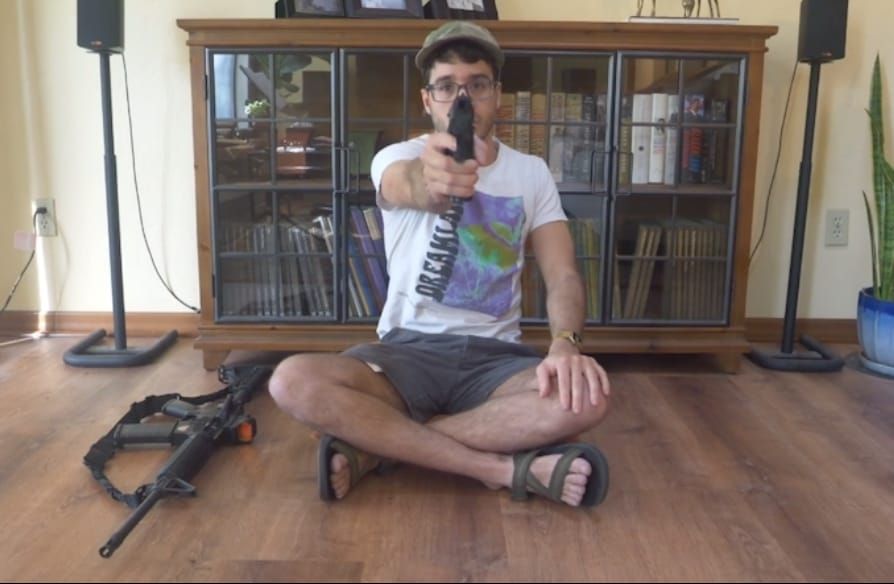
Around 2:00 p.m., on the day of his arrest, Domínguez published the following video:
"Suicide Note #1" (Domínguez)
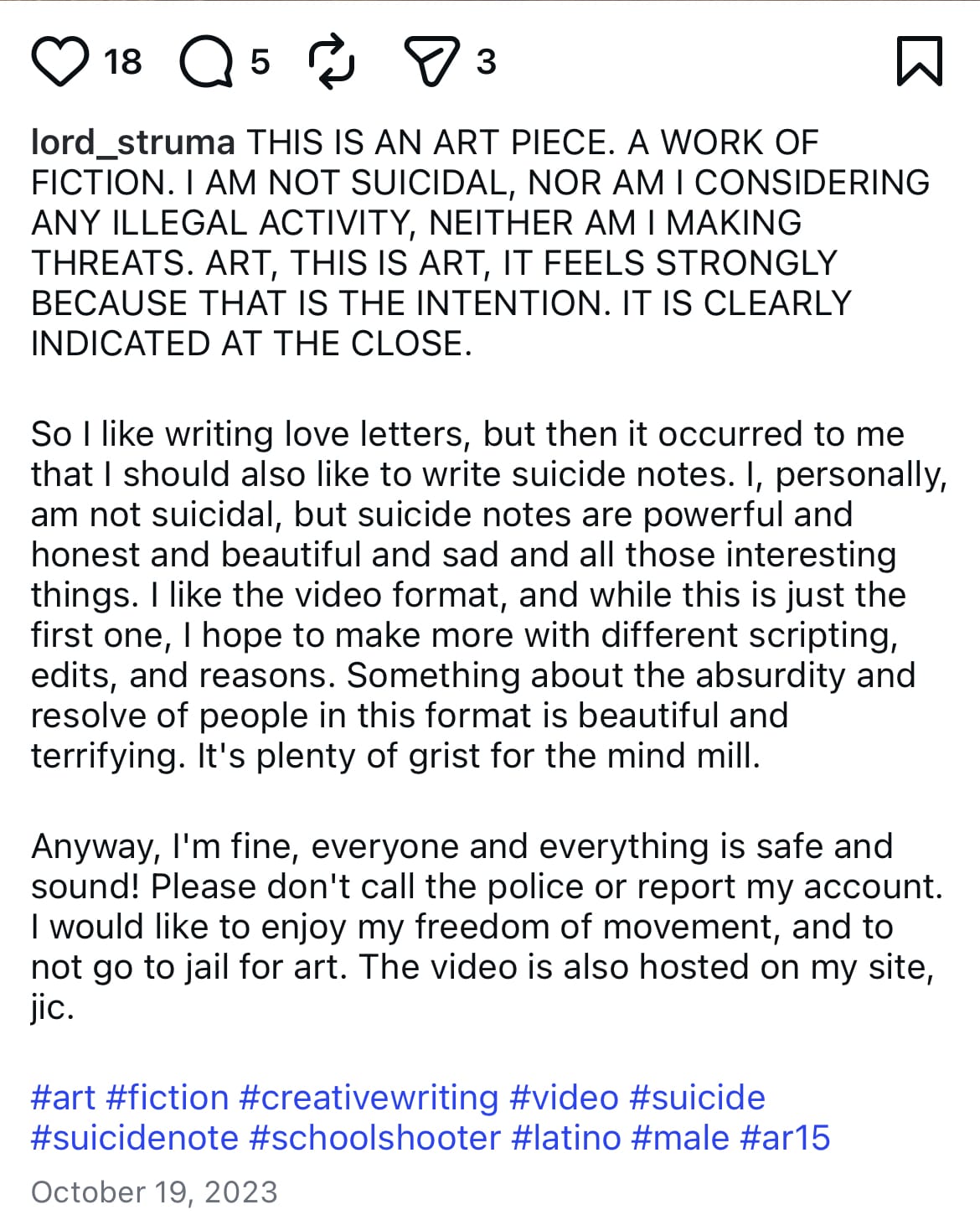
The video was published on Domínguez’s website, cushbomb.com , as well as his Instagram account. The Instagram video contains a disclaimer in the caption.
Deputy Lexi Burks reported the following:
“[The Florida Department of Law Enforcement (FDLE)] contacted GPD Lt. Lugo in reference to an analyst discovering this video. GPD officers were able to identify Domínguez (he provided his name in the video) and saw that he previously lived near Parker Elementary… It was believed that the school or a nearby school may have been his target. The information was then forwarded to GPD Patrol Operations. Lt. Lugo approved for dispatch to request a ping on Domínguez’s cell phone. Domínguez was eventually found in the area of Satchel’s Pizza… where he was apprehended without incident.
While being transported to the GPD station, Domínguez made an excited utterance advising that his guns were in his bedroom at his dad’s house... GPD Det. Dose sat down with Domínguez in a GPD interview room, where he was asked if he knew why he was here. Domínguez advised it was because of his video. Post Miranda, Domínguez stated that he wanted a lawyer.
At the time the information was provided to GPD, it was believed the target was within the city limits of Gainesville. GPD patrol and ASO patrol responded to [a different residence], where contact was made with both of Domínguez’s parents. After conducting a safety sweep of the residence, it was determined that the video was filmed in the residence, which is within |the unincorporated area of Alachua County. An AR15 style weapon, which appeared to be similar to that depicted in the video, was observed within plain view of the law enforcement officers conducting the protective sweep. The residence was secured, and ASO Detectives were summoned to respond.
Due to Domínguez’s statement of ‘I have decided to take up arms, and attack the state. I intend to target a middle school, particularly the middle school I went to’ and ‘I will be going on a Saturday or a Sunday when no children are there with the intention of getting off as many Nato .556 rounds from my AR15 at the building’ while holding the rifle, Domínguez committed an act of terrorism or conspired in terrorist activity.”
First Appearance
The day after his arrest, Domínguez appeared at his first appearance with Judge Thomas Jaworski.
“Do you understand what it was that you got arrested for?” Jaworski asked.
“I suppose. I’m a bit confused,” replied Domínguez.
Domínguez’s parents showed up to support him, with his father saying he had lived with him for the past two months and never felt threatened. “I really don’t think he’s capable of doing any of what he has been charged with,” said Domínguez’s father.
Public Defender Rachel O’Brien argued, “the conduct here that is alleged in the police report does not fit the definition of terrorism because there’s no act here that is dangerous to human life. There’s no act here that is violent. There’s a threat to do violence, but that violence, if we look at the four corners of the arrest document, is the threat to shoot up a school on the weekend, specifically, as he said, so no one would get hurt. He also left several disclaimers...”
Assistant State Attorney Scott LaPeer said the defense's argument carries the assumption "that the building and the grounds are completely empty on a weekend, that there are no extracurricular activities, that there are no cleaning staff or maintenance, that there are no teachers working in the building after hours, which certainly can’t be guaranteed. This electronic threat was disseminated over social media, Instagram. If any child or employee who would be there on the weekend knows they will be there... and were to see that on Instagram… that is certainly an electronic threat and would be perceived as a threat by that person. I’m sure they would be very alarmed and feel endangered.”
Jaworski sided with the state and set Domínguez’s bond at $2 million, prompting O’Brien to have him testify about his financial resources.
Domínguez said he had $15,000 in savings but no income besides “$10 or $15 a month” from his art.
Domínguez’s mom said she could contribute $10,000 for the bond.
O’Brien asked for a bond of $250,000, as it’s often possible to post a bond by paying 10%, which would be $25,000.
Jaworski said his order would remain.
Bond Reduction
On November 14, 2023, Public Defender Alexis Giannasoli submitted a motion to reduce Domínguez’s bond.
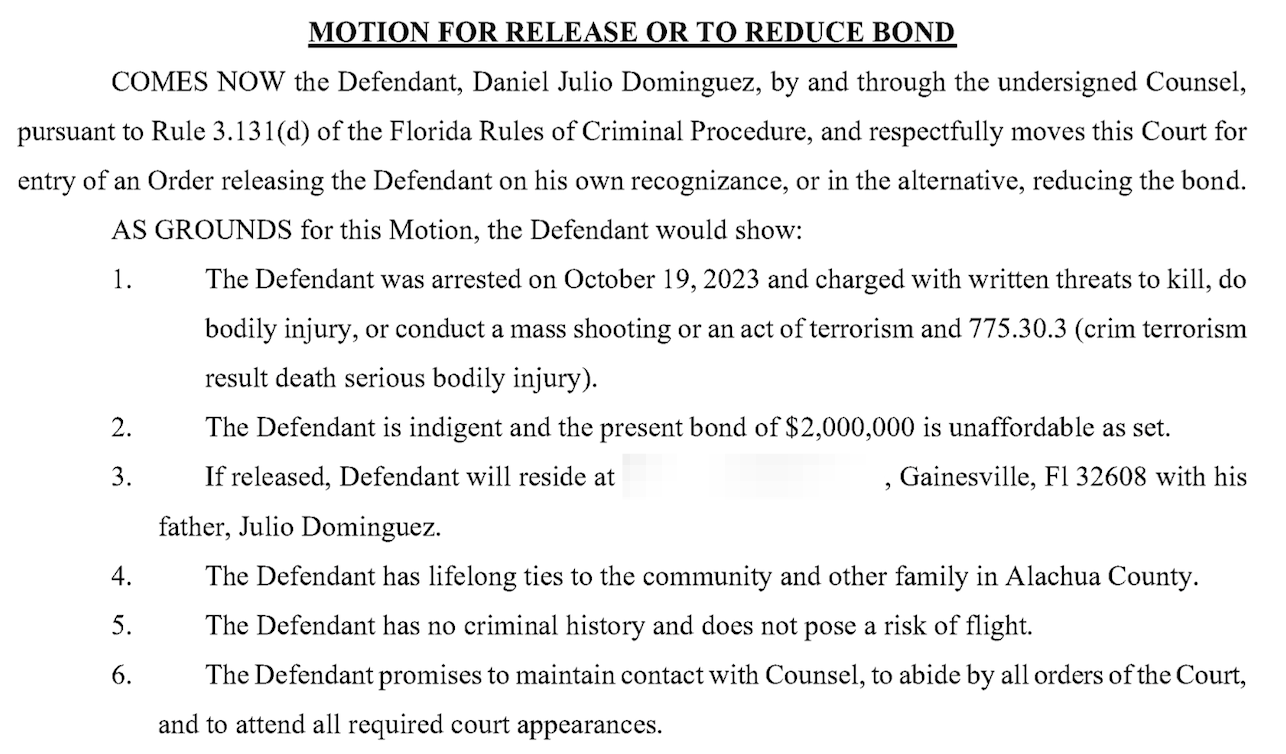
At the hearing, Domínguez's mother showed up to support him, as did one of his middle school teachers, Janet Wisby.
Wisby said, “During his college years, he created a video on viruses and how they attack the human body and other organisms. And he happened to send it to me, and I’ve used it – I did use it for years with my students because it was perfect… for an educational video. In fact, I talked to Danny, and I said, ‘You should get into this business. You have a great voice. You’ve got a great imagination. You know how to put it together.’”
Local bookstore owner Phillip Harris said he was acquainted with Domínguez, having met him when Domínguez came into his store and showed him his art. He said, “When Julio presented the art to me, if I had thought it was a threat at all to the community, I would have held him and arrested him – or I would have held him and called the police immediately… I believe Julio is a 100 percent peaceful person, and this is a misunderstanding.”
A number of other individuals testified positively for Domínguez in favor of his release.
When asked about his finances, Domínguez gave a similar answer to his prior hearing and added that he recently resigned from a position at Florida State University.
Giannasoli told Judge David Kreider, “The disclaimer is significantly more than just ‘this is an art piece.’ It goes on to describe that the video is a work of fiction. It expressly indicates… There is not going to be any harm done to anyone, and it goes on to describe where it is coming from, as far as it relates to his art projects. The substantial likelihood of conviction based on this disclaimer and the protections that Mr. Domínguez is afforded by the First Amendment in production of art should be factored into the Court’s consideration when we’re dealing with setting a bond.”
Kreider asked Giannasoli if police recovered a gun, and she acknowledged they did. She said the AR-15 was real while the pistol was not.
Assistant State Attorney Britanee Prince told Kreider, “These acts were not able to be followed through with because law enforcement was able to apprehend him prior to the weekend… [The State] has an extreme concern for the safety of the community, specifically at this school that the defendant targeted in his video. And the State believes that the bond is reasonable because of these arguments...”
The bond-reduction motion was granted by Judge David Kreider, but he reduced it by only $500,000, so it was arguably still unaffordable.
Bond Appeal
On January 31, 2024, Florida’s First District Court of Appeals ruled that Domínguez was being illegally detained and that he would need to be released in five days unless the court takes reasonable action.
According to Judge Stephanie Ray, “The Florida Constitution guarantees that a presumptively innocent individual will be released prior to trial on reasonable conditions… The only exception to the guarantee is if a court finds that no conditions of pre-trial release can reasonably protect the community, ensure the accused's presence, or ensure the integrity of the judicial process… That has not occurred.”
Pretrial Detention Hearing
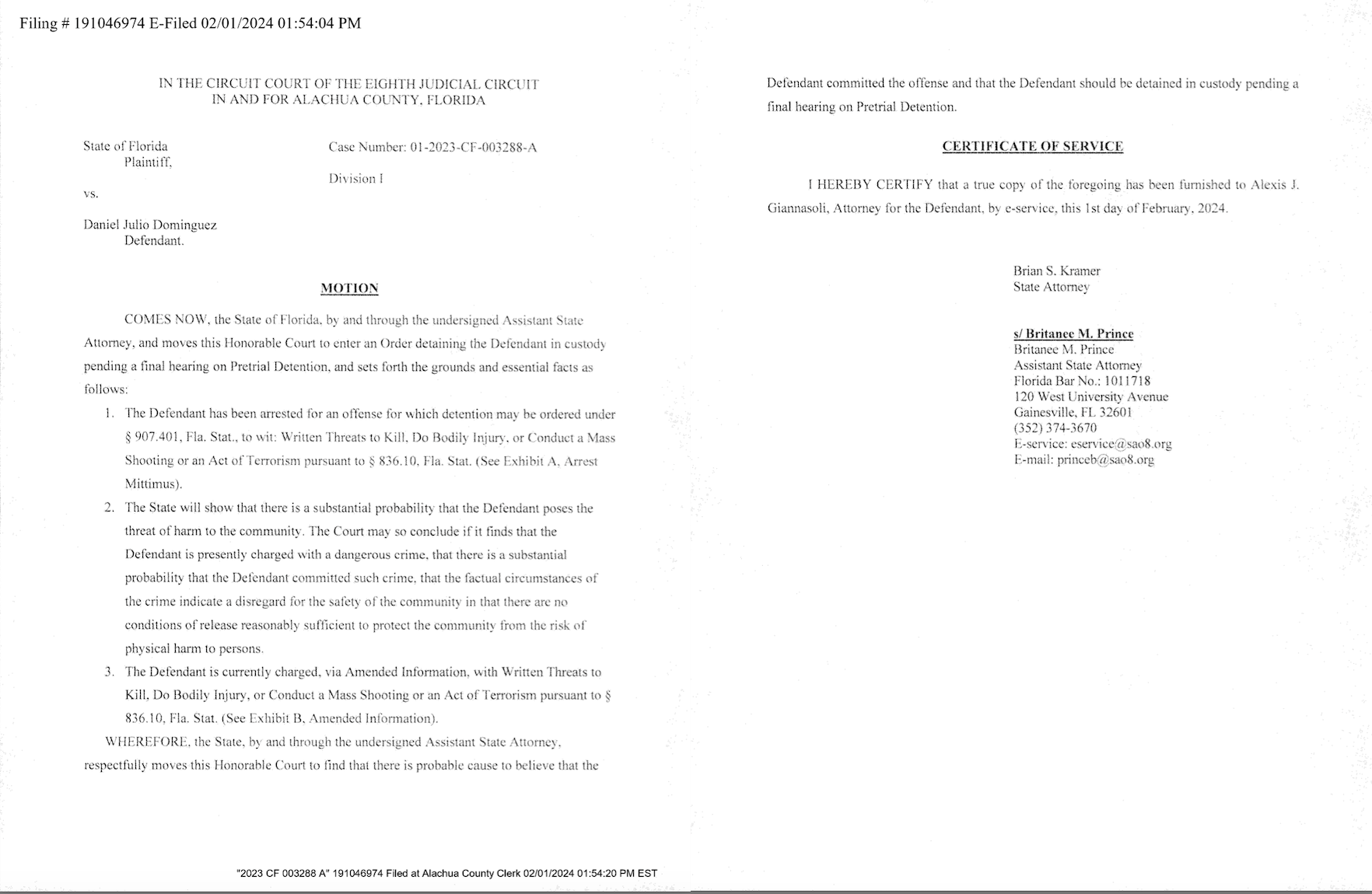
On February 1, 2024, Prince filed a motion for pretrial detention against Domínguez, and it was heard in court the following day.
At the start of the hearing, Giannasoli stated, “The defense received notice of this motion yesterday afternoon... We did have some tip-off that it might be coming, though not substantively what the motion might include. This morning, the State has indicated both that they intend to play the video without the disclaimer, so not what the defense was anticipating they would play, given that it’s not the full piece of evidence...”
Assistant State Attorney Ryan Nagel said, “The State is not opposing or suggesting that there wasn’t some disclaimer that the defendant put on the video prior to posting it. That’s not in dispute.”
Nagel went on to say, “This issue didn’t even arise until the Florida First [District Court of Appeals (DCA)] returned this because this Court had actually followed the procedures laid forth and set a cash bond. It’s the DCA that said, no, that’s tantamount to a detention: so this was filed as a result of the DCA sending this back.”
Kreider said, “Just reading the First DCA’s opinion… now that we have this new statute in effect… before the Courts were giving higher bonds… I’m assuming we’re going to have a lot more of these hearings now.”
Giannasoli said there hasn’t been any “new evidence available to the State that is available to the Court at this point to justify good cause to modify Domínguez’s admittance to bond to the extent that he is held in pretrial detention.”
Prosecutors called a witness at the hearing, Detective Justin Torres.
Prince asked Torres how he became involved with the investigation.
Torres said, “I was requested to assist the investigation by Lieutenant Lugo, who was a shift commander at the time. He received information from an FDLE agent of a video that they had found on Instagram, which indicated that an individual, identified as Mr. Domínguez, was going to take up arms and fire rounds – what is it? Nato .556 rounds at a school that he had previously went to. He did not identify the school. From research later, we kind of determined where the school most likely would have been.”
Torres continued, “I assisted patrol in looking for Mr. Domínguez. Lieutenant Lugo had dispatch approve an emergency ping on his cellphone, which he was later found by the Ole Barn on Northeast 23rd Avenue. He was detained and brought to the station, and post-Miranda, he invoked his rights. But after reviewing the video over and over again, I did observe a disclaimer at the end, but it was very - from my experience and from my observation of it and just, you know, being a normal person and also being a parent – I would not send my child to–”
“I would object to his feelings about it as a parent as relevance,” interjected Giannasoli. Kreider sustained the objection.
As the hearing continued, prosecutors played the video in question. Afterwards, Prince asked Torres to confirm the disclaimers, but then contrasted them with the realness of the rifle. Torres added that there were “other firearms found inside the residence… and ammunition.”
Nagel called the pretrial detention hearing a “dangerousness hearing” and said, “What do Audrey Hale, Nikolas Cruz, Dylan Klebold, and Eric Harris all have in common?.. What they have in common is they’re all school shooters and they have all made manifestos or wrote suicide notes prior to their school shooting that then society has looked back on and said, ‘oh, we should have known, because if we had actually paid attention to what these people were saying, we would have known that they were going to shoot up a school.’ Here, we have this defendant doing exactly what predecessors have done… he is making a very clear statement to society that he is frustrated… like other school shooters; that he sees an injustice… that the way to rectify this injustice is to cause an act of terrorism… to shoot up a school.”
Nagel argued, “it would be as if someone were… creating a snuff film, a murder on tape, but then putting at the end of it, ‘This is an act of fiction’ or ‘this is an act of art.’ Would that not make it evidence of a murder? Just saying that something is a piece of art or is a piece of fiction does not actually take away from what it is.”
Nagel said Domínguez was illogical in saying he would attack a middle school to combat wealth distribution.
“How does a middle school redistribute wealth?” Nagel questioned rhetorically. “The dangerousness comes down to the absolute unpredictability of someone in a mindset like this… He’s labeled this a 'Suicide Note,' and so the State argues that he would put himself in that category of someone who is unstable and unpredictable. Therein lies the dangerousness… The danger that could have occurred to members of the law enforcement community, members of the community at large, members of the school board, children within the school, far outweigh anything that the defense can present.”
Nagel argued that if Domínguez wanted to take his own life, no conditions set by the court would be sufficient.
Giannasoli said, “We get into muddy waters when we start talking about punishing someone for something they think they might be thinking about doing… The statute requires that an act actually took place. We don’t have an act… a violent act that took place or an act dangerous to human life…”
Kreider said, “The Court finds that the disclaimers at the end do not set aside the crime that’s been committed. And the Court finds that there is a substantial likelihood that he committed the crime and he will score a Department of Corrections sentence if convicted as charged and that there are no conditions of release reasonably sufficient to protect the community. The Court also notes in Judge Ray’s concurring opinion… [it] says, ‘Given the seriousness of the charge against the petitioner and other considerations, the Court was justifiably concerned about placing the community at risk of harm through the petitioner’s release.’ So Judge Ray, after reviewing the record that was before her, also could understand the Court’s concern about the community’s risk of harm... He’s to be held under pretrial detention unless there’s a further hearing by the Court allowing him to be released.”
Cush Bomb
Over the next few weeks, prosecutors started building their case against Domínguez and notified his defense of evidence they planned to use at trial.
Prince notified the defense that Domínguez’s entire website, cushbomb.com , may become relevant at trial.
The website contains several art projects, zines, writings and videos.
In August 2023, Domínguez published a piece titled “How to Writer,” where he gives advice on writing.
One section is titled “Consent,” where Domínguez wrote, “I once made a mistake and involved a reader in a story and made them uncomfortable. Thank god they told me. I have since corrected the mistake best as possible, but there are lingering effects and emotions that I cannot change. I love the reader, desperately, and I learned this seemingly obvious lesson the hard way. You must cut certain details and you should ask for consent when you need to. Be respectful of other people. Be kind. Not everyone wants to be implicated in your art.”
Regarding his personal process, Domínguez wrote, “Engage lots of ideas, especially when others tell you to stay away. (I.e. the Unabombers Manifesto).”
Another section is titled “Disclaimer,” which prosecutors affirmed they planned to use. Domínguez wrote, “In high school, a girl I knew got a young teacher fired because she wrote about her relationship with him in her personal diary and it was used against him in court. What a Lame-O situation. A disclaimer would have protected the diary from being seized and admitted as evidence for the state to read. It’s good practice to put one at the front of every personal journal or controversial document. I use the following disclaimer so that fiction stays fiction and doesn’t become evidence. This is adult content for 13+ audiences. I am not a writer. This is a work of fiction. Names, characters, business, events and incidents are the products of imagination. Any resemblance to actual persons, living or dead, or actual events is coincidental.”
Another work published by Domínguez is titled “Community Charms” and contains a similar disclaimer to the one described above. He wrote, “I keep getting attacked or threatened by my countrymen. I had two close acquaintances that were shot and left for dead and their car set on fire. I had a neighbor that came to my door at 3am covered in blood after experiencing domestic violence. I had to guard my door with a rifle because her big strong boyfriend followed. I experienced a dog shot in the face at a party next door that felt like it was in my living room. I have been nearly run off the street for nothing. I have things thrown at me from the road. I get followed and watched all the time. Finally, A neighbor, John, squinted at me and said ‘I don’t like the way you look’. He then jumped into the culdesac, grabbed me by my shirt, cocked his MMA experienced fist… and by the grace of the moment, was denied completion. He tripped, barefoot, over my little electric scooter. He chased me down the street screaming. He told me he would kill me. I had to call the police to retrieve my scooter. He lied to them and claimed that I, at 5’5.25' tall and 130 lbs, attacked him. The scooter fell forward when John tripped and it struck me in the shin. It was my only superficial injury.”
Domínguez then discusses his initiative to install community charms throughout the community to help society build connections with one another.
One document published by Domínguez was edited on October 19, 2023, the same day he was arrested. The piece appears to outline his plans for projects. One is called the “peaceful provocation project,” which contains reference to artistic “suicide notes.” Domínguez wrote, “These are art pieces, not real suicide notes, video threats, or descriptions of real intentions of impending events.”
Text Messages
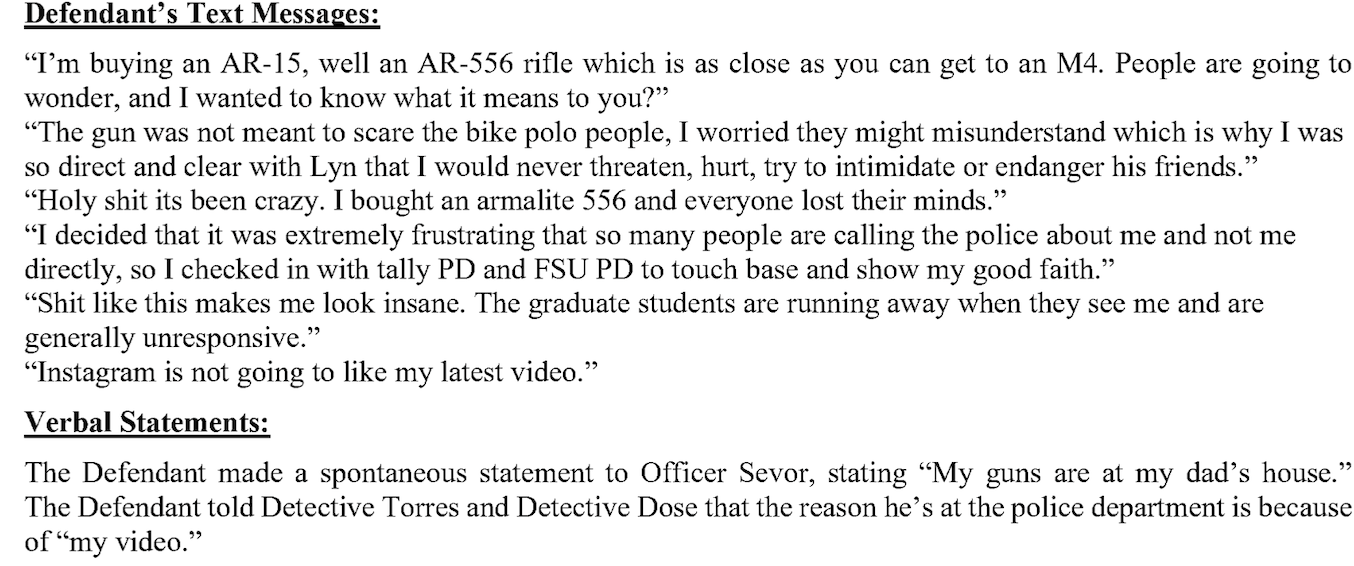
Prince notified the defense that they planned to use the following text messages and statements at trial.
Tallahassee Incident
Prince notified the defense that they intended to offer evidence of other “crimes, wrongs or acts” involving Domínguez and planned to call Tallahassee Police Department Officer Summer Harrelson as a witness.
According to Harrelson’s report, she made contact with Domínguez on June 9, 2023, in the area of 435 N. Macomb St. She reported:
Daniel Domínguez, pulled up behind me on his scooter. He waived his arm to flag me down. He advised he needed to know the address to the station. I remembered Daniel from a past encounter for a check on the welfare. Daniel advised he was going to all of the police departments in town to essentially clear his name because people kept calling the police regarding him owning a gun. I advised him we could move out of traffic and I would speak with him. We pulled into the above address.
Daniel advised he went to Bass Pro and purchased an ‘AR 556’ and his friends were worried about it. He stated it was because they were liberals and he was registered as a republican. He went on to say that he does not discuss politics with people and they probably do not know he is registered as a republican. He wanted officers to be aware his scooter bearing FL MSFJ44 did not have a secured storage compartment and he would not carry ammo or a firearm on the vehicle. He stated he uses the vehicle to travel to work at the university (FSU) and he would not even carry the firearm if it was broken down in his backpack.
Daniel advised FSUPD made a joke because they knew him [and] people keep contacting them regarding him. Daniel wanted to provide comfort to the local police departments. He stated he is a boy scout and was trained to shoot shotguns, rifles, and pistols. He advised he owns other firearms that are stored at his dads house. His dads house is not in Tallahassee and he is from Gainesville, Florida.
Daniel advised he told his roommate and landlord about the firearm and it ‘trickled’ out from there. He advised the community and everyone is safe. He advised even the people he has issues with do not need to be afraid. He stated he is not trying to create a threat of violence or intimidation to anyone. He was upset people knew he had a thousand dollar rifle in his house and doesn’t want his home targeted.
Daniel believes the people that know he possesses the firearm are overreacting. He advised he let his most credible colleagues and friends know he was going to purchase the firearm because he wanted to reassure them. He also advised a grad student contacted FSUPD about him last night."
Motion to Exclude (Motion in Limine)
On February 24, 2024, Giannasoli filed a motion to exclude certain evidence, referred to as a Motion in Limine.
The motion argues that Principal Sherri Estes of Kanapaha Middle School, where Domínguez previously attended and filmed the video in close proximity, shouldn’t be allowed to testify.
The motion argues against jurors being shown a test-fire of the rifle.
The motion concerns additional incidents involving the Tallahassee Police Department that the state submitted and says they should all be excluded.
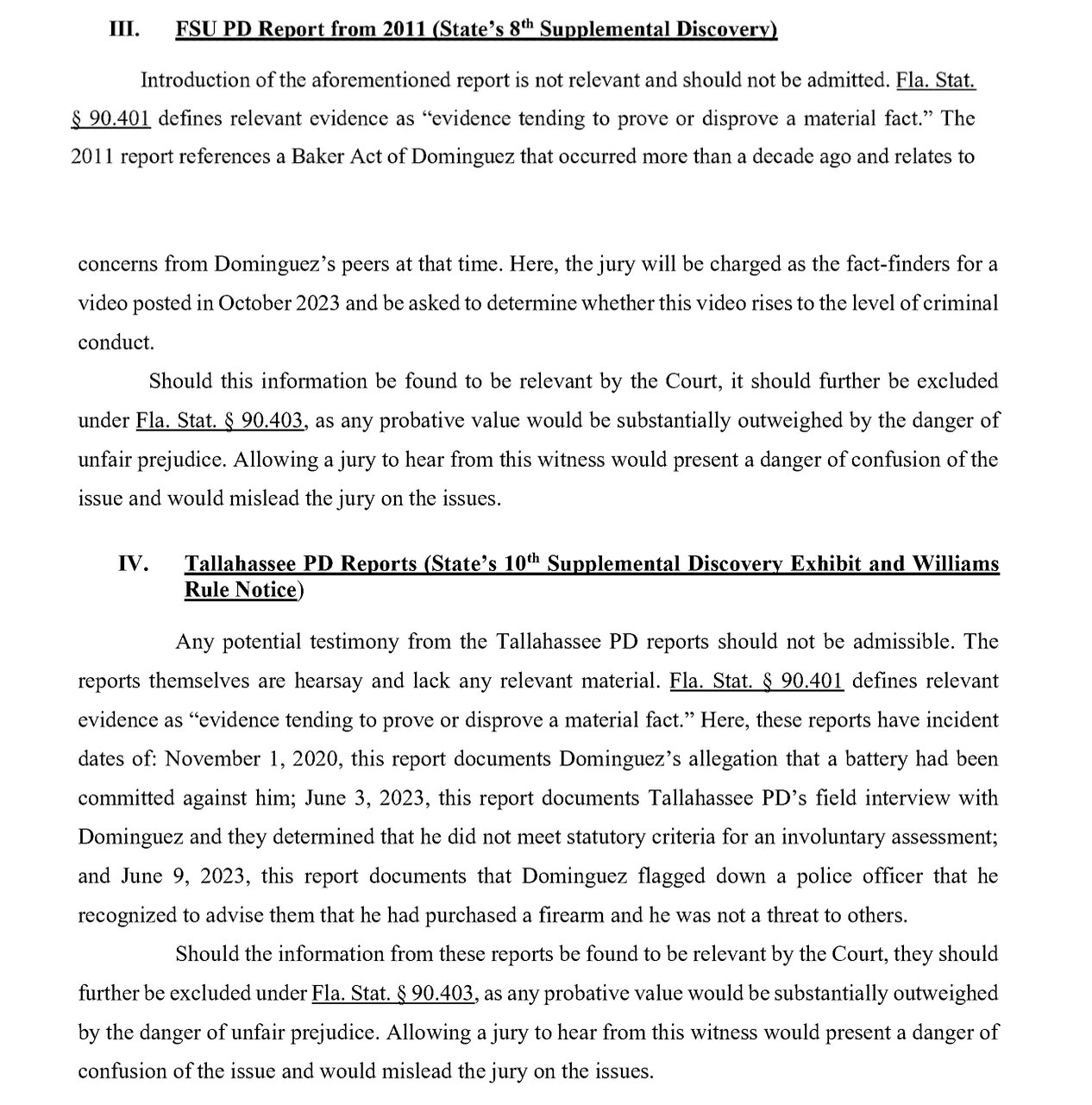
Regarding the text messages, the motion argues they should either be excluded or shown in their full context.
Motion in Limine Hearing
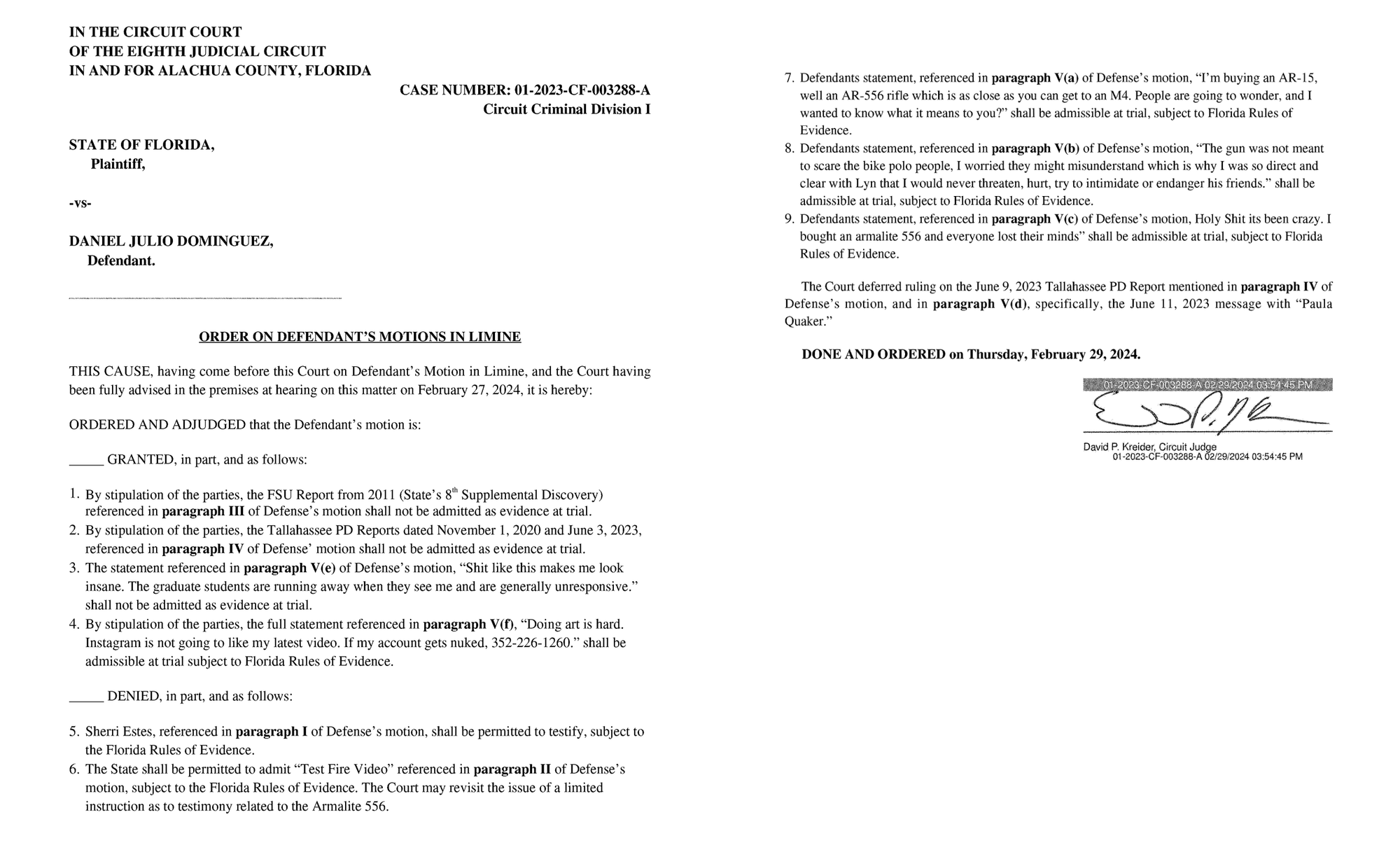
The motion was heard on February 27, 2024.
Regarding the Tallahassee PD reports, Prince said, “The State just was in receipt of them and submitted them in discovery in the abundance of caution, but is not planning on eliciting anything from them except for the June 9 report.”
Regarding Estes’ testimony, Giannasoli said it’s her understanding that she would say the school “rents its facilities out for use on the weekends.” Giannasoli said her statements are not relevant in proving the elements of the offense. Giannasoli said Estes’ testimony would "inflame the jury, confuse them about the issues and the fact that there were people there. If this were actually something that was going to happen, rather than an art piece, that there were people potentially going to be in danger.”
Prince argued, “The principal’s testimony gives legitimacy to it being a real place… To it being a real school… She will describe the layout of the school just like he does, so that way the jury can see that this is the school that he’s talking about… The principal would also testify that he was a prior student there, as he says in the video… There will be testimony presented to the jury that this school is .7 miles from the Defendant’s residence, where the firearm is located… He says in the video, ‘It is just right down the street…’ The level of specificity that he provides in the video regarding the school and the layout helps to prove his knowledge and intent.”
Giannasoli argued that the defense hasn’t received any documentation that would show Estes has knowledge of Domínguez being a student and called her testimony “speculative.”
Kreider sided with the state and said he would allow Estes to testify.
Regarding the test-fire video, Giannasoli said she doesn’t object to testimony that recounts the test-fire, but objects to a video physically showing it. Giannasoli said showing the video would be “more prejudicial than probative.”
Nagel argued the opposite, saying, “The idea that a rifle being fired at a target is prejudicial, that’s a moralistic opinion; that’s not a legal fact… Tens of millions of firearm owners in the United States will find no problem with a rifle being fired at a target. So to say that it’s prejudicial just because it’s a rifle being fired is incorrect. It’s not legally sound… The State has to prove that the Defendant had the ability to carry out the threat… To say that the State should not be allowed to present evidence to prove its burden on a false moralistic opinion of what is prejudicial denies the State its ability to fully present its case and to fully present its burden of proof.”
Nagel mentioned that the state would presents gunpowder residue showing the gun had been previously fired. Giannasoli objected to this as well. “We’re dealing with whether this video contains criminal conduct, and the making of the video and the posting of the video,” she said. “Not ‘Mr. Domínguez was a lawful owner of this rifle. He used it to shoot at ranges.’ We’re going down [a] potentially… long rabbit hole of justifying lawful behavior when the jury’s task will only be: ‘Does this video rise to the level of criminal conduct as it’s laid out…’”
“There are some actions that don’t rise to the level of being criminal conduct, but are probative in regard to the alleged criminal conduct,” said Kreider, who ultimately favored the state.
At the end of the hearing, Prince acknowledged that school shooters have become a point of discussion and clarified that they will not be bringing up school shooters from the past at trial. However, Prince said they will show “writing underneath the video where he does make a hashtag, #school shooter.”
Pretrial Meeting
Following jury selection, Domínguez appeared at his trial on March 5, 2024, before Senior Judge Peter Sieg, who had to decide if Tallahassee PD Officer Harrelson would be allowed to testify.
“It’s not a wrongdoing. It’s not a bad act,” said Giannasoli. “It’s simply a situation where I would say that the State’s characterization as Detective Harrelson having no prior involvement with Mr. Domínguez is incorrect. Approximately a week prior Detective Harrelson and another officer responded to Mr. Domínguez’s residence – that was June 3rd, 2023 – where they determined… he did not meet any criteria to have to be Baker Acted or represent any other concern for his lawful ownership of this firearm. Some background that the Court is not aware of… Mr. Domínguez was raised a Quaker. He has a large community in Tallahassee and Gainesville that are also members of the Quaker community… They’re antiwar pacifists. They are peaceful people. They have very strong feelings against firearms.”
There was much legal debate over whether Harrelson would be allowed to testify, but Sieg ultimately ruled in the state’s favor.
The Trial
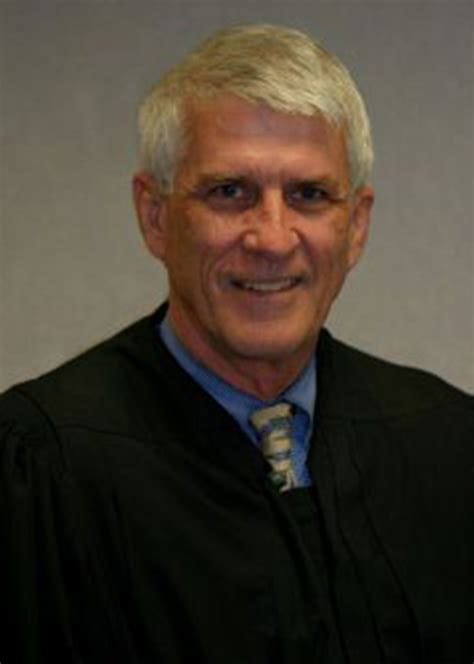
Day 1
Prince kicked off the trial by showing the jurors the video in question. “This video is the reason that we’re here today,” she said.
Prince said that Domínguez “mistakenly believes” that the video’s disclaimer “protects him from prosecution for the threats that he made…” Prince called the disclaimer a “mask” for Domínguez’s true intent to make a threat.
“He knew what he was doing,” said Prince. “He knew what he was doing when he filmed that video, when he uploaded that video. He knew that people would perceive it as threatening, and he wanted that. He wanted it to be perceived as threatening. That is what the evidence today will show you.”
“This is an art piece,” said Giannasoli. “A work of fiction… It feels strongly because that is the intention. There’s no intention of a true threat in those words.” Giannasoli emphasized the disclaimer and said the video was Dominiguez’s way of expressing his feelings on “hot topic issues.”
Giannasoli said, “The video entitled ‘Suicide Note Number 1’ includes as part of the caption how that project stems from his appreciation of love notes... The caption describes how the suicide note project stems from his love note project and how suicide notes can be just as honest and beautiful and sad and interesting and a combination of human emotions.”
Giannasoli said that police did not track Domínguez to a school or find him carrying out violence, but located him at an open-mic night at a local bookstore with people he shares his art with. She emphasized that the firearm used was obtained legally.
Witness 1 | Detective Summer Harrelson
Before Harrelson began her testimony, Sieg told the jurors, “The evidence you’re about to receive concerning other acts allegedly committed by the defendant will be considered by you for the limited purpose of knowledge… and you shall consider it only as it relates to that issue, the issue of knowledge. However, the defendant is not on trial for an act that is not included in the Information. I’ve read the charge to you from that Information.”
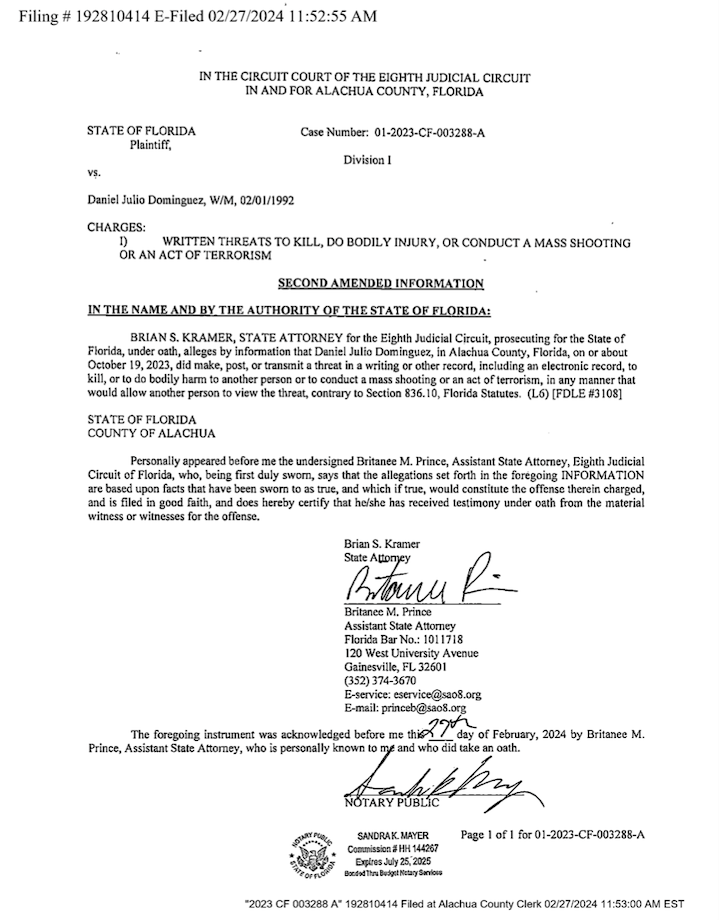
Harrelson spoke about how Domínguez flagged her down to discuss his ownership of an AR-5.56 firearm. “It wasn’t on his person at the time,” she said. “He said he wasn’t going to break it down and carry it in a backpack or anything because he worked at a university… He wanted the police departments to know that it was fine that he had a gun… He said that he told, I believe it was a friend and maybe a roommate, that he’d bought this gun, and they were concerned, and it had kind of trickled out amongst other people from there.”
Prince asked Harrelson if she considered Domínguez’s behavior odd, and she said it was. “I have never had anyone flag me down or try to justify why they bought a gun or that it was okay that they possessed a gun if they were lawfully possessing a gun,” she said.
Witness 2 | Kanapaha Middle School Principal Sherri Estes
Prince submitted images of the school into evidence and had Estes go into detail about the layout.
Regarding weekend campus activities, Estes said they do rentals and open the fields up as parks. She said that on Saturdays, the i9 sports group does a basketball camp in their gym, while on Sundays, a small church group meets in one of the buildings of the school.
Estes added, “Administration can go in and work on the weekend and has. Like this last Saturday, we had beautification… so we had kids as well as UF students on campus.”
Estes affirmed that many elementary-aged children are on campus on the weekends and said the basketball group ranges in age from five to 14.
Prince introduced school records into evidence and asked Estes for confirmation that Domínguez had been a student. Estes confirmed that Domínguez was enrolled from August 2003 until June 2006. Estes said she was not aware he was a former student when she first watched the video, but believed it was her school being described. “He described the windows in the front office area in the video,” she said.
On the cross-examination, Giannasoli confirmed with Estes that she wasn’t the principal when Domínguez attended the school. Giannasoli asked about the distance between the gym and the school's church service area to the front office area. Estes said that for the most part, the areas are separate, but added that custodial staff work around the entire school.
Witness 3 | FDLE Special Agent Yolanda Carbia
Carbia said she had been working at the FDLE for 22 years and had additional background with GPD, previously working there for six years.
Carbia said she became involved with the investigation after getting a call from her supervisor about helping Tallahassee PD. She said that she contacted GPD because Domínguez’s mother was identified as living in Gainesville while his father was in Alachua County.
Carbia said, “Based on the observations of the video, the guns being displayed, the threat that he was going to shoot the school on Saturday or Sunday… and based on my training and experience,” officers decided they needed to locate and arrest Domínguez. She said he was found in the parking lot of a place called the Red Barn across the street from Satchel’s.
Carbia said when she arrived, Domínguez was already in handcuffs and individuals were onlooking.
Carbia said it was relayed to her that Domínguez didn’t have any weapons on him and wasn’t doing anything violent in the parking lot.
Witness 4 | GPD Ofc. Ethan Sevor
When Prince asked why officers continued investigating in spite of the disclaimer, Sevor replied, “The video was a little scary. It seemed kind of threatening, so we wanted to make sure that we followed through with the whole investigation.”
Describing Domínguez’s reaction to being arrested, Sevor said, “He wasn’t very surprised… He didn’t really make any reactions.”
Sevor recalled how Domínguez advised that his guns were at his dad’s house while transporting him in his patrol vehicle.
On the cross-examination, Sevor acknowledged that Domínguez heard him discussing locating his firearms over the radio, causing him to say they’re at his dad’s house.
Witness 5 | GPD Ofc. Drew Marshall
Marshall recounted searching Domínguez’s father’s house. “Myself and Alachua County deputies made contact with Dad at the front door. I believe Mom might have been there also. Basically told them the situation and asked them if we were able to search the residence. They did not want us to search the residence. So we explained to them that we just needed them to step outside, that we were going [to be] writing a search warrant for the residence. They did that, and then we did a protective sweep, which is us making sure that nobody’s inside that residence that can hurt us while we’re waiting for the search warrant to be signed.”
Marshall said they found an AR in the closet, and it appeared to be the gun Domínguez used.
Witness 6 | ACSO Det. Peter Michaels
Michaels discussed a search warrant for Instagram to obtain Domínguez’s account information.
Michaels said that in addition to the AR and ammunition, they also found the replica (airsoft) Beretta handgun that was in the video, along with a Glock 43 that appeared to be functioning and real. He said the replica gun looked very close to a real Beretta and that he wouldn’t be able to tell it was fake from far away.
As the investigation continued, Michaels received a download of Domínguez’s cell phone. The jury was shown texts from the download, but with some redactions. Sieg told the jurors that the redactions are to “eliminate irrelevant portions” and that the redactions “should not concern” them in any way.
Michaels read aloud a text Domínguez sent to someone named Dallas on May 29, 2023, in which he referenced buying an AR and said it was the closest you can get to an M4.
Michaels read another message that Domínguez sent to someone named Mike on June 4, 2023, in which he stated, “The gun was not meant to scare the bike polo people. I worry they might misunderstand, which is why I was so direct and clear with Lyn, that I would never threaten, hurt, try to intimidate, or endanger his friends.”
Another message sent June 9, 2023, showed Domínguez referencing the AR and said after he bought it, "everyone lost their minds.”
The last message shown was sent on the day of Domínguez’s arrest, where he texted, “Doing art is hard. Instagram is not going to like my latest video,” before providing his phone number in case his account got banned.
On the cross-examination, Giannasoli asked Michaels if he’d agree that Instagram would remove offensive content that violates its community guidelines. Michaels said “yes.”
Giannasoli asked if the community guidelines allow a “filter” for “adult content.” She appears to be referring to the “sensitive content” disclaimer, which Instagram currently has on Domínguez’s post.
“I believe so,” Michael responded. However, he added, “When I received it via e-mail, it went directly to that specific video. And I don’t recall seeing any privacy or any way to censor it. It went directly to the video for public viewing. And I don’t have an Instagram account.”
“I understand,” replied Giannasoli. “It does now have that filter on it that you would have to click through the video. Would you agree with that?”
“It seems after the fact, yes,” replied Michaels.
Giannasoli pointed out that the video remains on Instagram and asked Michaels if he believed it violated their community guidelines.
Michaels responded, “I do not know their community guidelines verbatim, but it’s still up… so I’m assuming it did not.”
Witness 7 | ACSO Det. Christopher Avery
Avery said that until the prior week, he knew nothing about the case. He explained that the State Attorney’s Office contacted him, asking him to test-fire Domínguez’s AR.
Before they saw the test-fire video, Sieg told the jurors they were to consider it only to prove the firearm is operable.
Describing the rifle, Avery said, "It's been shot a few times and not cleaned."
Day 2
Before the jury was let in, Giannasoli confirmed that Domínguez would not testify.
Nagel confirmed the state had no more witnesses and would rest their case when the jury entered. Giannasoli said there were no defense witnesses and they would also rest their case.
With the jury still out of the room, Giannasoli motioned to acquit, arguing the state didn’t present enough evidence to sustain a conviction. Sieg denied the motion.
State’s Closing Argument
Nagel told the jurors, “Yesterday, during opening statements, I think defense started by saying this is an art piece… The problem is that the people who saw this, the people who are on Instagram and saw it, don’t see it as an art piece. They think, ‘What if it isn’t? What if this is a threat to shoot up Kanapaha Middle School, to shoot up a middle school? What if this is a threat to harm people, to kill people, to commit an act of terrorism?’ The people who viewed that video did not see it as art. We know that from the evidence… We know that from common sense.”
Nagel said it’s common sense that a school wouldn’t be completely empty on a weekend. He said that if Domínguez really wanted to avoid making a threat, he would’ve said he would go to the school at midnight, not during the day.
“Why does he know that law enforcement is going to come? Because common sense says law enforcement is going to rush in force because they know that the school is occupied,” said Nagel. “They know that him discharging 5.56 at the windows of an occupied building can kill, can maim, can do bodily harm, and is an act of terrorism. So did he post a threat regardless of whether it’s art or not? The answer is yes, beyond a reasonable doubt, his statement was a threat.”
Nagel went on to say, “Let’s go the farthest extreme that we can, that you, as a jury, say, ‘well, I don’t think that he would have actually done it.’ That does not matter. That is not a defense, and that does not negate the charge because the charge is threatening to do it. Was his threat intended to be taken seriously, regardless of whether or not a school shooting was going to happen, right? And let’s take it to the other extreme… You cannot, as a jury, say, well, ‘I’m afraid that he might have been a school shooter, so I’m just going to err on the side of caution -”
Eisenmenger objected, prompting a sidebar conference.
“That is an appeal to emotion, duty to protect the public, to inflame the jury against this idea of a school shooter,” said Eisenmenger. “It is no more appropriate to do it by subterfuge by saying, ‘I’m not asking you to do this, but I’m still going to put that out there in the air for you to hear…’ As it is to say, I’m asking you to do this because what could happen… It is a subterfuge to insinuate that they may have concerns that he’s a school shooter and, therefore, to then back it up by saying, ‘oh, but that’s not a proper reason to find him guilty.’”
Nagel asserted that he was conducting a “left hand right hand argument” and that nothing was improper about it, but said, “At this point if the defense wants me to move on and not finish my statements about what they shouldn’t consider that’s fine.”
“I’m asking for a mistrial at this point,” said Eisenmenger.
Sieg denied the motion, stating, “The rest of the sentence would have to be there for it to even be considered. A half a sentence, I don’t think it suggests anything to the jury. It didn’t suggest anything to me.”
The sidebar conference concluded and Nagel resumed his closing argument.
Nagel said Domínguez knew viewers of the video would experience fear and that’s what makes it a crime, not art. Nagel said if Domínguez didn’t intend to make a true threat, he wouldn’t have used a real AR and would’ve just used the airsoft gun. He called the disclaimer an “empty attempt to shield from legal ramifications.”
Nagel read aloud the “Consent” section of How to Writer.

“He can say all day that it’s not true, but it’s based in reality,” said Nagel. "It’s based in truth. And he learned that the hard way… ‘I’m going to change likenesses and put a little disclaimer that says, ‘any connection to people real or fake is just a coincidence...’ He’s still going to talk about true things. He’s still going to assert true feelings. He’s just going to do it in an artistic way, in a more cautious way.”
Nagel then read aloud the section on disclaimers.
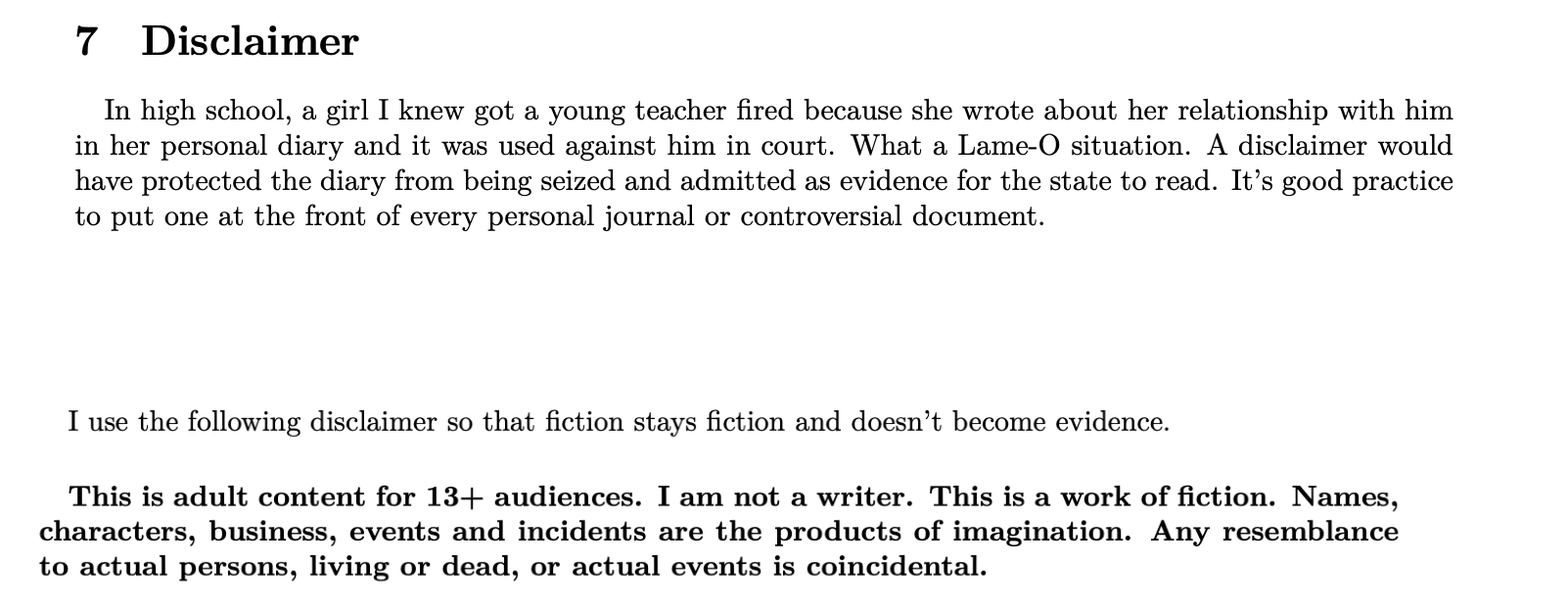
Nagel commented, “Once again, he’s not saying that this girl who had an inappropriate relationship with her teacher that got the teacher fired, that [the] situation never happened. Once again, he’s talking about real things. What he’s saying is that she should have put a disclaimer in her journal so the teacher, who I guess ended up in court, couldn’t have had the journal used against him for his inappropriate behavior.”
Nagel emphasized that Domínguez didn’t talk about a fictitious location, but a real middle school. Nagel said that Domínguez's interaction with Harrelson shows he had awareness of others perceiving him as threatening. "And then four months later he posts this but wants you to believe, 'I didn’t intend it to be taken seriously...'" said Nagel.
Eisenmenger objected to Nagel's statements, prompting another sidebar conference where he again motioned for a mistrial. Eisenmenger brought up the court’s rules mandating that Harrelson’s testimony be used for limited purposes of knowledge. “It has become a feature of the trial beyond what the State told you that they were going to use it for,” he said.
Sieg rejected the objection and denied the motion for mistrial.
Nagel concluded his closing argument, stating, “This whole thing is motivated by his feelings of wealth disparity and unfair treatment. And so he’s going to do this to make a statement, to coerce a civilian population or influence government policy… That was what he intended to post, that is what he did, in fact, post. That is what he knew people would receive it as… We are here because ultimately people did. That’s the last point. People saw it and took it as a legitimate threat. If they had not, we would not be here… The question today is, did the defendant beyond a reasonable doubt post a threat - make a threat… and intended it to be viewed by other people as a true threat? The answer beyond a reasonable doubt is that he did and, therefore, the answer is that he’s guilty.”
Defense’s Closing Argument
Giannasoli started her closing argument by reading the entire disclaimer that was on the Instagram post.
Giannasoli went on to say, “Was this video a good idea? No… It was not a good idea… Was it good art? Nope. Not good art. Was it misguided? Yeah. That’s a fair statement. Was it colossally stupid even? Also yeah. Not a great idea. I’m not asking you to like it. I’m not asking you to appreciate it... If you think those things that I mentioned, that it’s stupid, it was a bad idea, it’s a bad art piece, not your jam, I think a lot of people would agree with you… Being stupid in and of itself is not criminal. Making a poor choice in and of itself is not criminal.”

Giannasoli told the jurors that the prosecution wants them to “convict an innocent man based on emotion of what could be.”
Giannasoli went on to say, “The State has to prove to you that he intended a true threat in his mind. He wanted people to believe he was going to carry out this act. All of the evidence is to the contrary of that."
Giannasoli called Harrelson’s testimony a “distraction” and said it was normal that Domínguez told people in his life that he purchased a firearm.
Giannasoli emphasized that no evidence showed Domínguez was aware people were at the school on the weekends. “You have to believe that the fiction is actually true to believe it’s even Kanapaha Middle School,” she said. “Principal Estes was another distraction from the decision that you need to be making related to the video and the instructions on the law that you’ll receive.”
Giannasoli said she doesn’t fault the police for investigating but implied they didn’t conduct a proper investigation. “You heard they arrested him in a very short period of time after seeing the video. They tell you they did a protective sweep. He’s already in custody. He tells them where the guns are located because he overhears them trying to figure it out. He’s not a threat to anyone... he tells them that, and the evidence supports that.”
Giannasoli went on to say, “The State’s argument that there could have been people there, distraction. Mr. Domínguez had to intend a true threat… He is telling you ‘I’m going there when no people are present…’ If this was true, he goes there, there’s people present. ‘Crap. That’s not my plan. I’m going home.’ That’s just as fair as an alternative.”
“There’s a lot of hard things to see going on in the country,” said Giannasoli. “Maybe there should be more compassion, more love, more paying attention to your brother, when he refers to his ‘brothers’ and that he refuses to act out against them. That’s his fellow Americans. We need to come back to a place of nonviolence. That is what this video is about. He talks about wage gaps. He talks about violence. He talks about his mother being an immigrant… All of these things that every single day we hear about how horribly people treat situations where there are immigrants and issues of pay disparities between different groups of people, different genders. He talks about student debt. I can appreciate that… The meaning behind it when you take it all together is that there are other options to this violence… 'Love wins. Make friends. Julio loves you.' Anyone that is a threat, a true threat of committing a violent act against human beings doesn’t say ‘I love you’ in his post. Doesn’t tell you how he gets from love notes to suicide notes… It is completely misguided from the State to assume that what he was intending by this and the words on that video was to follow through on the violence he’s protesting. They want you to believe it’s nothing, the caption means nothing, that it was a distraction so he could carry out his true threat..."
Giannasoli concluded, “The law says it would be a miscarriage of justice to ignore the lack of evidence, the reasonable doubt that stems from the evidence. The only lawful verdict in this case, ladies and gentlemen, is not guilty.”
State's Rebuttal:
Nagel said one of his “bugbears” is when the defense argues the prosecution “followed the rules and somehow they should be disbelieved.”
Eisenmenger objected for disparaging counsel but was overruled by Sieg.
“There’s things that a judge says that’s not coming in,” said Nagel. “So when the State follows the rules, then the argument is the State didn’t show you the things that the judge said didn’t come in.”
Eisenmenger objected again for the same reason and cited Nagel’s tone. This time Sieg sustained the objection because the jury has no evidence of what happened when they were not present.
Nagel said, “The State gets to come up again. So let’s explain why that is. It’s called rebuttal, right. The State makes an argument, the defense gets to make an argument and rebut what the State said. And the State gets to rebut what they said. It’s called procedure. It’s not that the State gets an extra bite or the State gets to do something sneaky.”
Giannasoli objected for disparaging and stating facts that were not in evidence but was overruled by Sieg.
“Understood. It’s the characterization of the argument,” said Giannasoli.
Sieg snapped back, “I ruled. You don’t argue after I rule.”
Nagel said, “The question is, why is it so important for you-all to not trust me? Because then you ignore the evidence. Because then you make your decision based on emotion. Then you buy into the big bad State that the defendant is rallying against.”
Giannosoli objected again, citing subterfuge (deceit) and mischaracterization of arguments. Sieg sustained the objection and told Nagel to get to his rebuttal.
“The defense talked about… the State’s entire argument is an appeal to emotion,” said Nagel. “Nevermind that the defense went on a rant about 'this is the United States of America.'”
Eisenmenger objected for disparaging and was sustained by Seig, who told Nagel to “get to the rebuttal, please.”
“The defense talked about distractions,” Nagel said. “They made arguments and then committed exactly what they’re arguing and why because–”
Before Nagel could finish his sentence, Eisenmenger objected to burden-shifting but was overruled by Sieg.
Nagel continued, “because at the end of the day it’s these elements that you are to deliberate on.” Nagel cited that the prosecution doesn’t have to prove the threat was imminent or actually going to be carried out.
“The defense says ‘distraction’ about 1,000 times,” said Nagel, stating the defense is distracting from the elements required to prove the offense.
Eisenmenger objected for disparagement but was overruled by Sieg.
Nagel said the case isn’t about if Domínguez would’ve carried out a “school shooting” prompting another objection from Eisenmenger for subterfuge, but he was overruled by Sieg.
Nagel argued, “Listen to all of the defendant’s words. ‘Please don’t call the police.’ For the defendant to post that in all caps… it shows that he knew that this would be taken as a real threat by the people who viewed it. Why put that statement, ‘please don’t call the police?’ Because the sub-context is ‘I know you’re going to find this to be real.’ Listen to all the words. Now, stupid is not criminal, but the defendant is also not a stupid kid. He’s 32 years old. This is not a kindergarten art project. This is a person posting a threat to shoot up Kanapaha Middle School.”
Nagel highlighted that Domínguez didn’t post the video exclusively on his website but on social media where it would reach a wider audience.
“We are here today because law enforcement took it as a legitimate threat just like he knew they would,” said Nagel. “How do we know that he knew they would? ‘Please don’t call the police. Because if you call the police, I know that the police are going to take this as a legitimate threat.’ He cannot then say, ‘I didn’t know it would be taken as a legitimate threat. I didn’t mean for it to be taken as a legitimate threat.’”
Eisenmenger objected, saying Nagel disparaged Domínguez, but was overruled by Sieg.
Nagel said, “Defense talks about the Second Amendment and how many Floridians own [guns] – how many Floridians post an Instagram post saying that they’re going to shoot up Kanapaha Middle School?”
Eisenmenger objected, saying Nagel asked the jury to decide not based on guilt or innocence, but was overruled by Sieg who said it was a legitimate rebuttal.
In response to the defense’s argument, Nagel told the jurors he wanted them to believe “every word uttered” out of Domínguez’s mouth.
Nagel said, “The case is about whether or not that was intended to be a true threat. Why don’t I want you to take the disclaimer at face value or believe the disclaimer? Because the defendant has told you [that] you can’t take disclaimers at face value, that there’s some blanket that he throws over himself, that they’re not real. That’s why you can’t take those words to be real. Despite any sort of art interpretation theorized by the defense in this case.”
Eisenmenger objected, stating Nagel disparaged the right to a defense, but was overruled by Sieg.
Nagel emphasized that attorney statements are not evidence, and that the defense didn’t present any evidence to back up their statements.
Nagel said, “I don’t believe that the State has appealed to emotion. In fact, I was very clear I don’t want you to focus on the wrong things... I want you to go back to the jury room with the impression that this shooting never would have occurred because it’s the crime that I care about, the crime of making a threat.”
Eisenmenger objected to Nagel vouching experience and voicing personal opinion. Sieg prompted Nagel to rephrase his words. Nagel said, “What the State of Florida cares about is that the defendant made a threat… posted it in a forum that it would be viewed by other people and intended it to be taken by a true threat.”
Nagel said, “Why introduce the text messages?.. Those people do matter because they’re potentially people who could have seen it. But more importantly, they’re people who have put the defendant on notice that when you post this, it’s going to be viewed as real. I tell my son, don’t threaten to hit your brother.”
Eisenmenger objected, stating, “This is an imaginary script.”
Sieg sustained the objection, telling Nagel to make his argument in a different form.
“I’ll put it directly to the defendant,” said Nagel. “When in this case the defendant himself has friends in text messages saying your behavior is threatening and the defendant is aware of that, you cannot then make a threat and say I didn’t know it would be taken as threatening. You can’t be on notice that something is going to be a threat and then when it’s taken as a threat say, ‘I didn’t know… I didn’t intend that other people would take it as [a threat]. I didn’t intend for that to happen.’ He was on notice. He knew they would months before he posted this. It’s just like the disclaimer...”
After concluding his rebuttal, Eisenmenger prompted another sidebar where he told Sieg, “based on the cumulative effect of Mr. Nagel’s arguments... we would move for a mistrial.”
Sieg replied, “I’m glad you made that for the record, but I’ll deny it.”
Deliberations and Verdict
Roughly an hour into deliberations, the jury asked to see the video again. As they were watching in the courtroom, one juror began getting emotional and she got up and left.
Eisenmenger said it appeared to him that the juror was "disturbed by rewatching the video, began crying and had to excuse herself because she did not want to watch the video any further.”
Sieg noted that he had the same observation.
Eisenmenger said he had concern because jurors promised to set aside life experiences and tell them if something came up that took away their ability to serve.
Seig replied, “We don’t know if she had any life experiences behind that. I mean, people can have emotions without saying ‘oh, my God…’ She did attempt to cease the source of her emotions because she knew she was not supposed to be emotional. Or maybe she did it because the emotions were so strong she couldn’t tolerate it anymore. I suspect it was more because she didn’t want to stand there crying in front of all these people."
Eisenmenger said the juror expressed disappointment when picked for the trial and that he wanted to inquire with her but understood it might not be possible during deliberation.
Sieg said, “Depending on the verdict there may be no issues with it with anybody. And if the verdict causes either side to say I think we need to inquire of her, then post verdict I think we can.”
After roughly one more hour of deliberation, the jury submitted their verdict.
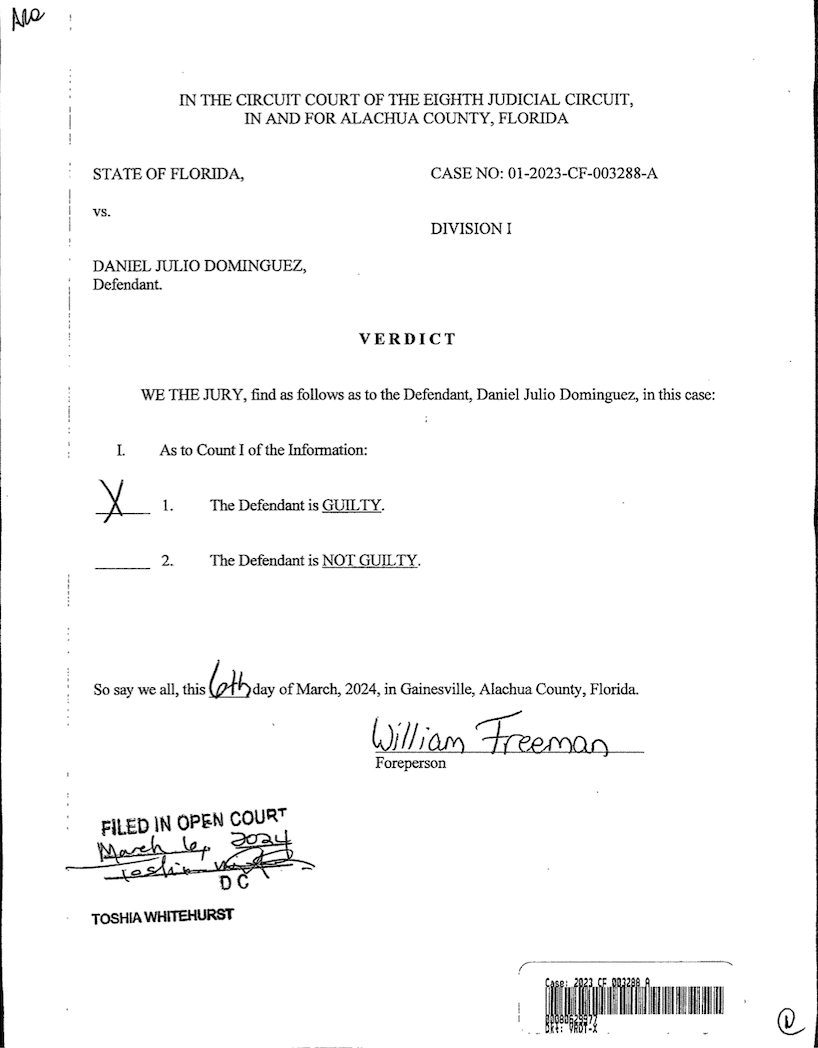
Post-Trial Release
Following the verdict, the court acknowledged that Domínguez was entitled to a pre-sentencing investigation and decided to set his next hearing for case management on April 23, 2024, but this was later canceled in lieu of a sentencing hearing the following week.
The clerk asked Sieg if he wanted to set a bond until the disposition, prompting Sieg to ask what Domínguez’s bond was at. Eisenmenger affirmed that Domínguez was in pretrial detention.
Nagel said, “I think procedurally, Your Honor, what the State would ask is that the Court just remand him in custody. Since it’s a pretrial detention I think it technically expires once trial is complete."
Eisenmenger said, “This is his first criminal offense. He’s not a flight risk as the Court can see from the gallery. He has a number of family members here...”
Nagel responded, “The pretrial detention was determined after a pretrial detention hearing on a dangerousness predicate. And so the trial court had determined conditions that there were no conditions of release to protect the community. At this point the State would ask that the Court just maintain that.”
Sieg ultimately decided to remand Domínguez back into custody but set a bond of $5,000, making his release very affordable.
Motion for Reconsideration of Post-Trial Bond
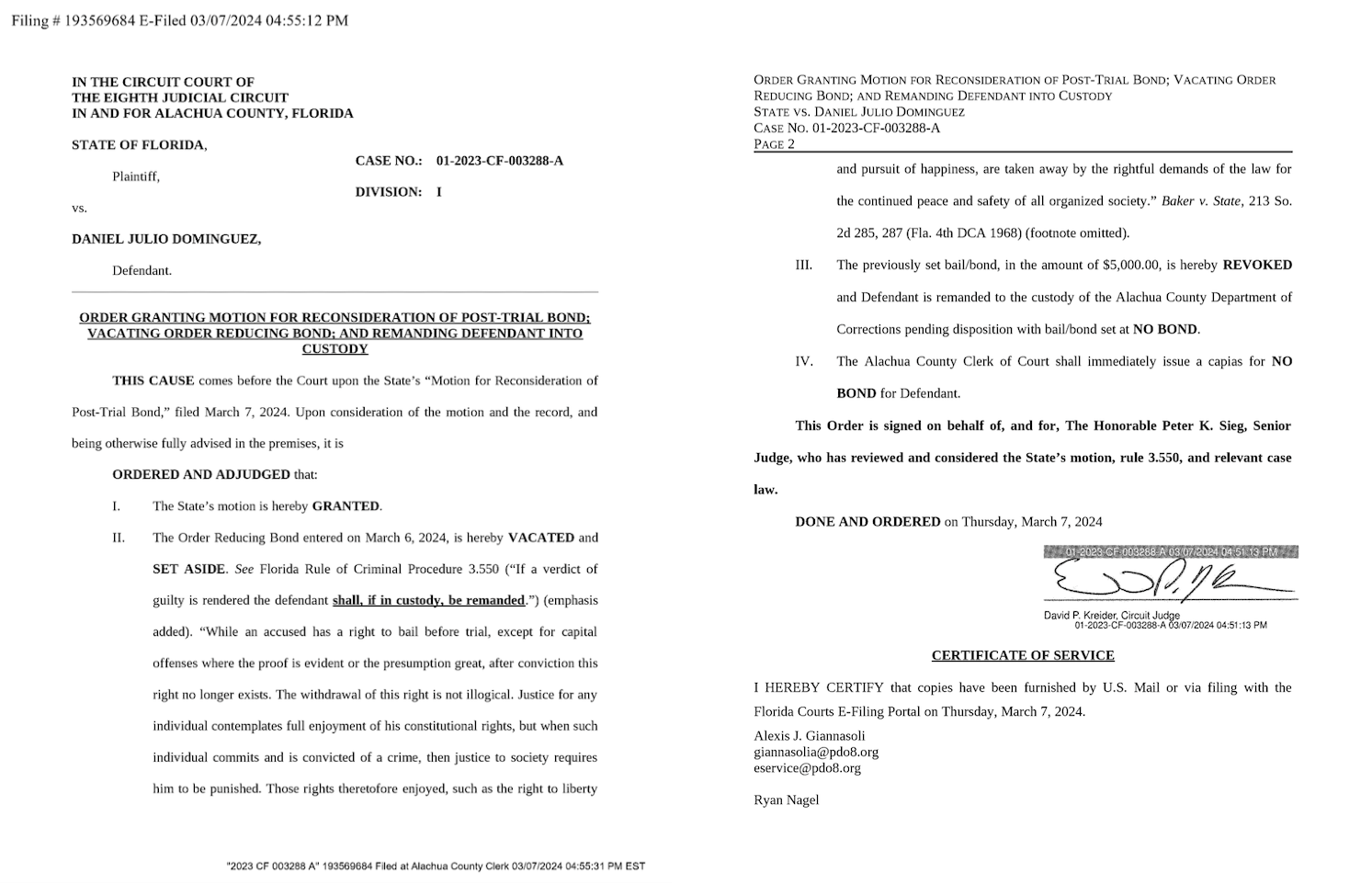
Domínguez was released after posting his bond but Nagel quickly filed a motion to revoke it. The motion states:
The defendant was deemed a danger to the community pretrial. The guilty verdict only affirms that concern, not lessens it. The Defendant in this case was charged for making a threat to, colloquially, ‘shoot up’ a middle school. It is clear from the record that school was Kanapaha Middle School, where the defendant resides .7 miles from. Regardless, all schools in Alachua County are at risk.
It appears from the proceedings following the rendering of the verdict, there is a substantial likelihood of error on the part of the trial court in applying pre trial release principles to post verdict detention proceedings, in that it appears the court believed that the state could file a motion under the rules for detention.
The undersigned Assistant State Attorney has spoken to the following individuals from the community who voice concern, and would be willing to testify in support of this motion at any hearing.
a. Principal Esetes, Kanapaha Middle School: ‘no idea what would prevent him from coming to the school’ to carry out the threat.
b. Chief Doug Pelton, School Board of Alachua County, who oversees implementation of the Florida Model for school safety… has indicated that this defendants release has triggered required implementation of safety protocols within an already taxed system.
c. Dr. Kristen Iannuzzi, District Threat Management Coordinator who reiterates additional strain on her department due to the ‘true threat’ nature of the defendant.
d. Lt. Rob Koehler, Gainesville Police Department, supervisor of School Resource Officers [(SRO)], who has advised that the SRO bureau is critically understaffed.”
With Kreider back on the judge’s dais, he granted the motion. Domínguez was back in jail by the morning of March 8, 2024.
Sentencing Hearing
On April 29, 2024, Domínguez appeared at his sentencing before Judge Sieg, facing a maximum sentence of 15 years in prison.
The hearing started with prosecutors calling four witnesses to speak on matters relating to sentencing.
State’s Witnesses
Witness 1 | FDLE Special Agent Yolanda Carbia
Carbia took the witness stand again and specified that the Tallahassee Operational Center “was monitoring” Domínguez’s social media.
Prince asked why he was being monitored, and Carbia replied, “We have behavioral assessment team experts in every region composed of attorneys, special agents, and locals, and federal agents… He hit certain criteria on our behavioral assessment that’s a possible threat.” She affirmed that Domínguez was being investigated or monitored by the FDLE long before he posted the video.
Prince asked Carbia if she would be concerned about a probation sentence and she said “yes.” “We would have to constantly monitor him for the safety of the community,” Carbia said.
“Objection, Your Honor,” said Eisenmenger. “Improper sentencing consideration. The Court can’t consider future dangerousness in any proceeding in the State of Florida…”
“I don’t know that,” said Sieg. “It may be purely administrative or logistical things that I’m going to hear… Let’s wait and see if it is what you’re objecting to.” He allowed Carbia to answer.
Carbia affirmed Domínguez would need to be constantly monitored and would put a strain on FDLE’s resources.
On the cross examination, Giannasoli asked Carbia if she was aware of plea negotiations. Prince objected but Sieg overruled.
“I will trust myself to disregard things that are not relevant,” said Sieg.
Giannasoli asked Carbia if she was aware the prosecution previously sought probation with no ankle monitor and she said she was not.
Witness 2 | ACSO Deputy David Brown
Serving as the SRO at Kanapaha Middle School, Deputy Brown said he attends conferences where he has received "extensive training for active shooter responses.” He described, “Part of that is social media posts that prior shooters have made before shootings occurred.”
Eisenmenger objected again, citing future dangerousness.
“I don’t know where this is going,” said Sieg. “I can’t possibly rule on your objection until I hear it all. I’ve tried to explain this. When you object to a question or to the first few words of testimony as inadmissible or improper to consider, I’ve got to hear the whole statement before I can determine whether it is inadmissible or improper.”
Eisenmenger replied, “Yes, sir. I think the case law is very clear that the State can’t present evidence of uncharged crimes. And I’m concerned that this deputy has already drawn a parallel between our client and school shooters.”
“I am prepared to deal with that,” replied Sieg. “I knew today was coming… I assure you that, if it’s something I should not consider, I will not consider it.”
Brown said it was clear from the video that Domínguez was referencing Kanapaha and that he would be concerned if Domínguez got a probation sentence.
“It’s just me and 1,300 people,” said Brown. “When he was released, prior to sentencing, there was a flurry of activity between myself and Principal Estes and my chain of command just to get additional security between that point and today just because of the absolute safety concerns that we would take into account for that.”
Witness 3 | ACSO Lt. Matthew Yakubsin
Serving as the head of the ACSO SRO Bureau, Lt. Yakubsin said, “We don’t have many threats or serious situations where we get notified by FDLE that there is a very potential threat to the school. So obviously, I was very concerned that night when I watched the video… School safety is our number one priority at the sheriff’s office, as at any law enforcement [agency]. We have threats numerous times throughout the year, which we’ve determined not to be, but this was considered, according to FDLE, a very serious threat to consider, so, yes, there was a lot of concern."
Yakubsin said a probation sentence would put a strain on SRO resources and ACSO as a whole
Witness 4 | Dr. Kristen Iannuzzi
Serving as a threat management coordinator for Alachua County Public Schools, Dr. Iannuzzi said the district would have an extra burden if Domínguez were released on probation. She said most of their resources are to assist students that might present threats. “When we are dealing with adult threats or threats with people who are not students in our campus, we don’t have any control over that,” she said.
Iannuzzi said Domínguez getting probation “would cause us preparedness because we have no ability to prevent. Unfortunately… The Florida model does not allow us to help and intervene like we would like to with a student making a similar threat and provide those resources to get them the help they need… It would force us to go to Kanapaha and make sure that the state of preparedness is elevated.” She went on to say, “The Florida model allows you to evaluate levels of concern, not necessarily threats… In the previous model, we could only evaluate threats, actual threats. In the new model, we can also evaluate concerning behaviors.”
Defense Witnesses
Several individuals appeared in court to testify in Domínguez’s favor and ask Sieg for a light sentence. The following represents a fraction of the number of people who appeared in court to support Domínguez or wrote character letters.
Susan Taylor
A former Tallahassee Quakers clerk, Taylor has known Domínguez since 2021 and appeared in court to support him.
Taylor said, “He salvaged a discarded computer from the roadside, made it functional, and with it was one of the major people in our meeting who made it possible for people to attend meetings for worship and committee meetings by Zoom. He worked effectively with the communications working group in our meeting on that project. He helped with our community garden that makes it possible for our meeting to contribute to a local food bank in an underserved part of Tallahassee.”
She continued, “His speech is loving, affirming and sincere. He has been a welcoming presence to everyone in our meeting. He is an artist who shared with us his uplifting drawings, thoughtful writings, and he beautifully decorated our gate with small bead figures. Sometimes his art has been challenging. He often spoke with us of the importance of bringing justice and equity to life. And that is how I saw, and see him living. I have had private conversations with Daniel where he shared his heart, questions and beliefs, all of which support life-affirming living. Daniel is a man who cares deeply for people, the earth, and life in general. He would never harm anyone. I am grateful for the peace that Daniel brings to our meeting and life beyond our meeting.”
After speaking, Price began questioning Taylor, asking her what artwork she specifically saw.
“It was a while ago,” Taylor said. “It was all pleasant and his name tag at meetings, it says ‘I love you…’ I haven’t seen all of his zines, and it was quite a while ago that I looked at the zines, but I was just impressed with his clear thinking.”
“Do you know one of his zines called ‘My Maria?’” Prince questioned.
“I don’t know that one,” replied Taylor.
Prince questioned Taylor, “Would it surprise you that he said, ‘Hey, a-holes. I have guns, ammunition and ideas. So if I was really insane, a danger to myself or the community, then you’re failing to make anything better. The police, the hammer we use to address a problem, have reliably been a-holes to me. They can’t help it. So with love, my sweet detractors, eff you.’ Did you hear that one?”
“I didn’t see that one,” said Taylor. “However, I would have conversations with him. If I read something like that, I would want to know what was more behind that.”
“What about another that’s called ‘Afraid of Me,’” said Prince. He says, ‘I’m bright. I have a master’s degree in science and I’m a talented engineer. So if I wanted to kill people, I could. And I could kill a lot more people with chemistry or physics than I could with bullets.’ Have you heard that one?”
“I have not,” said Taylor. Prince asked her if Domínguez’s statement surprised her, but was objected by Giannasoli who cited Taylor having no knowledge of what she was being inquired about.
As he had previously, Sieg refused to rule on an objection because he didn’t hear the answer.
Prince moved on to her next example from “Love Bomb,” another one of Domínguez’s zines. “‘For others, it’s way more glam to murder a bunch of people with a big dumb rifle, but that’s a lame and – or – but that’s a lame or despairing (sic) people that too often want themselves to die. Bombs, simple and sophisticated, are trivial to make and they’re so exciting. But man, they’re big flashy lures for the police. Yikes, that’s not me.’ Did you hear that one?”
Taylor responded, “I did not hear that one. As I said, I would like to know the context, and I would talk to him more about these things.”
Josia Yeargin
Josia Yeargin knew Domínguez through the Quakers group and appeared in court to support him.
“We ran into each other by chance so often that I still get the feeling that he could be just around the corner, even though he does not have that freedom,” said Yeargin. “The feeling is only compounded by finding his art everywhere I look. Most of what he makes, he gives away; and the rest is offered for a nominal fee, though small trinkets and jewels, but they’re full of his love and light. We’ve talked extensively about art, about the value of using it to connect to the people in our lives. Daniel expressed the value of using it to understand people and understand actions he would never otherwise understand. Something I felt deeply because this is how I’ve used writing and acting and art since I was 13. This conversation was not in common. Every time we speak, he manages to put into words something that I feel but could never articulate half as well about philosophy, God, the value of pacifism and love. Daniel has a beautiful heart. I hope you can see it as well as I can.”
Prince began questioning Yeargin in a similar manner to Taylor, asking if she was aware of "Afraid of Me,” which is on his website. She read a passage, “‘Nah, I’m concerned with problem-solving, efficiency, and most importantly not getting caught or shot to death in a spectacular climax with the State. No, I imagine introducing radio active powder into the food or water supply or using chemicals to leech poisons into the home environment, something mundane that could cause catastrophic damage to human life and create long-term suffering, massive panic, lack of faith in the authorities and widespread costs.’ Had he ever performed that one for you?”
“No,” replied Yeargin.
Prince then asked if she knew “Incorrect Dawn” and read a passage. “‘I purchased an ArmaLite-style rifle recently, specifically I purchased an AR-556, essentially an AR-15 from Bass Pro Shop. It was typically mundane. I looked at guns on Memorial Day, changed my license and purchased the rifle legally the following day and had it brandished in front of the mirror by Saturday morning. It makes me feel powerful sometimes, weak others.’ What about that one, had he performed that one for you?”
“No,” replied Yeargin.
Prince continued, “What about, ‘There is no denying the person I have become and what ideas have me. Why is it that I have a rifle? What could I mean? Who could I want to hurt? No doubt that little toxin rang out from the darkest place of your mind, but was it something or nothing? Did I hear it too?’ Had he performed that one for you?”
“No,” replied Yeargin.
Prince had no further questions.
Jim Owens
Educator Jim Owens, teaching humanities and thinking skills in 2010, had Domínguez in a class when he was in his senior year. He showed up in person to support Domínguez and had Giannasoli read his letter.
“He was always patient and compassionate to his classmates who were seldom as brilliant as he,” wrote Owens. “He was never ever cruel or condescending. He was patient with and respectful of authority whether he agreed with it or not.”
Owens recalled how in 2010 the air conditioning units at Gainesville High School did not work properly. “Daniel reprogrammed the thermostat in our classroom to rectify the problem and did it flawlessly,” Owens wrote.
Owens letter continues:
“For about ten minutes at the beginning of every class, students were required to write in a journal. Instrumental music from a wide array of genres played softly in the background. Students were guaranteed confidentiality, and I was true to my word. I promised to never read their journal, and I never did… Since I couldn’t guarantee that the authority figures would be equally respectful of their privacy, I encouraged my students to do as the first fiction writers did in the 18th century. I taught them to write a disclaimer on the first page of their journal: ‘The following is a work of fiction. Any resemblance to any event past, present or future, or to any individual is entirely coincidental.’
Such wrote the printer of the Parliament, Samuel Richardson, when he wrote ‘Clarissa.’ Such wrote the dean of St. Patrick’s Cathedral, Jonathan Swift, when he wrote ‘Gulliver’s Travels,’ ‘Tale of a Tub,’ and an ‘Argument for Abolishing Christianity.’ Such wrote the author of Tom Jones…
What could be more inflammatory or blatantly satiric than Dean Swift proposing a modest proposal… that the impoverished Irish sell their children to the wealthy to eat?
As a Nobel Prize winner for literature, Bob Dylan famously pinned in saying: ‘And if my thought dreams could be seen, they’d probably put my head in a guillotine, but it’s all right, ma, I’m only bleeding.’
Daniel is a well gifted mechanical engineer and an artist. An artist writes for an audience. An artist, a real artist, pushes the envelope, challenges boundaries, draws with windmills.
Long since he graduated from high school, I have often recalled the character and accomplishments of Daniel Domínguez. Had the Defense called me as a witness, I believe I could have spared the court and jury, as well as Daniel, the time, expense and agony of a most unfortunate misunderstanding...”
Prince asked Owens if he taught Domínguez to use a disclaimer so he couldn't be investigated by law enforcement.
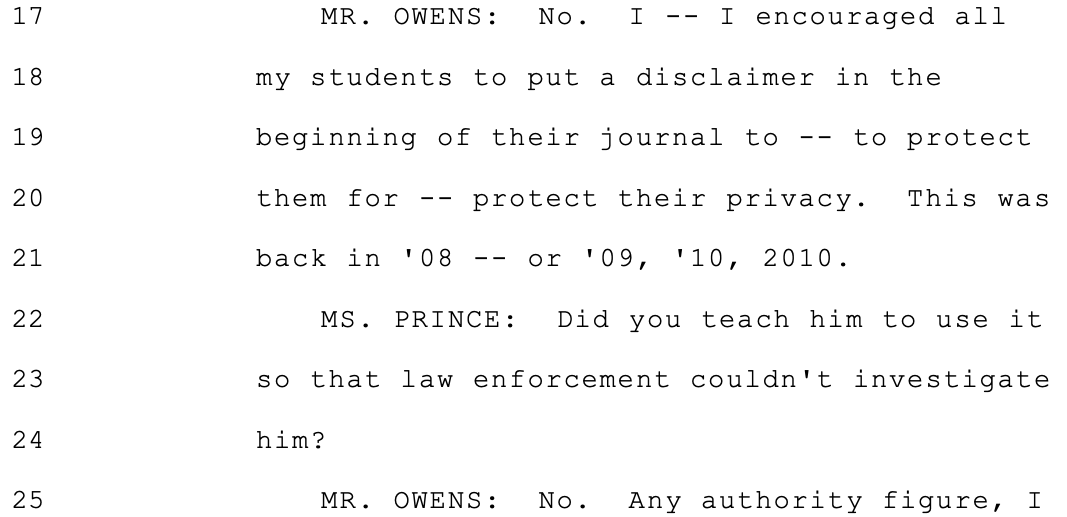
“No, any authority figure,” said Owens. “I didn’t want anyone to take someone’s journal and read their private thoughts.”
Prince questioned, “Were you part of the disclaimer that he talked about on his website where he said, ‘In high school a girl I knew got a young teacher fired because she wrote about her relationship with him in her personal diary and it was used against him in court. What a lame-o situation. A disclaimer would have protected the diary from being seized and admitted as evidence for the State to read.’ Is that the type of disclaimer that you’re talking about?”
Owens replied, “Well, I remember there being an incident where a fairly young soccer coach was having an affair with, I believe she was a senior student.”
Prince asked, “You’re saying that you taught Mr. Domínguez to write disclaimers to keep his thoughts safe?”
“For certain,” replied Owens.
Phillip Harris
Harris recounted how Domínguez was arrested in the parking lot leaving their literacy open mic gathering.
Harris said, “I first met him when he came into my store to distribute self-published short books, pamphlets, which I purchased for my local author’s shelf. My first impression was that he was a prolific artist, in that he had much printed self-published material and was actively distributing it. The writings of his that I read were focused on community and self-understanding. He seemed a very sensitive, peaceful and caring soul. He had a lot of energy and was driven with the creation of art.”
Harris recalled how during some of the open mic gatherings, Domínguez would wear a cloth vest with a medal chest plate that resembled a bullet proof vest. Attached to the plate were My Little Pony patches and other colorful decorations.
Harris said she asked Domínguez about his attire, and he “replied about the juxtapositions of polarities, the idol of a children’s cartoon and the violence of a world that required bulletproof vests.”
Harris said, “This impressed me with the belief that the Defendant had an interest in transgressive art that is directly incorporated into life like the Dada and surrealist movements of the 1920s that also made uncomfortable juxtapositions to attempt revelations beyond the objects in themselves.”
Harris records the open mics and read aloud what Domínguez said moments before his arrest:
“Today I did a piece of art. I write a lot of love letters, send a lot of postcards to the people I love and to institutions and various small businesses and things that I like. And I publish them. They’re an art project.
It’s partially like I’m writing a genuine love letter, but I’m also – I’m kind of playing a part. And so I concluded yesterday, oh, you know what would be really cool? To write suicide notes. That’s the opposite side of the love letter… So I wrote a suicide note. Only in the tradition of the modern era, I made a video and I posted that s-h-i-t on Instagram. I’m not wearing that ridiculous plate carrier, so I’m going to go ahead and play the audio through the microphone here. It’s only four minutes long, but you can hear so I’ll tell you how I did this basically.
I wrote down the ideas on a piece of paper, clearly kind of the ideas I wanted to get across, the general order of how I wanted to do it, but with suicide notes that are generally given, especially in front of a camera, they tend to be impromptu. And I was thinking a lot about Nicholas Cruz, that guy who shot up Marjory Stoneman Douglas High School. His video is very strange. It’s like him talking to himself practically on camera, so there is a real intimacy that has to happen with the camera audience. So I’m trying to capture that, and I’m also trying to do that impromptu speaking with a very general [form].
Anyway, that’s a lot of build-up to say that—6:00 a.m. we’re hoping the SWAT team doesn’t bust into my house, but if they do, all the guns will be locked up. So wait, I posted this today, earlier, but again, this is further alibi for me to prove to the authorities, if something does happen, that I am lucid and nothing bad is going on.
I absolutely gave a disclaimer on the Internet. I was like, ‘guys, this is a piece of art, come on.’ It’s four minutes, that’s fine, it’s just on Instagram. You go ahead and watch it, Lord Struma, it’s on the back of all my zines, which are in the corner over there.
All right. Here we go. Julio’s suicide note number one. I’m hoping to have, by the time I die, really die, I’m hoping to have over 100 of these things. They seem like a good idea. They seem fun…
[Domínguez Plays Video]
And then so the end reads, this is a work of fiction... Original concept, music and art by Julio Domínguez. It’s a work of fiction. I’m not gonna hurt anybody. I want to make that explicitly clear. I was very clear online, but, yeah, sometimes art will get the police to show up to your house.”
An audience member commented, “Well, it’s supposed to. I’m glad you think it’s funny because, if I saw that, as soon as I knew it was an art project, I would start laughing."
Harris told the court, "I find the video to be one-dimensional art. It uses the structure of the suicide note to give a one-dimensional critique of violence and class structure. There is no real depth here and fulfills the description of simpleminded and foolish. The soundtrack provides a contrast for parity with its absurd and sterile feeling. For comparison, look at the art of Eminem. I find Eminem simpleminded and foolish. Eminem has made millions of dollars writing verses and making videos depicting the brutal rape and murder of his ex-girlfriend. He’s only the most culturally celebrated figure in this genre I can think of, but it is a vast genre with thousands of artists whose work I also find to be simpleminded and foolish. I do not know anything outside the context of my brief experience with the Defendant, perhaps he has done something I am unaware of; but in my direct experience where the Defendant participated in the literary open mic gathering and presented the video as he had done with all his other art, I can only view the Defendant in person and character as an artist, albeit with simpleminded and foolish work ideas and concepts."
Wendy Kissinger
Wendy Kissinger has known Domínguez since he was six years old and said “he was raised a pacifist and that he remains a pacifist today.”
She continued, “In the course of creating a work of art that was intended to be controversial and shocking, Daniel made the immensely naive error of thinking others who did not know him would take his strong and multiple disclaimers at face value and know his true intentions to present fictitious, while artwork only. It was intended to be shocking. Daniel previously had a series of fictitious love notes on his artist web page. His next project was intended as a series of fictitious suicide notes. This was the first in that planned series and was not done as a random or isolated piece of art.”
Kissinger recalled eating dinner with Domineguz and his family the night he was released on bond. “He said to me that, while disappointed and a bit frustrated, he harbors no anger, ill will at all regarding his arrest and conviction toward anyone involved. That’s just typical Danny. The fact that he may be incarcerated for his naivety is a tragedy to me, a miscarriage of justice.”
Kissinger went on to say, “The guy who he was performing at an open mic for made a pretty good point about Eminem’s music and the song about raping his ex-girlfriend. [Look at] Martin Scorsese. I could go through an entire list of screenwriters, producers, movie writers. If we were to begin viewing all artwork as means of what people actually mean in society... a very large percentage of our society would be behind bars today.
Prince responded, “You would agree that’s not what we’re here for today, correct?”
Kissinger replied, “I would agree that Daniel was expressing art… That said, ‘This is a work of fiction… This is a work of art’ all over it and after it.”
“And were you there when the jury convicted him for that artwork, that you call it?” Prince questioned.
“I was,” said Kissinger. “A group of six people who didn’t know him and only heard your side of the story…”
Elizabeth Braun
A captain in the Gainesville Fire Department and former school teacher, Elizabeth Braun has known Domineguz since he was a baby. She appeared in court and spoke to support him.
“In my years of experiences with Danny, I have found him to be an honest, inquisitive, intelligent, compassionate, sensitive, and a gentle human that cares deeply about humanity and our planet,” she described. “Daniel’s inquisitive nature is ingrained in my brain with a memory of the time he just wondered how the household vacuum worked. He dismantled the machine. Not only did he answer his curiosity, he also returned the vacuum back to its normal operating status.”
Braun recalled how at 12 years old, Domineguz triggered a fire alarm while exploring a building his parents rented for an event. Braun described, “The music was playing loudly, people were dancing, and all of a sudden an alarm sounded. There were many people in this building. No one would have known who, what, where, or why the alarm went off, except he openly took responsibility for the event being interrupted and his actions.”
Braun continued, “Gifted, as you may be aware, is a label that characterizes a child as having extreme intelligence. What most people do not know is that these gifted children are seemingly cursed with an early understanding of the ills of humanity. They see and internalize humanity’s injustice when they watch the news, whereas a non-gifted child, such as myself, ignores the news. Their hearts ache when they see these injustices, and they can lose hope because they do not have the skills of an adult to take action or to compartmentalize their feelings.” She went on to say, “I believe his internal pain of life’s injustices prompted his extreme video. In my belief, the video was created to cause an emotional response. The response was clear as his video expressed his disappointment with the injustices he sees and feels in humanity.”
Braun brought up a frequent point, “If art that caused strong emotional responses resulted in artists being incarcerated, Kathy Griffin who displayed the severed head of then President Trump, the people who create movies that depict rape, murder and worldwide destruction, they would all be jailed. Edgy art called shock art is created with the intent to cause emotional disturbance. I remember my grandparents recounting the 1938 broadcast The War of the Worlds... It was a radio play that began with a disclaimer of a fictional martian invasion in New Jersey. Some people missed that disclaimer and heard the radio broadcast and felt that fake broadcast was actually occurring… CBS was not jailed, but the producers did begin to interject multiple disclaimers of the fictional aspect of future broadcasts.”
Barun concluded, “Daniel chose a topic for his video that is current, suicide and mass shootings. I did not care for his video because I do not care for shock art. But Daniel made it very clear through his disclaimers at the beginning and the end of his video that he was producing a fictional video. The topic was emotional. The video was shocking to some and dismissed as a crappy piece of art by others. I implore you for your leniency as you sentence Daniel Domínguez.”
Michael Gamble
Domínguez’s step father, Michael Gamble knew him since he was a young child.
Gamble said that as a school principal, he was shocked when he saw Domineguz’s video but was convinced his intent was to create a fictional suicide note.
Gamble said, “I’m a U.S. Navy veteran and know what it’s like to have others’ lives depending on me doing my job. During my time in active duty, I lost several friends and shipmates in what the Navy euphemistically calls a mishap. Most of these mishaps were due to incorrect decisions in a split second’s time. As a public school principal, my primary responsibility is the safety of all the students, faculty and staff on my school’s campus. It is a responsibility that I take quite seriously and is constantly on my mind. I also feel that, as an administrator, it’s my job to assuage fears while making sure my campus is safe. I know you have heard from others in the school system who have said that they are worried about the threat Daniel poses and that he should remain incarcerated. It does no one any good nor does it make anyone safer to hide a nonexistent threat. I am sure Daniel does not pose a threat to any school, nor anyone else for that matter. Daniel has been locked up since October 19, 2023, with the exception of the 36 hours he was out on bail following his trial. As a human and a conscientious taxpayer, I do not feel that anyone’s interest will be served with him going to prison... I know he feels remorse for what we have all been through these past six months.”
Domínguez’s Father
Appearing to support his son, Domínguez’s father said, “I believe it’s important to highlight the positive qualities that make Daniel who he is. Daniel has always had a unique curiosity and thirst for knowledge. Once, when mowing the lawn, I happened to glance over and found Daniel, who was a toddler at the time, lying prone on the grass with his arm in what appeared to be a hole in the ground. Concerned, thinking snakes, I pulled him out only to find him holding a mole in his hand. And far from being fearful, he was laughing in delight. When he was – I don’t know if I can do this.”
“I’m happy to read, would you like?” Giannasoli offered. Domínguez’s father accepted and Giannasoli read the rest of his comments:
“When he was in middle school, he would take off across town on his bike to muck around the creek in creek beds looking for shark teeth. In high school he got interested in entomology and learned how to beautifully pin the insects he caught.
He has always been an avid learner, constantly seeking out new information and exploring different perspectives. From a younger age, he has shown great dedication to his studies, always striving for excellence. This outstanding work ethic, intellectual curiosity and ability to absorb information has helped him excel academically and in the workplace.
Daniel is also deeply involved in the Quaker community in both the Tallahassee and Gainesville chapters. As an active member, Daniel has consistently demonstrated his commitment to the values upheld by the Quaker tradition, including peace, equality and social justice. Through his unwavering support, he not only served as a beacon of inspiration for fellow community members, but had an instrumental role in organizing and participating in numerous initiatives prompting positive change.
To participating in peaceful protest or advocating for the rights of marginalized groups, Daniel consistently championed the Quaker principles of fairness, inclusivity and respect for all, a testament to his dedication to creating a more harmonious and equitable society for all. Whether it’s helping organize and maintain a community garden, volunteering at a local shelter or simply being there for a friend, his kindness and support have touched the lives of many.
However, what truly illustrates his true character and the values he holds dear is his website...
It is in the virtual realm that Daniel’s true essence shines, encapsulating his commitment to promoting goodness, empathy and the pursuit of a better tomorrow.
Unfortunately, as smart as Daniel is, he can make mistakes. In a world where artistic expression knows no bounds, it is not uncommon for artists to push the boundaries of conventional norms to provoke thought and challenge societal perception. Driven by his passion for art, he sought to capture attention and spark discussion through his performance art. Posting on Instagram, a platform known for its vast reach in artistic community, was a way to share his creation with like-minded individuals and gain feedback on his artistic vision.
However, in the pursuit of artistic expression, one can sometimes be oblivious to the potential interpretations and optics of their work. Daniel, caught up in the fervor of his creativity, did not fully comprehend how his performance art featuring an AR-15 rifle would be misconstrued and perceived as a threat. He knew it would be controversial and that it would provoke a response, but felt the disclaimers would temper it.
I want to be clear. Daniel never ever intended to harm anyone or himself. Unfortunately, with the current climate today that feature gun shootings seemingly every week, the disclaimers included were unable to prevent the situation from escalating and leading to his current incarceration…
I stand before you to humbly plead for mercy on behalf of my son. While I acknowledge the severity of the situation and the importance of justice being served, I implore you to consider the broader context of Daniel’s life… As a result of everything that has happened, Daniel has shown immense remorse for his actions and has actively taken steps towards redemption. He has shown a genuine willingness to address the underlying issues that have led to this unfortunate outcome.
With a strong support system in place, including family, friends and mentors, Daniel has the opportunity to rebuild his life in a positive and constructive manner. Imposing a sentence that allows for reflection and growth would not only benefit Daniel but also society as a whole. It would provide him the chance to make amends, contribute positively to the community and become a shining example of transformation and resilience.
I kindly urge you, Your Honor, to consider the potential of redemption and mercy in this case allowing Daniel the opportunity to rebuild his life and become a productive member of society once again.”
Domínguez’s Mother
Appearing in court to support her son, Domínguez’s mother told Sieg, “All you need to do, Your Honor, to see the support he has, is look at this courtroom, look at the people who know and love him...”
Domínguez’s mother went on to say, “Daniel has a heart of service and a desire to make our world better by giving freely of his time and his talents… He volunteers in the civic media center (CMC). He feeds and mentors the homeless. He set up a community garden mapping project in Tallahassee. He collaborates with local artists. He created masks and gave them away during the pandemic. He’s one of the webmasters for the Gainesville Gem and Mineral Society. He refurbishes computers and gives them away to those in need. He donates materials for school gardens. He worked tirelessly with the Tallahassee Quakers in their community garden. He passes out charms to bring happiness to strangers. He is part of community and peace organizations. He participated in the student security network. He volunteers his time to do coding and research. He stops to help anyone who is broken down. He created a zine library at The Bark, a restaurant in Tallahassee. He translates for Spanish-speaking customers who need help at stores. And he tries to rescue animals who are hurt."
Domínguez’s mother continued, “Even in jail, he tries to make a difference by helping inmates who don’t speak English and translating for them… Brainstorming ways that we could get the CMC involved in a book drive to get more and better reading material for inmates. Or calling me from jail to see if there is any way I can help another inmate who is not getting medical attention and had collapsed… Although he may be unconventional, Daniel is all about love and peace. He is an idealist who is passionate about making a difference and treating the ills of society. He is about helping the disenfranchised and standing up for them. He is about protecting our natural resources. He takes his responsibility for his stewardship of our world to heart and truly believes that we can attain world peace in our lifetime. He uses his art and writings to show the things that are wrong with our world, as well as the beauty of everything and everyone in it. His art and writing are thought-provoking and meant to bring about conversations. He is introspective and is constantly striving to change, improve and become a better person. Daniel is one to apologize when he has unintentionally said or done something to hurt anyone’s feelings. He is one who wants to make amends. That is the man that Daniel really is.”
Domínguez’s mother said the attorneys “told us that we can express disappointment in the verdict, but should do it without expressing anger. The thing is, that I am angry. That I am disappointed. I am angry at Daniel for having been so naive and idealistic that he believed he could put that fictional video of a fictional suicide note out there in today’s world, in today’s Florida and not be judged for it. I’m highly disappointed at the law enforcement officers, the prosecution and our school system who do not seek the truth, but just seek to make an example of Daniel. I realize that, like Daniel, I have been naive and idealistic about our system of justice and the notion that the truth will set you free. In my son’s own words, 'I use the following disclaimer so that fiction stays fiction and doesn’t become evidence...' “That disclaimer is what the prosecution turned around and spun a story... to convince the jury that his video was not fiction but a true threat to cause harm to others, to children. How does that make any sense? How can I, his mother, who knows his heart and his love not feel anger and disappointment?"
Domínguez’s mother went on to say, “Our family has shed many tears these past six months. Many of us have stopped watching the news and reading the paper for fear of having to read another article riddled with untruths about our family and our Daniel. We are not the same. We don’t trust the legal system like we used to. I know I’m not the same person today that I have been my entire life. I don’t think I can ever be me again. I’m trying to let go of the anger as Daniel keeps telling me to, but it’s not easy. I pray every day for God to soften my heart again. I know my inner light is much dimmer than ever before, and I worry every day how this entire ordeal is affecting my other three children, as well. Are they as marred as I am by this painful experience with the justice system? Can they themselves be themselves again? Daniel is kind, forgiving and talented. He has so much to offer society. He also has aspirations for the future that this conviction has stripped from him. He had planned on going to Cuba to visit cousins and aunts and uncles whom he has not seen in years. He had planned on traveling to other Central and South American countries to immerse himself in our native Spanish language and Hispanic culture. He was hoping to go back to school and get a Ph.D. I fear that all these plans have now slipped away because of this conviction."
Domínguez’s mother continued, "After Daniel was arrested on October 19, all I wanted was to be able to hug him and talk with him candidly without that pit of fear in my stomach. I was not able to do that until you, Judge Sieg, released him on March 6. We got to hug him and have a meal together as a family. He was able to literally hug a tree, literally hug a tree, and visit a park in downtown Gainesville with some friends. They got to spend a day just hanging out with him… Me and his dad were able to watch movies and just be together. Judge Sieg, I will forever be grateful for that day… That we had him home, so thank you for that. I look forward to having those moments again. No one, no one benefits from Daniel staying in jail or going to prison, because he is not nor ever was a danger to anyone. On the contrary, he is someone who will work to make this world better for you, for me, for everyone. He is someone who uses this experience as one for growth. I am respectfully asking you, Judge Sieg, I am begging you to send Daniel home to us, to his family, to his friends, to his village.”
Daniel Julio Domínguez
Giannasoli read aloud a letter that Domínguez prepared:
“Before this episode began, I was feeling very optimistic about the future. I had, for the first time in my life, taken some time off from scientific research and engineering. I had just won my first patent after giving 13 years of time and energy to the Florida public university system and to students across the nation.
COVID took so much from all of us and affected my research especially. I saw many friends die during that period and lots of opportunities and expectations fade away. I gave myself over to the community during that frightening time. I started a community and peace organization and ended up falling in love with my countryman. I had only planned to spend a few months in Gainesville towards the end of 2023 to share the holidays with my family, and then travel to Central and South America and the Caribbean to reconnect with my roots during 2024.
I hope to come back fresh in 2025 and finally accomplish my dream of earning a Ph.D. in the burgeoning interdisciplinary field of insect-plant interactions and to add to it my skills in big data statistical analysis and industrial optics development.
The time off was also an opportunity for me to focus on my love of art, which had taken a back seat in my life since undergrad, graduate school and then my full-time position as a scientific research specialist and supervisor in the department of Earth, Ocean and Atmospheric Science at FSU.
Today I want to thank everybody who’s kept up with me through my life journey and the many who have stood for me through this unexpected and difficult chapter. It has been your presence, your love, understanding, your time on the phone, and your postcards filled with poetry, messages and advice that has helped me through the past six months I have been in jail. And though I am disappointed with the outcome of this trial, I remain steadfast in my belief that a beautiful future is possible for all of us.
Further, I’m sorry to anyone and everyone who got caught up in this terrible mess. I sincerely never meant for this to happen. I want the world to know that I am not a dangerous person, that I have sought and will continue to seek to be a messenger of love, peace and understanding, that I will forever repudiate anger, bitterness and hatred, feelings that I don’t allow to fester in my heart. I’m certain that, if people are given the chance to know me, that they would understand me, that they would see me and take me for the beacon of kindness and generosity that I work so hard to be.
I’m not sure if my dream is still in the horizon. This episode greatly complicates and sets back that future, but that’s no matter. If I might leave this court and you-all with a final statement, it’s this: I don’t want to hurt anyone. I should beg to help everyone if I could.
My name is Julio. I’m not trying to hide my face or cause problems. I want people to understand me, to know me, to know that I love them and that I’m here on this earth to help. Thank you all. XOXO, Julio.”
State’s Presentation
Prince began by quoting Domínguez’s words from the video and emphasized, “The Defendant was 31 years old… He knew what he was doing. He knew the type of warning he was sending out to the community, and he wanted that. He wanted that power and attention. He’s a highly educated, intelligent and sophisticated individual. He’s not making a mistake by posting that. He knew what he was doing.”
Prince recommended Domínguez receive the maximum sentence of 15 years in prison and urged Sieg to not withhold the adjudication.
“Incarceration is the only way to ensure the safety of our community, the safety of our children and the safety of everyone at Kanapaha Middle School,” Prince said. “Electronic monitoring will not suffice. Probation will not suffice. Any non-incarceratory sentence will not be enough to protect the community from his dangerousness. We cannot entrust him to not harm people. Any day less than 15 years is a day that he can harm the community and continue making threats.”
Prince said Domínguez’s actions drained resources from local law enforcement and the school district, stating he “put law enforcement lives in danger.” “If released, he will continue to require countless resources and time and worry from law enforcement.”
Prince said “the jury found it wasn’t art” and called the claim that the video is art “a joke.”
“Even adopting the Defendant’s position on this video, that this was just a funny joke," Prince said. "This type of behavior needs to be punished and deterred. This behavior is not acceptable. He will continue making these videos and continue making these threats… He caused staff, parents and children to lose their sense of safety, scared and worried about whether or not he’s going to come to their school... These children and these parents cannot get their safety back. Incarceration is the only way to make them feel safe at Kanapaha Middle School again.”
Defense’s Presentation
Giannasoli recalled how during a meeting where she and Domínguez sat down with prosecutors, he offered them an origami dove which she said they “obviously could not accept as a gift… but he did bring this symbol of love and peace to that meeting in an attempt to explain the art piece that he had created.”
Giannasoli emphasized that the prosecution was previously willing to offer Domínguez a probation sentence with no ankle monitor.
Giannasoli continued, “Mr. Domínguez was willing to take down the video, post a retraction, attend counseling, and agree to an [risk protection order] relinquishing his rights to own firearms, all things that he is still willing to do and that I believe are appropriate conditions that would be satisfied by a probationary sentence.”
Giannasoli asked Sieg to withhold the adjudication of guilt and went on to say, “I believe the support that Mr. Domínguez has and that the Court has had the opportunity to see speaks heavily to the underlying intent of that video. The State’s witnesses and the folks that did not, Mr. Domínguez understandably took that video a different way, but the true intention that the Defense, while we understand the verdict, believes that the underlying intention was not to harm anyone because [of] the video. If you take it as absolutely true, the only harm to any person would have been to Mr. Domínguez himself, as it’s titled the ‘Suicide Note’ in his repeated indications that he did not intend anyone to be present at the time he would shoot at the building, if that were to be taken as true.”
Giannasoli continued, “I would add that Mr. Domínguez has not had the opportunity to show the Court pretrial that he is willing and able to complete any of these conditions, remain a law-abiding citizen. In the short time that he was out, he spent that time with family. He was able to be taken back into custody once that was revoked.”
Final Sentencing Arguments
In response to Giannasoli, Prince said the probation offer was “based on an evaluation from a mental health expert. If their evaluation came back that they did not believe that he was a risk or a danger to the community, that is something that we could discuss. Then the evaluation never came. Mr. Domínguez never turned over the evaluation... The State suspects [the contents of] the evaluation [were] alarming. So that argument that there is a probationary offer is inappropriate… and is not something that was ever a formal negotiation. It is not something that should now be used against the State during this sentencing… Additionally, that was before the State was able to get the full story on Mr. Domínguez and be able to fully investigate Mr. Domínguez and his cell phone and his website, to be able to show the threats that he knew existed, the threats that he knew people would perceive, and then how he doubled down on that and he continued with that behavior… All of that conversation was done prior to knowing what was on his website and prior to knowing what was in his cell phone."
Prince added that risk protection orders generally are not permanent and said Domínguez needs to be a felon to prevent him from owning firearms.
Giannasoli responded, “The evaluation the State mentions was during our discussions of a preintervention contract. Once we were not able to accomplish that and the charges were filed we made the strategic decision to not do that since we were not able to negotiate a pretrial intervention”
Giannasoli disputed that Prince said there was never a formal offer by showcasing what appears to be a formal plea offer from Prince.
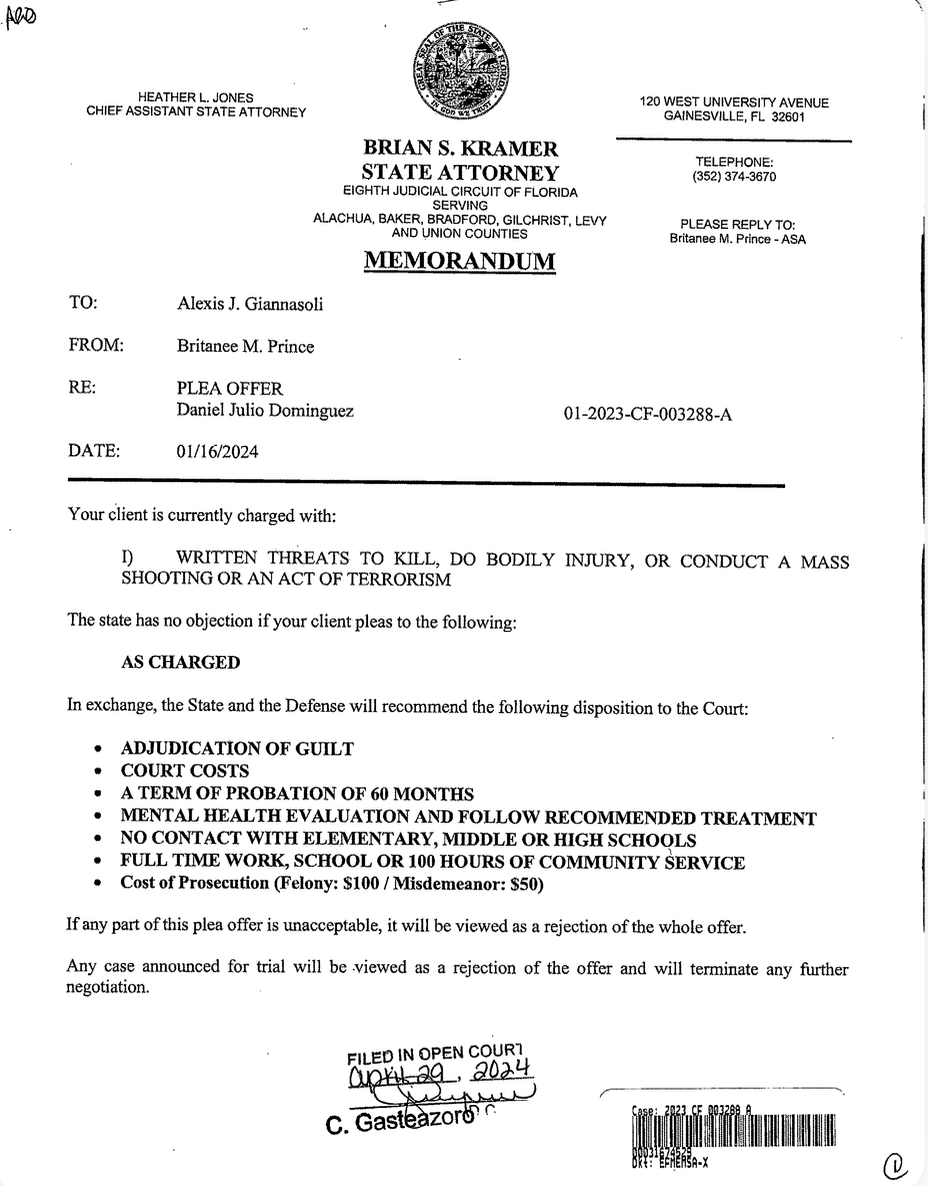
Sieg’s Comments and Sentence:
Sieg commented on the rapid increase of school shootings in the U.S. and said, “What does the crisis in school shootings matter in this case? It matters because it provides the answer to the essential questions that have to be answered in a sentencing; and that is, who is the victim of this crime and what harm was inflicted. I’ve got to identify the answer to those questions before I can sentence."
Sieg said that the most direct victims are students of Kanapaha Middle School. He commented, “A study about four years ago on the social media usage of 1,000 children in this country showed that 40% under the age of 13 use Instagram, an adult website. I don’t have any means of knowing how many children saw that video or read about it or heard about it from friends or classmates, but I think it would be head-in-the-sand denial to say, because these kids are nameless and faceless, that they didn’t see that video. Evidence at trial established that it was available to the public and that at least several persons in Alachua County viewed it soon after it was posted. So we know that access to that video wasn’t limited just to Kanapaha students..."
Sieg spoke to Domínguez directly, “school children across this county, this state and even this country who saw or heard about that threat were at some degree harmed by it and some were traumatized because their minds are already burdened with memories or images of Nashville, Uvalde, Parkland, Sandy Hook, Columbine and many, many others. Our school children know that not only are their school buildings targeted, but kids just like them are being killed. School shooter drills tell them that. Other than a few closing remarks of the prosecutor, I’ve heard nothing in this courtroom in four and a half hours that talks about the true victims of this crime, that was simply posting a threat that would be perceived as a true threat. Nothing about whether he would really do it. Nothing about actual shooting up a school. Just posting the threat is the crime. Those victims are real. Those are who I think the victims are in this case that the State and the Court are responsible to. And it’s important for other reasons that I won’t get into. Protecting crime victims is a major part of my responsibility. And, Mr. Domínguez, the crime you committed and the harm that you inflicted on the most vulnerable among us are children really calls for me to carefully think about what I’m going to do. I can incarcerate you or place you on probation or both. I want to explain that incarceration for centuries has served three basic purposes: punishment, protection of the public, and deterrence. As with most crimes, I think all three are appropriate here. I think the most important of the three is deterrence.”
Sieg ultimately ruled that a maximum sentence would be disproportionate and sentenced Domínguez to three years in prison followed by ten years of probation, with special conditions to undergo a mental health evaluation and follow up with recommended treatment.
Sieg also ordered Domínguez to have no contact "with any institution or school where children congregate during the period of supervision."
Domínguez was given credit for 192 days of time served in jail and ordered to pay standard court costs.
Prince asked Sieg to limit Domínguez’s social media use which Giannasoli objected to. Sieg said he’d let the probation monitoring deal with it.
Appeal:
On May 8, 2024, Giannasoli made a motion post trial release pending appeal and another motion that argues in favor of a new trial and acquittal.
The release motion states Domínguez fully intends to seek appeal and would follow court order if the case was re-tried.
The other motion argues that the court made errors in allowing Estes to testify and states Nagel made “repeated improper and inflammatory statements in their closing argument.”
Sieg denied both motions.
On May 13, 2024, Giannasoli formally submitted a notice of appeal for Domínguez, prompting the case to enter the Florida Appellate Court.
On August 25, 2024, Appellate Attorney Robert Berry submitted the appeal form, which provides three arguments against Domineguz’s conviction.
The appeal argues, “No reasonable trier of fact could find the Appellant had made a “true threat” against anyone. His words in his video on their own make clear he does not intend to harm anyone. He specifically eschews the notion of hurting anyone. He explicitly states the film is a 'work of fiction.' The State conceded in closing argument that there would be no prosecution if he had only posted the video on his website, but it became criminal when he posted it on Instagram. This alone proves the State had no legitimate basis for a prosecution..."
The appeal argues that Sieg made an error in not granting the acquittal motion at trial.
The appeal concludes that Domínguez “was denied his right to question the venire about their ability to accept a defense that this was an art piece. Specifically, defense counsel wanted to ask ‘if the jury would accept an argument from the defense that a video art piece would not be a true threat [and] would not include a true threat of violence in its performance.’ The trial court ruled that question could not be asked and that counsel was limited to asking if the jury could follow the law. This is in direct violation of the Florida Supreme Court decision in Lavado v. State... Given the nature of the defense, the ability to ask this question was critical.”
Response from Attorney General’s Office
Assistant Attorney General Steve Woods responded to the appeal arguing in favor of Domínguez’s conviction.
The response called the disclaimer “after the fact” and “nominal,” stating Domínguez’s “sham disclaimer does not refute the State’s contention that his statements were intended as a true threat.”
The response states, “Every relevant aspect of State’s Exhibit One proved that the statements therein were intended as a true threat. Without question, viewing the evidence in the light most favorable to the State, a rational jury could have concluded that the State proved beyond a reasonable doubt that Appellant’s statement was intended as a true threat.”
The response states assertively in bold font that Domínguez “threatened to commit an act of terrorism.” It says, “A rational jury could have concluded that the State proved beyond a reasonable doubt that Appellant threatened to commit an act of terrorism.”
The response says that when Sieg “ruled that the instruction would not specify the illegal, violent act that Appellant threatened to commit, Appellant did not object to that ruling… Even if the issue were preserved, Appellant still could not prevail since the trial court did not abuse its discretion in failing to specify the illegal, violent act Appellant threatened to commit. As the trial court pointed out, the standard jury instruction is permissive. And given the specificity and clarity of Appellant’s threat, it cannot be persuasively argued that no reasonable person would have declined to list the illegal, violent act that Appellant threatened to commit.”
The response goes on to state, “The jury had an easy task. Without question, the act that Appellant threatened to commit was an act of terrorism. Opening fire upon a school is indisputably violent, obviously illegal, and, by Appellant’s own words, intended to affect government through the destruction of property. Given the foregoing, a reasonable person clearly could have concluded that there was no need for the trial court to specify the violent, illegal act that Appellant threatened to commit.”
The response argued that “the prosecutor never conceded that Appellant’s threatening video was art when it was posted on his personal website, cushbomb.com. The prosecutor never conceded anything. he argued… the fact that Appellant posted his threat on multiple platforms tended to prove the State’s contention that his statement was intended as a true threat —one that Appellant wanted to be spread on multiple platforms... [Along with] his personal art website, Appellant posted his violent threat on Instagram —a platform normally used for non-fiction— and tagged the video multiple times to maximize its exposure. The prosecutor was responding to the Defense’s claim that Appellant lacked knowledge that his video would be perceived as a threat.”
The response states that Domínguez was free to choose a fictional target but deliberately chose a real location that was familiar to him. The response emphasizes that, while possessing a real firearm, Domínguez “implied a timeframe” for the attack (Saturday or Sunday) and “knew and desired that his viewers would take his words to be an active, live, current, and true threat.”
The response states Domínguez "exhibited consciousness of guilt. Tellingly, he was not shocked when he was apprehended.”
Judges’ Affirmation of Disposition
Judges of the First District Court of Appeals affirmed, “The central question in this case was whether Domínguez intended the threat he made in the video to be a true threat. Although there was evidence to support the defense’s theory, there was legally sufficient evidence to support the State’s argument and for the jury to reasonably infer that Domínguez intended to make a true threat. Thus, the question was one for the jury to decide. And the trial court did not err when it denied the motion for judgment of acquittal.”
The judges affirmed Domínguez's sentence and conviction.