Breaking the Silence: Former Israeli Soldier Admitted to Detaining Palestinian School Children While Speaking for Gainesville JVP Event in 2025
Editor’s Notes: Some quotes have been edited slightly from the video for grammar and to remove filler words (e.g., “um,” “like,” “you know”)
One year ago today, Gainesville Jewish Voices for Peace (JVP) hosted former Israeli soldier and Breaking the Silence member Luiz Aberbuj, 33, via Zoom for a speaking event at Unitarian Universalist Fellowship Church.
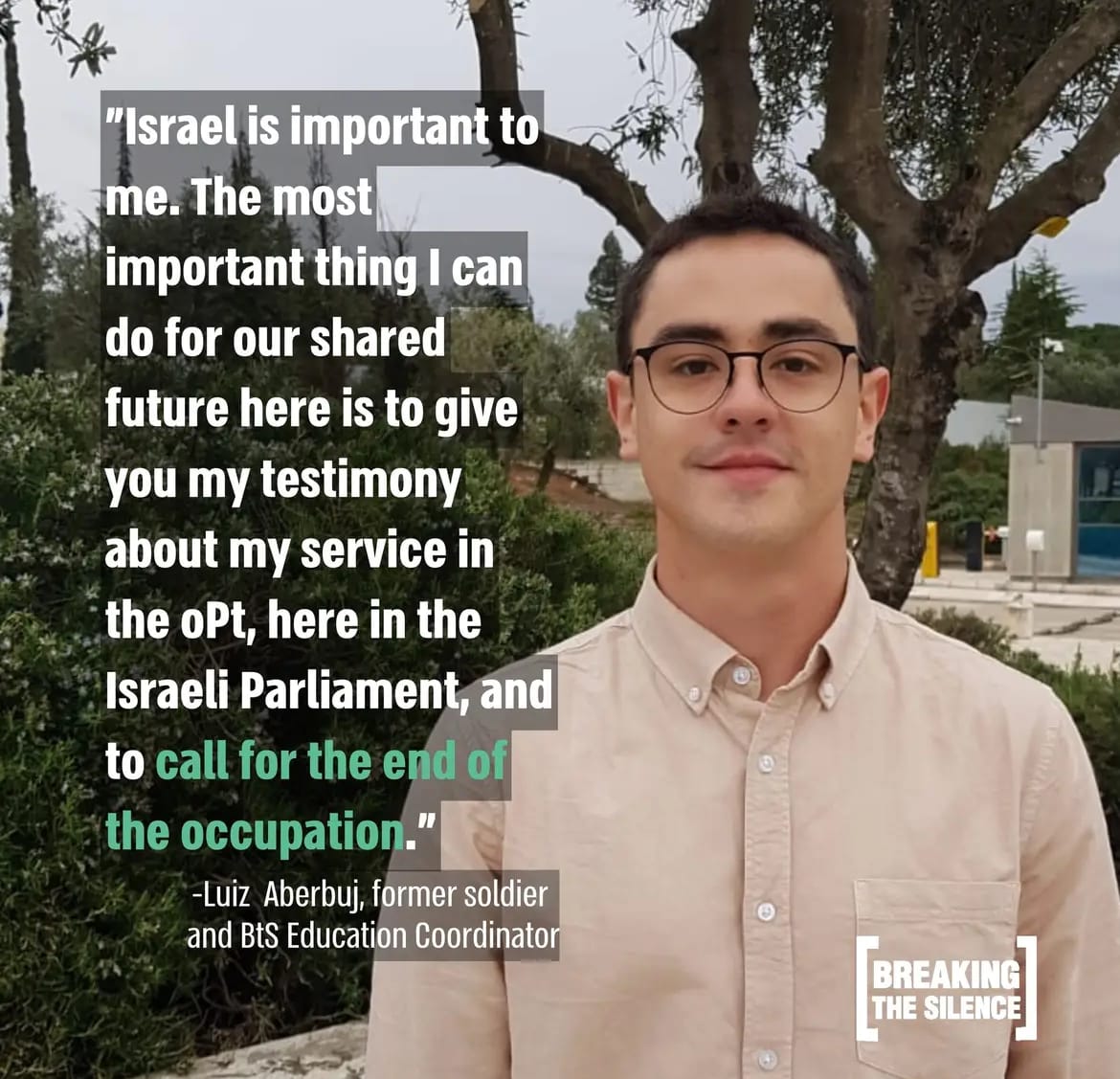
Aberbuj currently works as Jewish Diaspora Education Coordinator for Breaking the Silence.
According to their website, Breaking the Silence seeks to “expose the public to the daily reality of the occupation and Israeli military rule over the Palestinian civilian population in the territories, a reality we witnessed firsthand during our military service.”
Breaking the Silence does not directly oppose Israeli military refusal, with the website stating, “As a movement that brings together many testifiers who have different views on conscientious and political objection, we do not believe that we can or should determine one view that is representative of all testifiers. There are many ways to challenge the occupation. We believe that every person should choose their individual path in resisting the occupation. Any such decision is one’s personal choice, and as an organization we have no intention or will to impose any binding form of action.”
The Breaking the Silence organization was introduced by retired University of Florida Professor Dr. Zoharah Simmons, who acted as a moderator and speaker for the event.
Simmons said, “I was fortunate to meet with members of Breaking the Silence when I was there in Palestine and Israel back in 2002. Breaking the Silence, the organization that Luis is with, is an organization of veteran soldiers who have served in the Israeli military since the start of what was called the Second Intifada, and have taken it upon themselves to expose to the public, both in Israel and around the world… the reality of everyday life in the occupied territories. Breaking the Silence endeavors to stimulate public debate about the price paid for a reality in which young soldiers face a civilian population on a daily basis and are engaged in the control of that population’s everyday life… Their aim is to bring an end to the occupation.”
Simmons said Aberbuj was born in Porto Alegre, Brazil, and was a member of the local Zionist Socialist Youth Movement. In 2011, he visited Israel for a gap-year leadership program before moving there three years later.
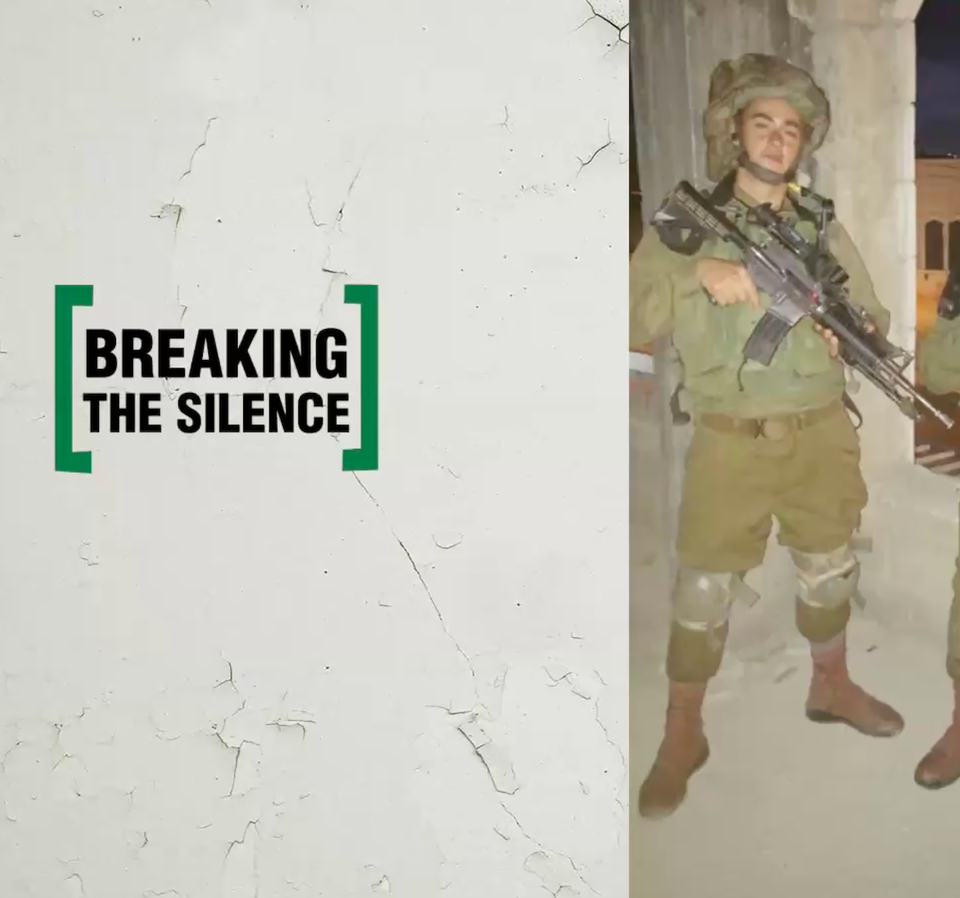
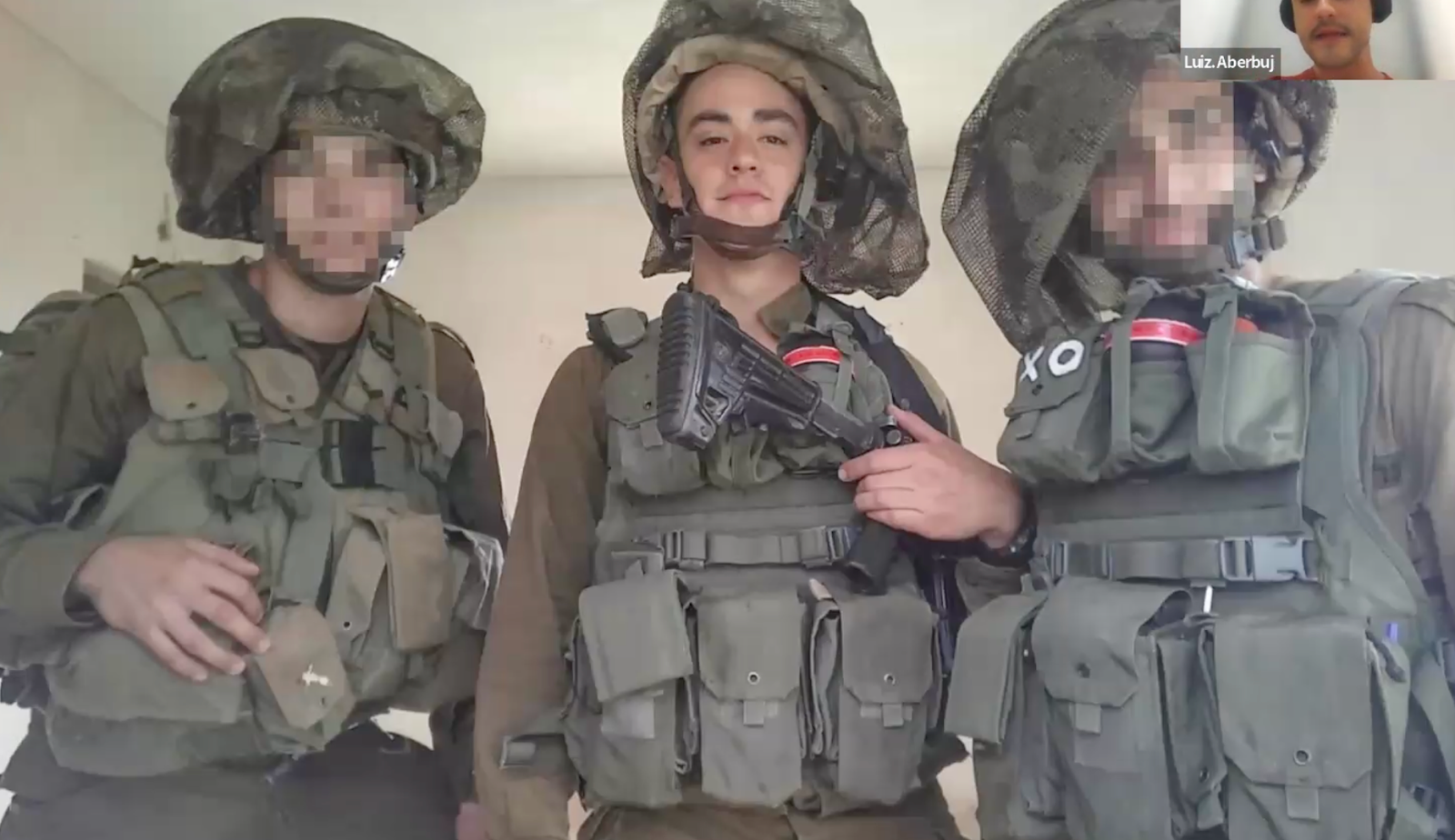
From 2014-2016, Aberbuj joined the Israeli military, serving in the Nachshon regiment of the Kfir Brigade. Aberbuj shared several photos in his presentation, one appears to be him with his unit, however, everyone except Aberbuj has their face redacted. This remains the standard for other photos he shared.
According to Simmons, Aberbuj spent most of his military time in the West Bank but also served on the borders of Gaza and Lebanon. After completing his military service, Aberbuj spoke with Breaking the Silence and joined the organization.
Introducing himself, Aberbuj said, “Thank you for your willingness to hear me break my silence here with you and talk about this very complex and painful reality that we’ve been living for almost 60 years with the beginning of the occupation… It’s very important to ask the hard questions and try to generate dialogue and conversation about the reality in Israel and Palestine.”
Aberbuj said Judaism, Israel and the Zionist Socialist Youth Movement were a large part of his identity growing up in Brazil. He said, “We talked a lot about the politics, the history, the wars, conflict with Palestinians, of course about the occupation, but from so far away in Brazil, it's really hard to grasp and understand what it means [for] the daily life of millions Palestinians living under occupation, or even for Israelis sometimes, soldiers, or settlers, what it really means, like ‘occupation?’ In my naive perspective of growing up so far away from Israel but at the same time feeling so connected, in my mind there were those areas where the Palestinians lived, the West Bank and Gaza, and unfortunately we need to do what we have to do. ‘They want to kill us, they have terror organizations. They want to push us to the sea, they are very violent. Of course [we] would prefer two states, peace, diplomacy, but we don't have partner for that.’ That's the basic essence of the narrative.”
Aberbuj said during his gap-year trip to Israel he did a lot of “social work” and “studied lots of Hebrew history, wars, politics, and met a lot of different organizations and people.” Aberbuj said he heard a presentation from someone who was in an elite unit of the Israeli Army, and it caused him to “ask a lot of questions,” but he still went on to join the military.
“In my mind it wasn’t even a question. I was very sure that I wanted to serve,” said Aberbuj. “Of course I would be a combat fighter…”
Aberbuj said he believed he was going to “defend Israel, arrest terrorists and save lives” when he joined the military.
Aberbuj went on to say, “I was trying to understand how some things we were doing were related to security at all. How do some things bring security to Israel? For example, sometimes we were entering houses just to train; to train how to enter in a house. We go in the night and wake up all the family. The kids start to cry and then you ask yourself, ‘okay, [why did we do that?] That’s for training.’ Or sometimes we’re entering the house and there’s nothing there [and] we’re supposed to find something—to find weapons… Or sometimes why this settler is giving orders to our commander? He’s a civilian… Or sometimes we were actually arresting Palestinian workers that were trying to [get] to Israel so they could work."
Aberbuj said “all those questions really started to bother me” and that he was starting to understand “Things are much more complex than simply security.”
Aberbuj said, “What I call the moment that broke the camel’s back, in Hebron, we were posted in the settlement living together with settlers… One day, me and my team commander were instructed to open a check post (mobile checkpoint) in the middle of the road in the street close to us… We were instructed to check all the male and military aged [men] from 18-45 years old more or less, women and children are free to pass. Suddenly, something happened, and we didn’t know how to deal with that. Two dozen meters from us, there was this Palestinian school and the children started to gather in the exit. They finished their classes and the bells started to ring and they started to go in the direction of their homes. We had this wave of children running in our direction and we didn’t really know what to do because we just know we have a lot of pressure on our shoulders, as soldiers we're the last obstacle between anything that could happen. There are people we need to protect and to keep order and tranquility…”
“We had this micro self discussion about what we were gonna do and we decided to check the children’s bags,” described Aberbuj. “We’re not willing to hurt them or make them afraid or something but I just want to make sure that nothing will happen [during] my term… We put the children in line and started to open their bags and in my mind I was this progressive guy and a good soldier… a very naive understanding of the situation. [We] very softly opened their bags and made sure nothing was there and let them pass. Then suddenly this guy was walking close to us and saw that scene and became very angry and started to scream at us, ‘What are you doing? They’re children, do you really think they’re a threat…’ He was a Dutch activist who was passing in Israel during the day. At that moment he really touched my soldier ego, ‘I’m the authority, who do you think you are? [We] don’t know who they’re parents [or teachers are], don’t know who prepared their bags, who were in this school and I wanted to make sure.’ We were screaming at each other and I’m asking for his ID and trying to somehow explain why this is logical. Suddenly something flipped in my mind… and I understood I’m not simply justifying to this guy why I’m doing what I’m doing. I’m justifying it to myself. I didn’t come from the other side of the world and leave my family in Brazil and became a soldier in Israel to stop children in the middle of the streets and being this policeman kind of enables the policy of military occupation, which is basically a military dictatorship…”
Aberbuj said that after a few moments the Dutch activist and Palestinian kids left the area but that the moment stuck with him.
Aberbuj presented a summary of the division of territory in Palestine and said, “In the Israeli narrative a lot of people believe we left the Gaza Strip after the engagement in 2005 but actually the occupation keeps going on to the policy of the siege; we control everything that goes and in and out of the Gaza Strip, the sea, air and land ports in cooperation with the Egyptian Army from their side of the border.”
Aberbuj went on to say that in the soldier’s mentality, “Palestinians are divided into two groups. The first are those who are involved in terror activities and therefore are a threat by definition that must be eliminated, controlled… [The second is] those who are uninvolved in terror activity. But those who are uninvolved in terror activities, they are potential threats. Why? Because you as a soldier, dealing with a civilian population… You don’t know from where to identify the threat will come from necessarily. It’s not like everyday in the West Bank is like October 7 and you can see a fully equipped terrorist and know this is a threat. For example, I served in 2015 and we had the Stabbing Intifadia… You cannot necessarily know from where a stabbing can come. It can be an old lady… a pregnant woman… an old senior citizen… a young guy. Those who are uninvolved are potential threats and you must be aware of them.”
Aberbuj said that as a member of the Israeli military, soldiers wouldn’t consider the idea of an “innocent Palestinian.”
“We see them as involved or uninvolved,” said Aberbuj. “Threat or potential threat.”
Describing one of the pictures (shown below this paragraph), Aberbuj said, “We entered an apartment; it was an abandoned building… We took the windows, and now we are using this apartment [because it's] a place to spot the road and protect the area… [We were] being felt, being seen, passing the idea that we are at all the places all the time, you can run but you can’t hide, don’t mess with us… Classic showing off of security to try and generate deterrence.”
Aberbuj described how once a month, the Israeli Army grants permits to settlers to go to the Palestinian city of Nablus to visit Joseph’s Tomb. “Of course that demands a full military activity,” he described. “I had a small confrontation with a group of settlers who were clearly trying to generate provocation and provoke Palestinians there. Even to me, as a soldier protecting them, they start to call me a traitor [and say] I came to protect the Arabs… That I’m a leftist and I hate Israel. Just because I asked them to keep quiet and stop their provocations.”
During the Q&A session, a man asked Aberbuj what percentage of Israelis have a clear understanding of what Israel is doing in the West Bank and Gaza, if Breaking the Silence is affiliated with the refusenik (military refusal) movement, and how many current military personnel are affiliated with Breaking the Silence.
Aberbuj responded, “It’s hard to give an exact answer about percentages but I really feel that to answer your question the key word here is ‘narrative…’ There’s this myth that all Israelis are soldiers. Mainly nowadays that’s not so true. Of all the 18 year olds who are drafted, only half of them will serve in combat roles in the army. From all those combat roles, only half of them are really inside of the occupied territories and really applying the policy of occupation in their daily life.”
Aberbuj said that Israeli society is very “tribalized” and that there are differing communities of religious and secular people. Aberbuj said that most Israelis don’t really know what's going on and “simply follow the official narrative that everything is made for security… That demands a very cynical use of our trauma as Jewish people. We as Jewish people… I’m pretty sure that we’re not the most loved people in the world and we have a very traumatic past. But to use that and weaponize that politically to justify what’s going on and to silence voices of discussion within Israel and all around… ”
Regarding the refusenik movement, Aberbuj said they have contact with people from the movement but said, “We as an organization don’t promote necessarily refusal — of course it is valid.”
A woman stood up to ask Aberbuj a question, stating, “I’m still a little confused about your group because having followed this issue for many years… I have not seen any evidence of any pro-Palestinian group in Israel… Even your group from what I understand would probably not be considered a pro-Palestinian group. There are pro-Palestinian protests from what I understand even with the huge thousands protesting to return the hostages and against the judiciary reforms that Netanyahu is trying to make. I think any protest in favor of the Palestinians is not allowed and is illegal and you’re not even allowed to fly a Palestinian flag, so, first of all do you consider yourself a pro-Palestinian group? Are you fighting for Palestine to be free? Or are you just writing down testimony of what it's like? Who is fighting for Palestine? Whoever is doing it, from my vantage point, is not doing a very good job. Nothing personal, but the vast, vast majority of Israelis do not consider Palestinians human. Do you consider yourself a pro-Palesinian group? Is that your goal, to save the lives of Palestinians and to end the occupation? It's not complex.”
Aberbuj responded, “In this case I don't have absolutely any problem with that definition… We as an organization are not at any moment pretending to say that we have the solution. I'm not saying that I'll come here with the absolute truth… I’m not saying what the absolute way is to solve the conflict, end the occupation and save Palestinian lives. Our objective as a group since the beginning establishment as an organization was of course using part of our privilege as Israelis to bring this debate to try to change things within Israeli society and have this educational approach. I don’t have any problem in defining myself as a pro-Palestinian in the sense that of course I believe they are a legitimate social group, a legitimate nationality. They are people that exist and they must have the rights of anyone else living in an equal system. But we as a group, we as an organization are talking about something that is very niche inside of a very complex and very difficult to understand reality… We’re talking about occupation since 67’, of course we also have to talk about 48…’ the beginning of the nationalist movement in the end of the 19th Century—All of those discussions will be necessary. They are very important and need to exist in a process with Palestinians as equal so then we can somehow develop peace and the end of occupation.”
Aberbuj continued, “Here in Israel… we’re fighting against very strong forces and it's very difficult… The government, they try to intimidate groups that are trying to show solidarity with Palestinians. I’m not promoting any specific kind of solution or any kind of absolute truth but I think that I can talk from my perspective, from my side, why those things are not moral… not related simply with security based on my military experience from living here and also the voices of the 1,500 soldiers that are willing to break their silence and have this discussion. It’s really hard… We have a lot of different groups and we have people that absolutely define themselves as pro-Palestinan but in the end I would say the solution would not be black and white… It would be something that must need to be pragmatic, realist, and based on solidarity…”
Someone watching online asked Aberbuj, “Are you safe?”
“Like here in Israel in general?” Aberbuj questioned.
One of the moderators added on to the question, asking Aberbuj what safety looks like for him “when doing this work.”
Aberbuj said “there are some risks” but that he doesn’t feel them very much. Aberbuj emphasized that he’s an “immigrant” and came from a “Jewish progressive base,” saying he’s met “other faces of Israeli society” who are more radical in their narratives.
Aberbuj continued, “Of course we don’t feel safe in the context that we’re always in this war… keeping the occupation alive, controlling millions of Palestinians, of course that’ll generate violence and sometimes we have these cycles of battles and fighting. We’re always constantly living the security issue. In that sense, I cannot say that I’m safe, mainly after October 7 that was very clear. Everything exploded in our face based on this idea in the Israeli government that it was possible to keep managing that without any real consequence. In general I’d say yes I feel safe…”
Aberbuj indicated that Breaking the Silence has a lot of "Palestinian partners” and that they speak on their tours.
A local activist brought up the Nakba, which refers to the ethnic cleansing of Palestinians in 1948. She said, “What happened with the Intifadas were ostensibly a non-violent movement and if this is your first time learning about the history of Palestine and the Israeli occupation, what you just heard was from the perspective of a Zio–-or an Israeli settler. It’s important to go beyond that. If this is really your first exposure, go deeper." She told Aberbuj she thinks it’s important he is speaking because “when there has been movements to overthrow an oppressive government it has always been preceded by people defecting from the army that is oppressing the people on that land. It happened in Hati… Cuba… Russia, every single revolution for independence has happened that way.” She asked Aberbuj, “What do you feel is your role in liberating the Palestinian people and fighting for their independence… What are you doing to try and make more people defect from the IOF in Israel?”
Aberbuj responded, “As I mentioned before, of course there’s a lot to be discussed… 48,’ Nakba, those things are a fundamental part of the discussion and I believe that in the moment that hopefully the military occupation of the territories will end through an honest process we will have to see [and] ask those hard questions. Sometimes we may not agree, sometimes we may agree, sometimes we may find an equilibrium in the different narratives. The discussion is absolutely necessary. We as an organization, we specifically focus on the 67’ war and consequently the occupation of the territories because mainly the political system and the policy that I took part and that I implemented, in the sense that my speaking place—and I talk about this reality that I implemented.”
Aberbuj continued, “What I mean when I say we don’t promote any specific solution, it’s not because I don’t have any perspective of what we would like to see, but because… there are a lot of different organizations and movements within Palestinian society, within Israeli society… They have their own proposals… perspectives, and ways to try reach a solution that would guarantee rights and security to everyone from the river to the sea. But unfortunately, as we look at the situation within Israeli society nowadays… We are not at the historical point to discuss solution[s], but we are at the historical point to understand that we have a problem.”
Aberbuj went on to say that the “occupation policy” got “deeper “since the Second Intifiada—“expansion of settlements, more violence… [not applying] the laws on settlers… That happened and I think that the point is we don’t need to erase other perspective[s] by saying that the Intifada wasn't violent. It was a very violent period for everyone. That was the beginning of the narratives that definitely gave power and legitimacy for the accession of the Israeli extreme right-wing which now are in power… Unfortunately, a political symbiosis between the extreme hardcore right wing—settlers… and the violence of this very Jiadhit and more extremist movement within the Palestinian resistance—I think Israel and Palestine and the Middle East in general is a place where maybe a place where terrorists and things got really complex because we’re talking about the place of the birth of civilization—society… What I do promote is dialogue, education bringing the reality to Israeli society, promoting this discussion that if we don’t change, things will get really worse but they’re already immoral and absolutely unacceptable. Mainly after all these years of war crimes and destruction in Gaza, genocide, killings… it’s very clear for us–for me at least that we’re trying to bring to Israeli society that all these elements are being used to fulfill political interests of specific sectors of society and politics.”
Aberbuj said, “It’s much more complex than it seems. As I see the occupation as a violent way to control Palestinians… For me it’s hard to say that extremist violent resistance would be the solution. I don’t think that Hamas achieved too much for the Palestinians because it made possible for these very extreme narratives in Israeli society to be legitimized.”
As the Q&A came to a close, Simmons asked Aberbuj if he sees any hope, saying “people in our government are still talking about a two-state solution even though there are hundreds of thousands of settlers now in what was to have been Palestine. What are your hopes for the present and the immediate future?”
Aberbuj said that Israelis “don’t see too much” of what goes on in Gaza and they more or less see things “from the soldier’s perspective.”
Aberbuj said that when he was in the U.S. he saw the destruction on T.V. that was not shown on Israeli T.V. for the general public.
Aberbuj went on to say that he knows nowadays a two-state solution “doesn’t seem relevant” and said, “Maybe the real solution is something that we haven’t thought about—maybe something in the gray areas between these big possibilities that people discuss. The first step that we must reach, that we haven’t reached at all, is the step of political willing to generate change, to choose different kinds of leadership and to have different narratives.”
The Breaking the Silence website contains numerous other admissions from former members of the Israeli military.