Federal Civil Trial Jury Favors Plaintiff in K-9 Attack Lawsuit
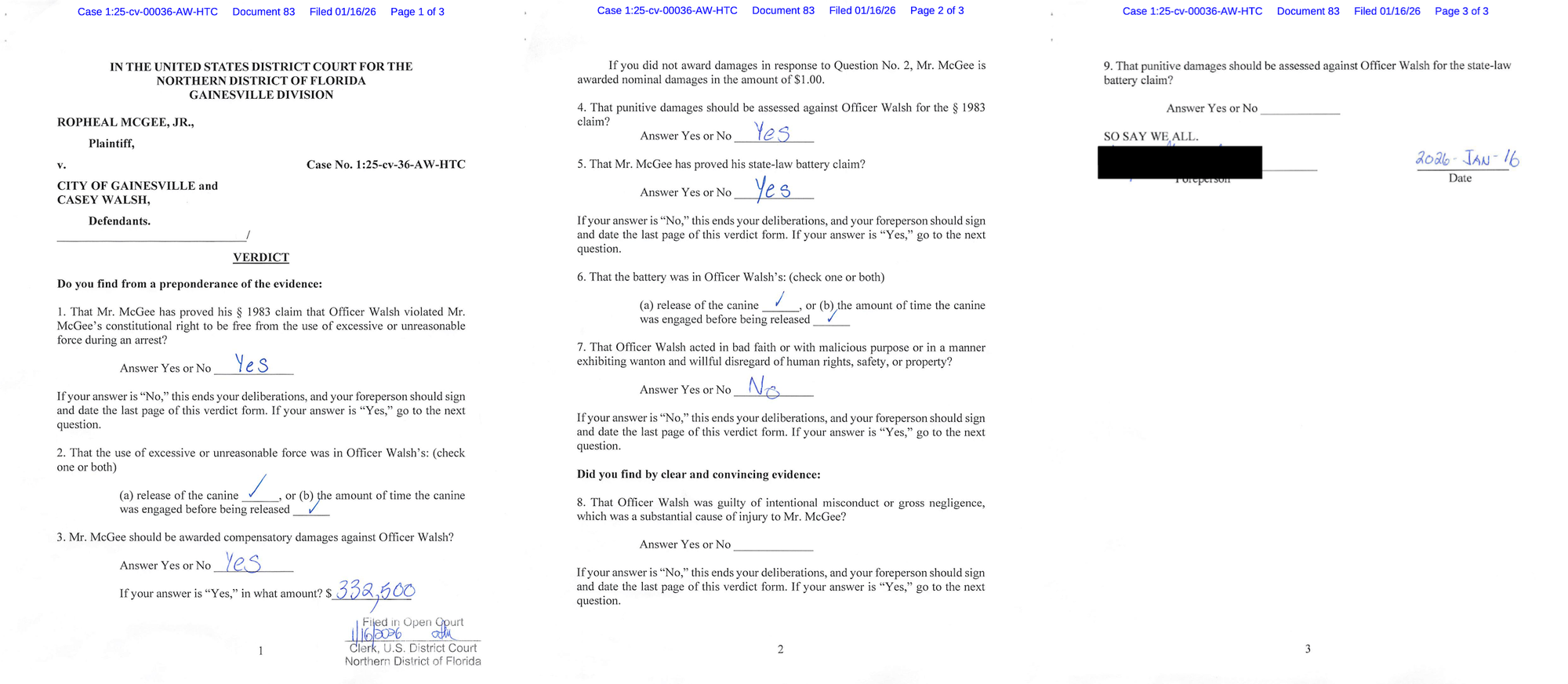
A jury declared that Ropheal McGee Jr. should be granted over $300,000 in compensatory damages after he sued the City of Gainesville and Gainesville Police Department (GPD) Corporal Casey Walsh for attacking him with a K-9.
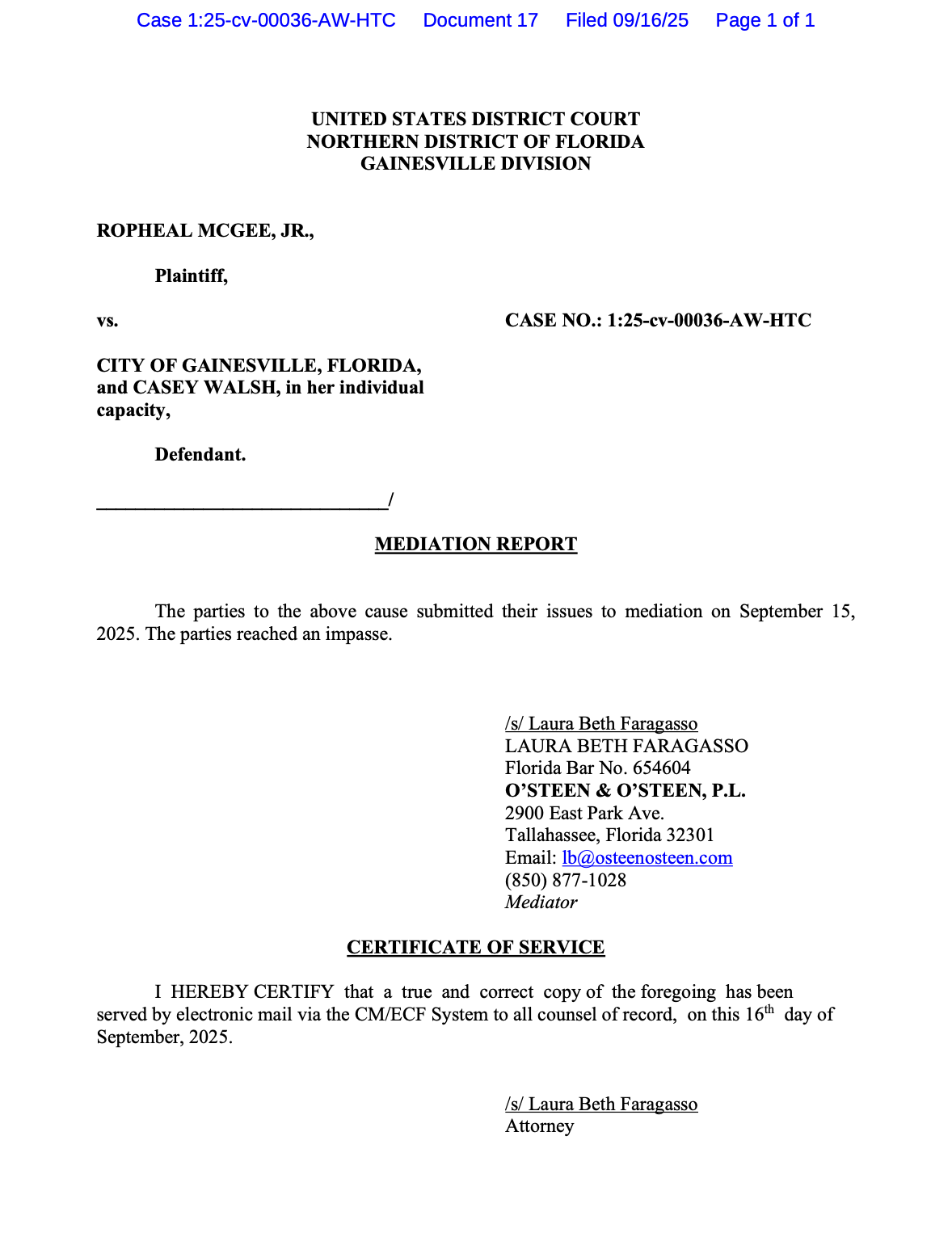
With counsel for McGee and the counsel for the defendants reaching an impasse during a mediation conference, they took the case to trial last week.
The day after the trial concluded, a juror contacted GnvInfo, speaking on the condition of anonymity.
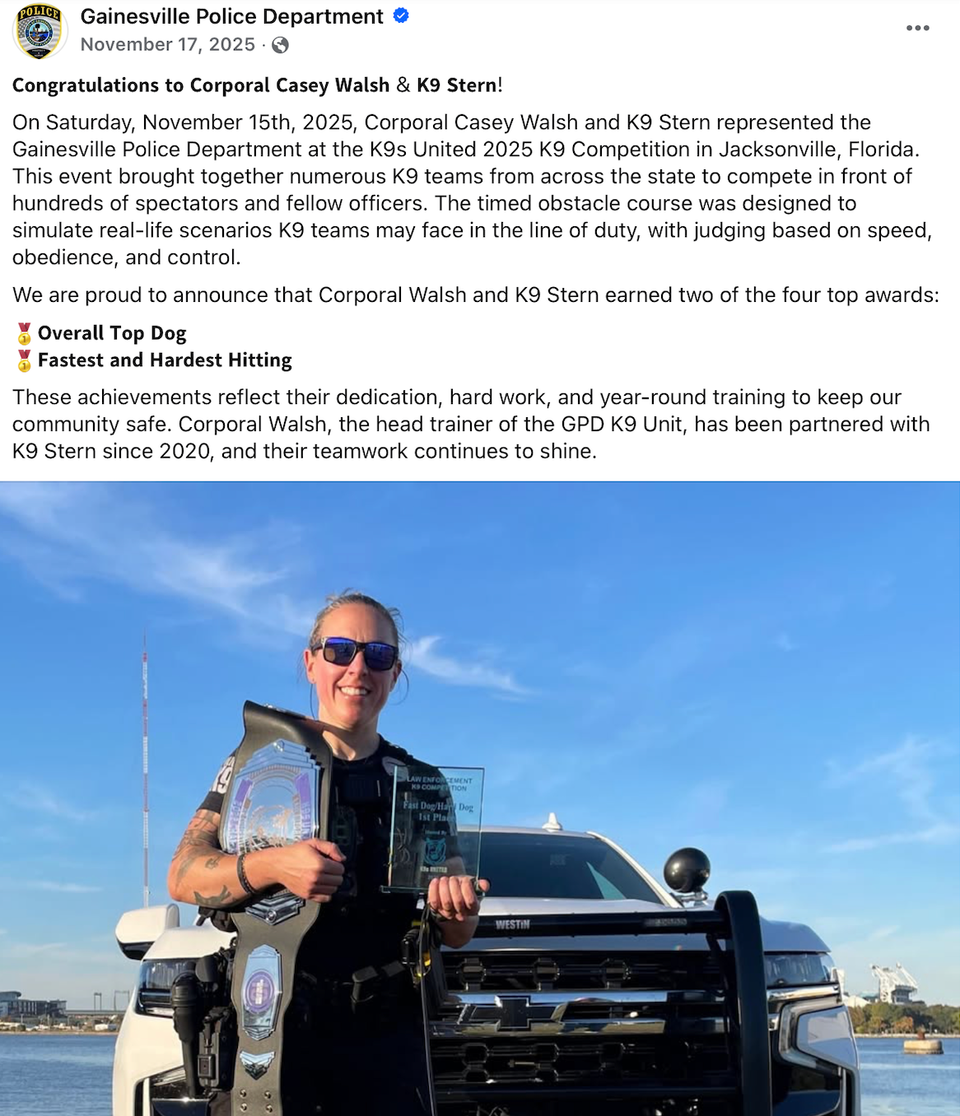
In pre-interview text messages, the juror advised that he believes Walsh “dropped the leash and lied,” stating her dog “behaved completely out of control, shaking his head and shredding to the point he needed a tourniquet… This was in 2021, just after [graduating] from the K-9 program. The city freaked out when it heard we were going to award punitive damages against her as well as the $300k compensatory damages, and [they] flew over to offer a settlement, which Mr. McGee accepted… We found without malice, which means the city is responsible for her actions… I [don’t] doubt the city will continue to employ her. Her dog just won the ‘hardest hitting dog’ in a national competition. He looked like a trained fighting dog, not a police dog. They're supposed to bite once and hold. He was doing real damage, and Mr. McGee almost bled out... She literally dropped the leash the second they announced their presence. No orders given, no time to comply. He was literally hands up and kneeling when the dog got him, less than 2 seconds after they announced… We specifically wanted her to be on the hook for the compensation but the city for the punitive, because it was the city that approved both her and the dog as trained, and clearly the issue goes beyond just one dog and one officer. The entire division needs to be fixed.”
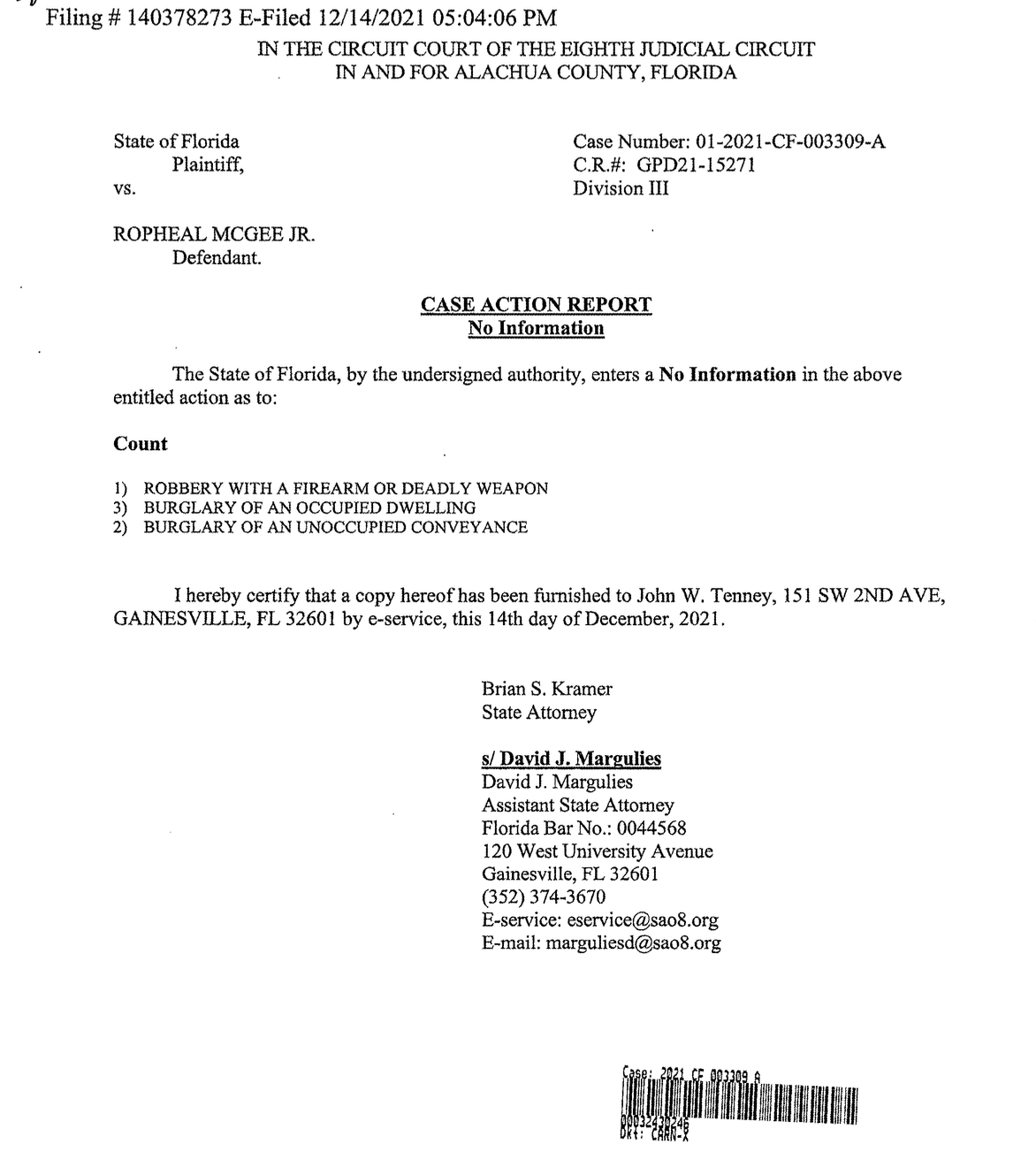
Court records show officers were chasing McGee over charges of robbery with a firearm and two counts of burglary. McGee, unable to post the $350,000 bond, spent over a month in jail until prosecutors dropped the charges.
Complaint:
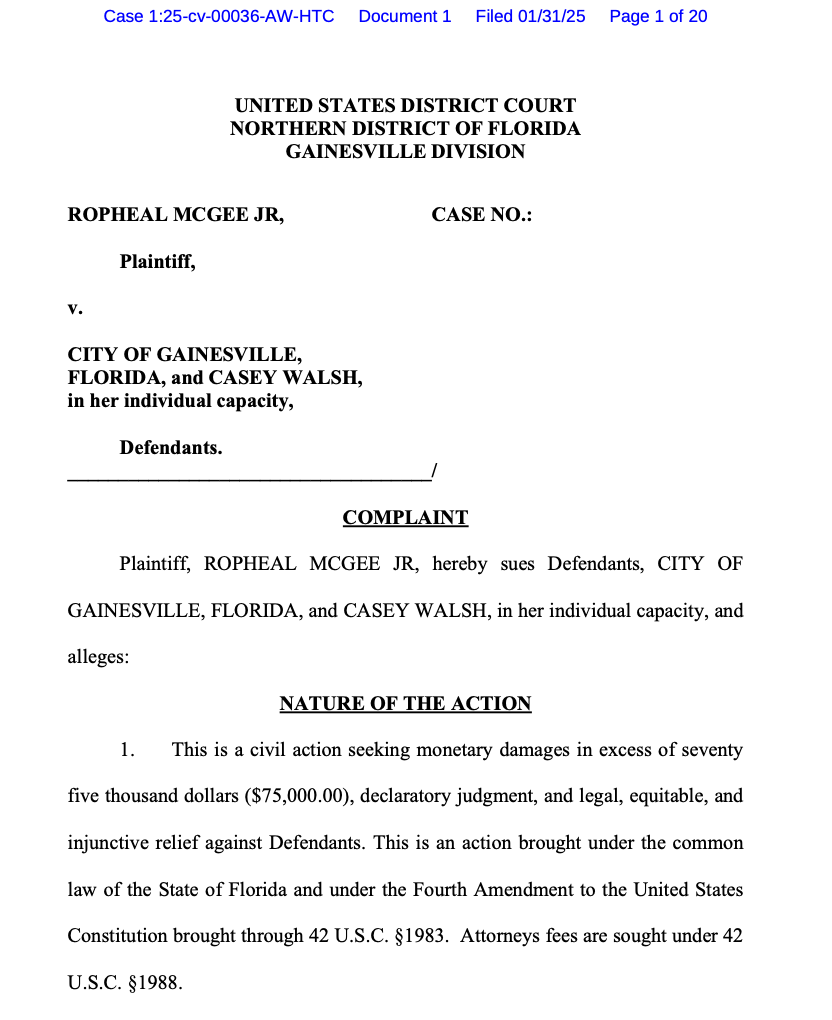
McGee’s counsel filed the lawsuit on January 31, 2025, for an amount in excess of $75,000.
The incident occurred at night on November 7, 2021.
According to the complaint, McGee was in his house when he heard his car alarm go off. He went outside to check on his vehicle and heard GPD officers yell at him to get on the ground. As he was complying by lying down, Walsh's K-9 attacked him. "This officer’s use of force was extreme, excessive, unwarranted, and unnecessary as captured on a video recording," the complaint states.
The complaint states the attack lasted at least 28 seconds and that officers did not take sufficient action make the dog stop biting McGee.
The complaint states Walsh did not determine if McGee posed a threat to himself or others, and had no knowledge of whether he was attempting to escape.
The complaint details that after the dog was released from McGee's heavily bleeding arm, officers handcuffed him with his arms at his back while he remained with his stomach against the pavement. After seven minutes, officers repositioned McGee's handcuffs to be at his front, allowing his blood flow to stabilize.
McGee was placed into surgery at the UF Shands Trauma Center and treated for "extensive and permanent injuries caused by the canine," states the complaint.
The complaint continues, "More specifically, Plaintiff was admitted for uncontrolled bleeding from the dog bite to his left forearm, among other injuries... Plaintiff’s future care will involve extensive rehabilitation and healthcare services for years to come."
The complaint cites other incidents of K-9 attacks within GPD, stating, "Canines have mauled other persons in Gainesville, namely Terrell Bradley in which Mr. Bradley lost an eye, and an innocent homeless woman. There appear to be others. The injuries in these and other cases caused the [City of Gainesville] to cease using its K-9 program for a period of years, fueled primarily by citizen groups outraged by the actions of the officers and canines in this program."
The incident involving Bradley occurred in 2022 and led to the temporary disbandment of the K-9 unit.
The incident involving the homeless woman, which was perpetuated by Walsh, occurred in 2024 two months after the K-9 unit was reinstated.
City Lawyers Defense:
Attorneys representing Walsh and the city responded, showing photos from body camera footage depicting what they say shows McGee running away from officers.
According to legal documents submitted by city lawyers, Officer Christian Hickey responded to the Polos Apartments shortly before midnight to follow up with an armed robbery investigation.
Believing McGee could be armed, Hickey contacted Walsh, along with officers Andrew Milman and Ethan Sevor.
Sevor attempted to set up in a position to see the front door of the apartment while Hickey, Milman and Walsh set up under a canopy of trees.
In an attempt to lure McGee outside, Hickey set off the car alarm on his vehicle.
The document submitted by city lawyers states:
The officers then came out of the darkness, called Plaintiff’s name, announced themselves as [GPD], and ordered Plaintiff to get on the ground… Plaintiff admits that he heard law enforcement officers announce themselves and order him to get on the ground…
Plaintiff alleges that he complied with officers’ commands to get on the ground… Plaintiff alleges he was ‘attacked’ by K-9 Stern [while] ‘laying down on the ground on his stomach…’ Plaintiff alleges that he ‘had already complied with commands to get on the ground at the time the canine was released to attack him…’
Cpl. Walsh, Officer Milman, and Officer Sevor testified that when they announced their presence, Plaintiff took off running… Body-worn camera footage of the incident establishes that: Plaintiff did not comply with orders to get on the ground; Plaintiff attempted to run from officers; K-9 Stern was only released after Plaintiff attempted to run; Plaintiff never got on the ground; Plaintiff was apprehended by K-9 Stern while he was standing. Very shortly after he started running, Plaintiff appeared to acknowledge that he was not going to be able to get away, at which time he stopped running and threw his hands out to his side… Cpl. Walsh attempted to recall K-9 Stern with a “foos” command, but he had already apprehended Plaintiff…”
Police Conduct Report:
As McGee’s lawsuit moved through pretrial litigation, he retained Robert Drago of Eye to Eye Consultants as an expert witness. Drago is a retired lieutenant colonel with the Broward County Sheriff’s Office with 38 years of law enforcement experience.
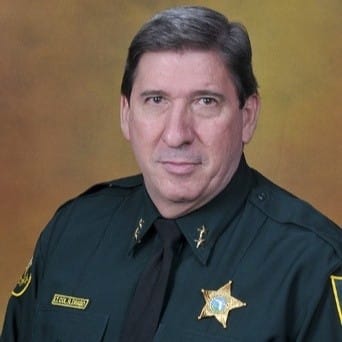
Drago competed a report on the incident, stating:
“A team of officers—including Officers Hickey, Milman, Walsh, and Sevor—initiated an attempt to apprehend McGee. According to the involved officers’ statements, an audible police announcement was made, which allegedly caused McGee to flee toward his apartment. However, the body-worn camera footage from the scene raises disputes regarding whether such a verbal announcement occurred. McGee was ultimately apprehended by K-9 Officer Walsh, whose K-9 partner, Stern, engaged and bit McGee. The K-9 maintained contact for an extended duration, resulting in significant injuries to McGee while he was on the ground… Following the apprehension, McGee was handcuffed with his hands in front due to the severity of his injuries and was immediately treated by Alachua County Fire Rescue. He was transported to UF Health Shands Hospital for medical evaluation and treatment. After release from the hospital, McGee was booked into the Alachua County Jail…
Based upon my review and analysis of the incident reports, body-worn camera footage, and witness statements provided in this matter, it is my professional opinion that the City of Gainesville, Florida, and its co-defendant, Officer Casey Walsh, engaged in the use of excessive force during the arrest of Mr. McGee. My opinion is rendered to a reasonable degree of professional certainty in the field of police practices and is based on nationally accepted standards for the use of force, K-9 deployment, and arrest procedures…
Drago called the actions of Walsh and GPD "inconsistent with nationally recognized police practices" and "other professional standards." "Both national guidelines and [GPD] policy mandate the application of de-escalation techniques prior to the use of force whenever feasible," Drago reports.
Drago reported that officers did not engage McGee with any "meaningful de-escalation measures," responding to the incident "in a manner consistent with a stealth or surprise deployment, which afforded Mr. McGee no opportunity to comply or avoid injury."
Drago wrote that GPD "failed to conduct an adequate internal investigation or meaningful review," stating, "This lack of oversight, coupled with prior incidents involving unjustified K-9 bites and the temporary suspension of the department’s K-9 unit, reflects a pattern of deliberate indifference toward the improper use of force by its K-9 handlers. This pattern suggests the existence of an informal or 'unwritten' tolerance for excessive force within the agency, which is inconsistent with accepted police practices and constitutional requirements."
Drago compared McGee's attack to the Rodney King case, stating, "In that case, multiple officers stood by as excessive force was inflicted upon a Black man without meaningful intervention. Similarly, in the present matter, Mr. McGee was subjected to a prolonged K-9 mauling while multiple officers were present, and none took action to prevent or stop the excessive force. The critical difference here is that, unlike the Rodney King incident, the officers’ own body-worn cameras captured the misconduct in real time."
Drago called GPD’s investigation of McGee into question, calling the issuance of a warrant "inappropriate." “The quality of the investigation and the resulting report were substandard and failed to meet generally accepted investigative protocols. Despite these deficiencies, the warrant was issued,” he reported.
Drago reports that GPD officers did not establish a "formal arrest or de-escalation plan," and that "no supervisor was present on the scene."
Drago reported that "officers had only been shown a photograph of McGee shortly before the operation. They had no familiarity with his physical characteristics such as height, weight, or age. Given the lighting conditions, distance, and lack of prior knowledge, it is this expert’s opinion that a reliable positive identification of McGee by officers at that time was not feasible. In law enforcement, field identifications or ‘show-ups’ are typically conducted in well-lit conditions and in close proximity to the subject. They are recognized as the least reliable form of identification and have frequently contributed to false identifications. The identification made in this case does not meet accepted standards."
Drago called Walsh's K-9 handling abilities into question, stating she "does not appear to be in a stable K-9 control stance. She lacks a proper two-handed grasp on the lead and appears unprepared for the dog’s reaction."
Drago described Walsh's K-9 as breaking free when the dog advanced towards McGee, reporting that Walsh yelled "loose," indicating the K-9 escaped.
According to Drago, McGee made "no effort to flee" and remained in a "compliant posture as he begins to crouch down."
Drago's report continues:
Before McGee can fully comply, K-9 Stern reaches him and begins biting and mauling him. McGee is taken to the ground and shows signs of pain but no resistance.
None of the officers present made immediate attempts to call off the K-9 or physically intervene. No verbal command was issued to the K-9 to disengage, despite the dog continuing to bite McGee while he screamed in pain...
Officer Walsh also failed to demonstrate the situational awareness expected of a trained K-9 handler. Rather than attempt to control the dog, she directed verbal commands at McGee—who was actively being bitten—telling him to place his hands behind his back, a command physically impossible under the circumstances.
Walsh reportedly allowed the K-9 to remain in the area after the attack. When she eventually walked the dog back to her vehicle, "footage shows she continued to mishandle the lead, using only one hand and allowing the K-9 to pull her off balance—further illustrating a lack of proper K-9 handling skill," notes Drago.
Drago's report criticizes GPD for failing to keep proper documentation of the incident, stating, "The only documentation generated following this event includes a general offense report by Officer Hickey, a supplement, and a bite report by Officer Walsh. The latter is notably incomplete and lacking required details. The bite report is substandard in both content and quality. Its deficiencies call into question how it passed supervisory review and was allowed to proceed through the chain of command without correction."
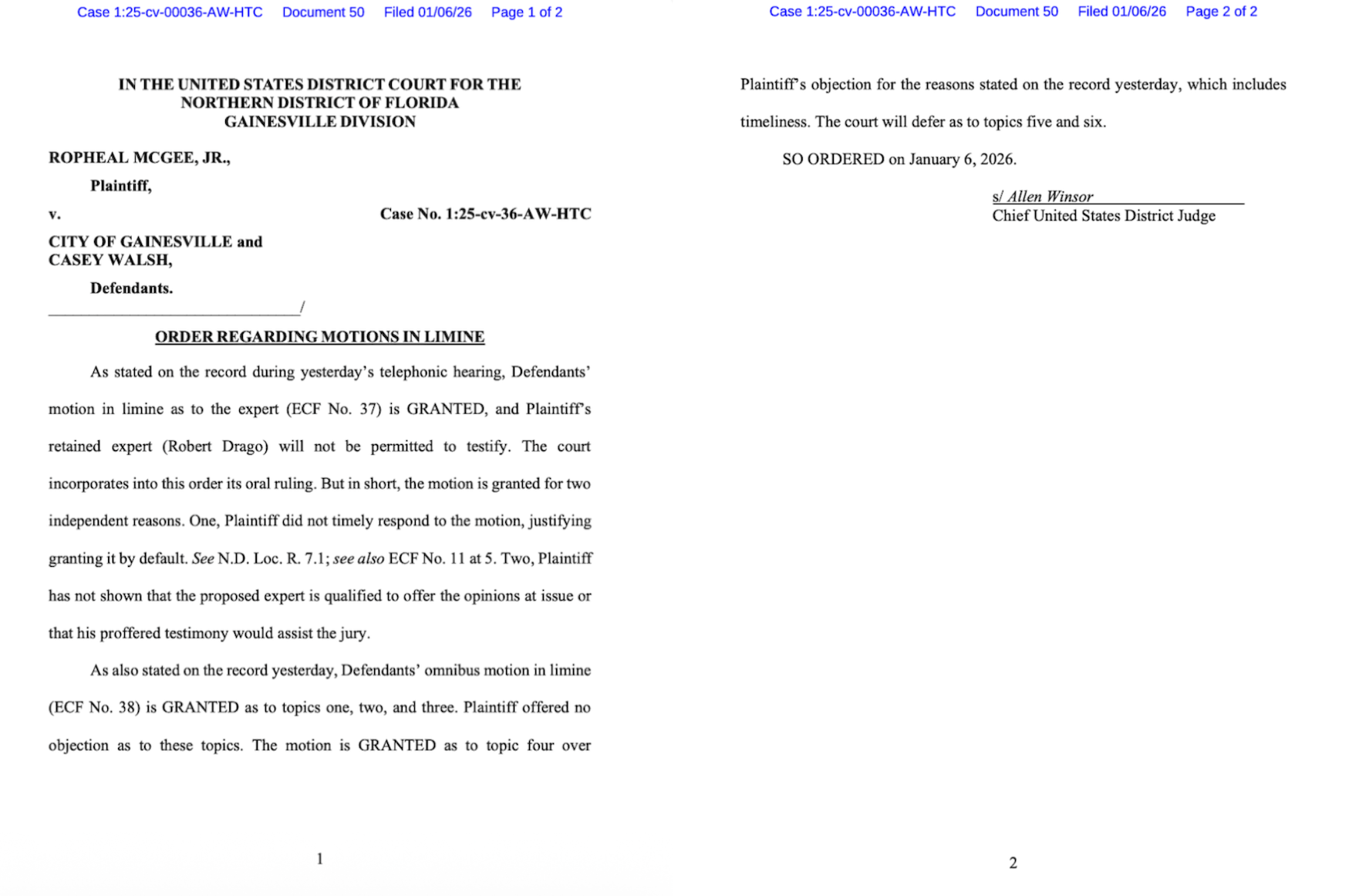
The defendants objected to the use of Drago’s testimony in trial, a move that was accepted by U.S. Florida Northern District Chief Judge Allen Winsor.
Juror Interview:
The Juror who contacted GnvInfo gave an anonymous interview:
Q: Was this a one-day or multi-day trial?
A: It was multi-day; it started on Wednesday and ended on Friday...
Q: What kind of questions did they ask you during jury selection?
A: If we knew any of the involved parties, basic stuff like that. One that stuck out to me was if we're dog owners. Although, they did not select only dog owners [but] I think the majority of us were.
Q: You mentioned [over text] officers showed up in support of Walsh. Was that mostly on the first day, on the last day, or the entire time?
A: The entire time.
Q: How was it apparent that they were in support of her?
A: They were there in uniform. They parked their cars out front of the courthouse, and I know that's dedicated police parking, but when it's all police K-9 units, you know.
Q: Do you remember what counsel for the City of Gainesville said in their opening statements?
A: I think it was basically like the videos were tough to watch, but that it was clear he ran away...
Q: What did Mr. McGee's counsel say in their opening statements?
A: I think it was just basically refuting [him running]... That video evidence would show he's in the same area he started out at when they first came out and announced themselves... When the police officers were running at him, they came out because they were hiding behind some trees and some bushes, behind a fence. The cameras are bouncing all over the place, but you don't really get a clear shot of what it is that anyone is doing until they're all on top of him...
Q: What evidence did they show you throughout the trial?
A: From the plaintiff's side, the video evidence... They pulled a bunch of still shots from the videos that they said showed him surrendering... Basically, the other side tried to take those same photos and say that they showed him running. They played brief clips of the videos; I think it was maybe two or three minutes [of videos] played in court... I think all of the videos were about 20 minutes long, and there were about five videos...
Q: Did you watch more in the jury room?
A: Oh, we watched all of it in the jury room. Over and over again.
Q: So you like analyzed it?
A: It seemed to be the only way to determine what actually happened... It's the only non-biased source that you can depend on.
Q: How many times do you think you watched it? You indicated it was a lot.
A: We spent at least two hours on Wednesday watching videos and reviewing the written evidence and everything. There were case reports and supplemental reports and things like that were presented into evidence. Then we spent almost all day Friday watching the videos.
Q: So was pretty much all of Friday just deliberation?
A: Yeah, Friday was completely deliberation...
Q: You found her without malice... How did you come to that conclusion?
A: We discussed it at length, and according to the instructions for malice to be found, we had to see that she was acting in a way to deliberately violate his rights, like she set out to go after him specifically or was like, "I'm going to go out and break the law today." It seemed much more like it was just bad policy. She may very well have followed policy. They might be allowed to immediately release their dog under Gainesville police policy, but as far as I'm aware, that's not a standard practice. The same as letting the leash go, and then the fact that she immediately tried to recall the dog. That's her own testimony as well as video evidence that backs that up—that just suggests to me, had they stopped and waited for even a split second, a couple seconds, announced themselves, and given orders before they released the dog, it could've all been avoided. In the video, when we slowed it down... Walsh's video, you can clearly see Mr. McGee is wearing a light-colored shirt; I think it's gray, and you can see the shirt in the video, arms are raised, you can clearly see that both hands are up in the air, and then the shirt started lowering to the ground, so he either started shrinking or he was dropping to his knees. In the video, within seconds of the dog being on him, he's obviously yelling and screaming and asking why they did it, and he said, "I was on my knees when the dog hit me." I don't think the moment when the dog is still tearing into you or right afterwards that you have the time or ware to start making excuses... He said consistently throughout it, "I wasn't gonna run..." The fact he is literally within five feet of where he was when they came out of the bushes at him, even if he did startle at first, that's a startling experience. He had three police officers and the K-9 unit come out from behind the fence with no warning whatsoever. Just running out of the bushes with flashlights on. All they did was yell "GPD K-9" and then dropped the leash right on top of him. To me, any normal person would need a second or two to understand what's going on and comply with an order when even being given before the dog hit him, which absolutely did not happen.
Q: Did Mr. McGee testify?
A: He did.
Q: What did he say?
A: He basically just gave his side and said that he came outside because they lured him out by setting off his car alarm. Which, you know, seems like a safe way to do it if you wanna get somebody outside their apartment. But it was midnight, and I think it was the second time the alarm went off. He said he just came out to turn off the alarm again and see what was going on. He said he was startled and that immediately—when he recognized who was there—said he heard them announce themselves and say, "Get on the ground," and so he was getting on the ground, and immediately the dog was on top of him. I also think the fact the leash was still attached to the dog, besides probably not being normal procedure, absolutely increased the viciousness of his—I guess they'd call it apprehension—I'd call it an attack because that's what it looked like. The leash was wrapped around him tightly—around Mr. McGee when the dog was on him because of how much thrashing and rolling around was going on. In my mind, the leash is pulling on the dog's collar and making [the dog] think they're being attacked and resisted against, and it made it just that much harder for them to get the dog off him...
Q: Did Walsh testify?
A: She did.
Q: What did she say?
A: She claimed that he ran approximately 30 feet away from his original position, which is what she wrote on the report... Based on the video evidence, he was absolutely not within 30 feet. One of the officers claimed he ran in a circle, and that's why he ended up back where he was. That in somehow in the space of literally two seconds maximum because that's all it was before they were on top of him from coming out of the bushes. That he somehow managed to run in a circle and ended up back where he was, and that's why it looked like he didn't run. Another one testified that he ran first to the left and then back to the right and that's why he was in the same general area. The final officer was extremely careful to not ever say that he ran. He said things like, "He took a running pose," or "He went to go run," so it was extremely interesting there.
Q: Do you happen to remember the names of the officers who testified?
A: One of em's Milman.
Q: Yeah.
A: Yeah, of course...
Q: Did you guys hear from Sevor and Hickey?
A: Yes. Hickey was definitely one of them...
Q: Do you remember who was the one who was very careful with his words?
A: I would have to see a picture of him. He was also very angry with their lawyer, and I mean, that's her job to piss off people... She was good at that.
Q: Did you read their depositions in the jury room?
A: No, the depositions I do not believe were entered into evidence. The only time we got to see them was up on the screen in the actual courtroom when the lawyers were referring to them because they'd use them to call out – "Hey you said this and now you're saying this" kind of thing. As far as I know, it was never entered into evidence, and it wasn't provided to us.
Q: Did you ask any questions during jury deliberations?
A: We did, but most of them were not really met with any kind of direct answer. If I remember correctly, we asked if there was a legal definition for "fleeing." Just to see if literally turning or startling, or even stepping foot would be fleeing, and we were told there was no legal definition of fleeing and we were supposed to just use our common sense, which is how we came to the conclusion that he must not have fled... From what we saw, he didn't do anything outside of what an ordinary person would do in the space of two seconds... We [also] asked if there was anything in evidence for like medical bills or loss of income or anything like that because none of that was presented at trial, and our instructions were very specific that compensatory damages were not to be used to punish anybody... Since they hadn't made any claims like that, the return reply that we got was that the only thing we could really [measure] was pain and suffering... We could assign whatever value to that, if any, that we felt was necessary.
Q: So the city, they only offered a settlement after you all said you were gonna side with the plaintiff?
A: Yeah, the way the instructions in our verdict form were laid out, it only gave us the opportunity to say that we did think punitive damages were due... There was only a dollar amount for the compensatory damages. We indicated on the form that yes, we did think punitive damages were due and that we were going to assign them. When we came in to present the verdict and said we're going to award the punitive damages, the judge said both sides would get a chance to present a defense or closing remarks before we would go back and deliberate and come up with a number for punitive damages. At that point, the city attorney came over and approached, and they had a little sidebar... We were told to leave the room for a few minutes and come back. When we came back in, we were told that the parties had come to an agreement and the plaintiff had dropped his punitive damages claim... My assumption is it was at least seven figures.
Q: You don't got a confirmation on what the number was?
A: No confirmation, we left at that point.
Q: How do you think this will affect the city going forward?
A: My hope would be that it would trigger an investigation from an external source like the Department of Justice or FBI or something like that, something for oversight to go in and look at the K-9 program to see if this is a problem that is occurring on a regular basis... For me personally, I had heard about some of the attacks and some of the issues with the department, but I wasn't aware that it had been shut down and reorganized... Knowing this was a precursor event to the ones that have led to that, it makes me think hopefully someone will come in and go through everything with a fine-tooth comb, and make sure that stuff like this doesn't happen, because as a taxpayer in Alachua County, I'm gonna be footing the bill... He's due the money, absolutely, but maybe we could do without settling for millions of dollars just because of poor training, or because of split second decisions that while regrettable, just need to stop happening. I get that hindsight is 2020, but if someone is literally going to surrender and it only takes two seconds to find out whether or not that's happening, let's take that two seconds. To me, innocent until proven guilty does not include being tortured by a dog. An innocent person should not be injured in apprehension if at all possible. If there's a presumption that people are innocent, I really don't care what they are accused of doing or what they did or did not. Certainly with four different people on site, the dog could've been there as a secondary or as a backup.
Q: Did you guys hear a report from Robert Drago?
A: No, I was very surprised they did not bring in an expert to testify about police dogs or arrests or anything like that.
Q: Yeah, the defendants didn't want him to, and the judge agreed...
A: I saw that stuff after the trial... didn't know anything going in. It's been eye-opening, to say the least afterwards.
Q: You estimate they lost like seven figures. Do you think they'll lose seven more if Walsh remains?
A: God I hope not, but I mean, there's really no way of knowing. As far as I'm aware, there are multiple pending cases against the Gainesville Police Department K-9 unit at the moment. I would expect that this would at least set a precedent because this happened before all of 'em. If you can sit there and go, "Well, you knew this was a problem in 2021 and you did nothing, and then in 2022, 2024, 2025," like, come on now, that's a pattern... I can't speak for anybody else on the jury, but to me, I think we've probably moved on to a point where dogs can be used as tools for all the different benefits they have. They're small, they're agile, they can get into small spaces, they got a fantastic nose. I'm not sure that their teeth are really a tool that we need to be using at this point in time.
Q: How do you think this will affect the Terrell Bradley trial that's scheduled for [August]?
A: I don't really know much about the case. I think from what I do remember, he was running away from them which I think does change things to some extent, but, I would hope that... if something similar happened where force was used that shouldn't have been, that wasn't proportionate to the threat presented, that hopefully this case would set some precedent that would help him get justice.
Editor's Notes: Some edits and cuts have been made to the interview transcript but nothing that substantially changes the content.
Documents