Gainesville City Leaders Put Off Anti-ICE Resolution After Voicing Concerns
Thursday afternoon, Mayor Harvey Ward and members of the Gainesville City Commission for the most-part spoke against a resolution by the Gainesville Immigrant Neighbor Inclusion Initiative (GINI) that would stand against operations by U.S. Immigration and Customs Enforcement (ICE) and uphold the rights of local immigrants.
GINI discussed the resolution at a prior meeting and the commission agreed to put it on the agenda. Since then, reports have come out suggesting that the city could lose federal funding for homelessness and domestic violence resources if they pass the resolution. This is due to President Donald Trump’s executive order “Ending Taxpayer Subsidization of Open Borders,” which directs the U.S. Department of Housing and Urban Development (HUD) to ensure funds do not “facilitate the subsidization or promotion of illegal immigration, or abet so-called ‘sanctuary’ policies that seek to shield illegal aliens from deportation.”
GINI coordinator Ethan Maia de Needell responded to the criticism in a press release and said they consulted attorneys about the resolution with potential funding issues in mind and they gave the green light.
At the beginning of the item, Ward started by saying, “We promised that we would hear this. A resolution draft was brought to us at our last meeting I believe. We promised that we would put this on the agenda for today. I will tell you right now up front, for good or ill, as I have told many people throughout the community, I believe if we take an action toward a resolution on this issue, there will be ripples of harm throughout our community because of the action that we might take, [which is] something that has no force of law on our part. I am unlikely to support any resolution moving forward today on this because I believe it will cause harm to individuals in our community.”
Commissioner Casey Willits said he is “not prepared to” pass the resolution within its current text. Willits said, I”ve since learned that the county commission is looking at something similar but they’re not gonna talk about this until well into August I believe, with kind of their own—inspired by what the community brought to them, but in a perhaps much different format and much more in line with what the county and their leadership thinks is kind of, I’ll say possible for them to make a comment on.” Willits then said he was not prepared to enter the "majority" of the resolution’s text.
Willits said, “This feels like an ever-changing issue where part of what the community—I think some members of the community were asking us is now—I’m not gonna say the least of our worries. But we have some enhanced worry about what is happening in other states and that even the federal government is now confused about who’s calling the shots in any kind of immigration enforcement.”
Willits commented on the dispute regarding ICE traffic stops and said, “with the deaths of residents–I believe in the State of Florida, a resident who was killed crossing the street after being chased, a death of someone in public—a young father in public in Biddeford, Maine. By chance I actually know one of the main city councilwomen there that I used to work with [over] a decade ago… Seeing her tell the response of Biddeford, Maine has been heartbreaking and that came on top of what we saw in Texas with another resident of Texas. So I just wanna say like I’m a little thrown off by just like the development and then I’m like ‘woah’ what is it that we need to even be communicating if we as a body or the community as a large wants to communicate up–particularity up to our state and federal government about the current situation. I want us to and I do believe we have the right and ability to speak basic truths about how we are experiencing what other levels of government do, particularly when it interacts with what we believe is 4th and 5th Amendment liberties, or rights.”
Willits said he wants to save further response until seeing more from the county commission. Willits said, “Mr. Mayor, I hear you, and I do think we need to be somewhat careful but at the same time, across all issues, portions or different parts of our government—local bodies make just opinions known up the chain… Everything from, ‘Oh there’s a small error in a law that’s holding us up, can you please change this’ to ‘We believe you are infringing on the 4th and 5th Amendment rights of people who are in the United States…’ You do not have to be a U.S. citizen to have 4th and 5th Amendment rights. You do not even have to be here as fully documented and with permission to have 4th and 5th Amendment rights. Those are given to all people largely. At least that’s my understanding I could be wrong.”
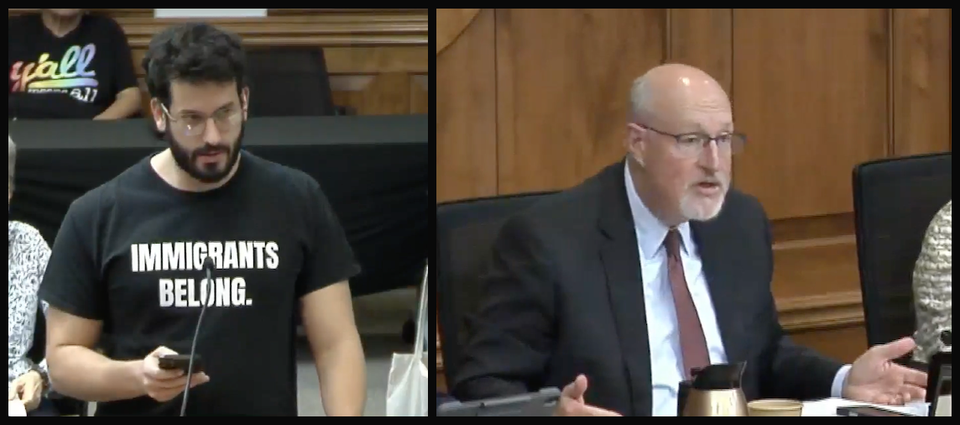
Commissioner Cynthia Chestnut suggested scheduling a discussion about the resolution at a joint city-county meeting next month. She received no response. “Nope?” she questioned. Ward appeared to throw up his hands and mumble something.
(City of Gainesville)
Willits said he doesn’t know when the respective commissions are planning to meet. The commission then moved into public comment.
Diane Bellemy said, “When we turn our heads and deny the violation of human rights in our country, our state, or our city, we the people have become accomplices. Perhaps the residents of Gainesville and the city commissioners themselves are not yet familiar with the suffering that takes place in cruel and unnecessary detention of our immigrant neighbors. I’m certain that when ICE policies are more understood by the good citizens of Gainesville, ICE will be resoundingly rejected… and denied the chance to continue the torture and detention of hardworking members of our community. These are immigrants—hardworking immigrants making a life for their families as did our forefathers.”
Bellemy said she visited ICE detainees in a detention center near Gainesville and their lives were “diminished to numbers,” stating “hopes were dimmed for all who pass there.” She said most were on track for asylum status when they were detained. She said that detainees are sleep deprived and lack adequate access to medical treatment, are given inedible meals, unclean mattresses and poorly washed undergarments. She also noted the lack of staff who speak a language other than English which many detainees understand little of.
Westminster Presbyterian Church Pastor Rebecca Lawson Putman referenced a recent post that Ward made as part of his re-election campaign where he said, “When I ran for Mayor of Gainesville four years ago I promised to deliver for working families across our City. And we HAVE delivered.” (Ward typed “have” in all caps).
“I’m not questioning his assertion,” said Putman. “Ya’ll have certainly done good work. But I am reminding him and the city commission that the immigrants in our city are the working families... If you want to deliver for working families that must include the 20,000 immigrants who call Gainesville home. As part of our resolution, one section was asking for the city to pass a language access plan, which is a tangible way to provide help, welcome and city services… It would deliver on a promise that was first made years ago and formalize a system for communication which is the first step in being able to truly understand one another and build community.”
Putman told the commissioners to act out of love, not fear, and to deliver on their promises.
Shift GNV Lead Pastor Joe Smith said that in years to come, people won’t remember this specific agenda item, but will remember the choices communities made when their neighbors were afraid. “It’s easy to let tomorrow’s ‘what ifs’ drown out today’s opportunity to do what's right,” he said. “This resolution won’t solve every problem facing our immigrant siblings. What it will do is tell them that when fear and uncertainty came to their doorstep, their city didn’t look away. One day this meeting will just be another page in the public record. What won’t be forgotten is whether when your community needed its leaders, those leaders answered the call. I’m choosing to believe that you will.”
Baker Interfaith Friends volunteer Jone Anderson said their group frequently visits ICE detainees held at the Baker County Detention Center, which is about 60 miles north of Gainesville.
Anderson described an arrest that one detainee recounted. She said he was on a long drive across the state with his father, when a Florida Highway Patrol (FHP) trooper started trailing them and pulled up beside them, “to confirm their dark skin.” The trooper pulled the vehicle over and said there appeared to be a dent in the vehicle. “The next thing he knew he was being taken to detention on account of the color of his skin,” Anderson said.
Anderson talked about another detainee who asked if they could help him locate his new truck that was left on the side of the road when he was dragged out and taken into custody. Anderson said abandoned cars are a common story.
Anderson urged the commission to resist ICE before someone is killed in Gainesville.
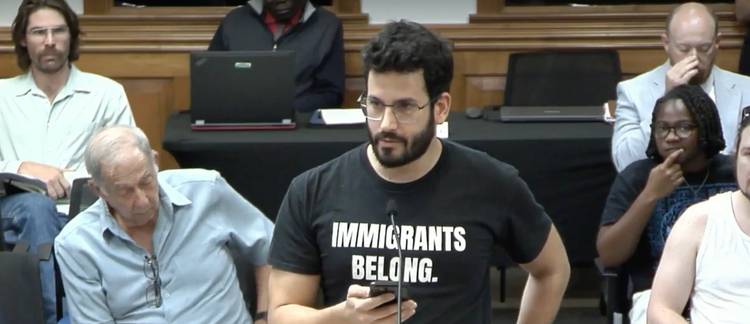
Maia de Needell said, “We have in the past week seen multiple articles covering the GINI petition and resolution. However, none have covered the reason for why we gathered over 2,500 signatures and put together a resolution in the first place. There has been zero mention of the over 160 neighbors who have been arrested, the majority of whom have committed no crime whatsoever, and then [are] picked up from our jail to be taken to a concentration camp. There has been no report on the debilitating fear of an environment that allows this to happen without any comment that leaves so many of those in our city and county afraid to go to work, take their child to school, and simply enjoying and participating in our community. Instead the focus has been on the potential harm passing a resolution may cause rather than the very real harm that has been impacting thousands of our neighbors for over a year and a half.”
Maia de Needell said the funding concerns should be taken seriously but not reacted to without further investigation. He said the commission should move to share the resolution to the city attorney for review and bring it back for the commission to pass. “As it stands now, the language in our resolution would simply denounce the illicit and discriminatory immigration enforcement actions taking place in our state and community,” Maia de Needell said. “Such as the arrest of over 70 Alachua [County] and Gainesville residents for no crime, the documented and reported racial profiling by FHP… the arrests by ICE and FHP of multiple U.S. citizens in Florida alone, just to name a few, not to mention the atrocities occurring in the detention centers themselves. The resolution would oppose the encroachment of [ICE] processing and detention facilities into our region, commit to passing a language access plan at a time when open and clear communication with our immigrant community is more important than ever, and ensure that all our neighbors understand their constitutional rights and that they are welcome in our community.”
Abigail Perette Gentile, who has experience working in homeless communities, said the “GINI proposal was carefully crafted with the law in mind by the same people I have known for years to be deeply concerned about the housing crisis.”
“This is not two separate groups competing for protection or resources,” she said. “I am saddened by the narrative that has been spread that both groups cannot be considered at the same time, pitting marginalized people against one another. The idea that supporting immigrants and those experiencing homelessness are competing goals is a false narrative pushed by those who want to weaken our safety net and our bonds. Allowing these tactics to manipulate us is how we got here in the first place. We should not let fear-driven reactions undermine thoughtful decision making or our moral compass. The proposed resolution does not create a sanctuary city and the executive branch cannot simply cut housing funds for being immigrant friendly. Federal courts have repeatedly blocked attempts to withhold HUD funding for such reasons.”
The commission heard from several more members in the community who spoke in favor of the GINI resolution.
Following public comment, Ward said he believes taking any official action would “invite more FHP and ICE scrutiny on this community.” Ward said that more people would be harmed and that he’s “not going to be a part of that.”
Commissioner Ed Book said they are “not fearful” of “consequences” and “not fearful of having a welcoming community.” Book said he believes Gainesville is a “very welcoming” and “inclusive” community, stating they “do a really good job in the way that we treat people, the way that we’re respectful, and compassionate and show dignity.”
“Not perfect, but very–very good,” Book said. “We certainly have not shared some of the real divisiveness that has been in many other areas of not just Florida but the whole nation, and that shows that we’re doing good things.”
Book said that the city is “not afraid to take a stand” but that sometimes “the stand looks different.”
Book brought up the federal funding concerns and said, “we don’t wanna do collateral damage” and “create collateral consequences.”
Book then cited a letter from a person that he did not name who said the resolution made Gainesville stand out in an “unwelcome way.” Book said he agrees. Book called the resolution "extremely well-intended” but that “often what happens when you think you’re creating language that unifies, it doesn’t unify the entire community. It creates further divisiveness. This is my opinion.” Book said that he doesn’t believe the resolution makes Gainesville a better community. Book, a retired policeman, said, “we have long standing relationships with federal partners and other agencies and it’s not always about the whether something is illegal or legal, it’s about continuing to have those partnerships that we can do more good for more members of the community.”
Willits said one of the reasons he rejected the resolution in its current form is because “there’s an inclusion about our language access policy,” which he called a "completely separate issue.”
Commissioner James Ingle said he’s not worried about risk to a specific commissioner or public speaker but said his worry is that “Florida kind of likes messing with Gainesville.” Ingle said he could see the legislature retaliating in the form of “increased rates on these vulnerable communities and increased pushback.” Ingle added that he doesn’t believe a resolution holds ICE accountable, calling it a “strongly-worded letter” that is ignored in the best case scenario and invokes further harm in the worst case scenario.
Ingle went on to say that he was frequently in the chairs of immigrants-rights activists as a union activist, and said he would support the resolution if they truly believe it’s the best course of action. He said he has a “couple issues” with the way it’s worded and that he’d be happy to sit down with GINI to “talk about a different way to do this.” Ingle said there needs to be “serious soul searching” on if the resolution is the best way to move forward.
Commissioner Bryan Eastman said that “what we see on our news every day is awful” and “the way that this is being done—not that immigration enforcement is new, but the way that it is being done, in which there’s a numbers games where folks that are in a pseudo legal state because we have this broken immigration system where people—it is not clearly black and white—where people are being taken, where people are in fear, where there is—it is bad. It is not good for the folks that are on the wrong side of this. It is not good for the communities that they live within.”
Eastman said he personally agrees with the resolution but that he’s hesitant for the city as an organization to take its position.
Eastman said he thinks there’s a way to “stand up for our immigrant communities while at the same time making sure that we are defending and protecting the very real services and the very real things that people rely on everyday…”
Commissioner Desmon Duncan-Walker said there “is clearly not a single person up here who does not have compassion, love and a desire to stand up.” She said that “sometimes you have to play the long game” and that she “wants to have a conversation” about the language of the resolution. Duncan-Walker said the city should demonstrate the importance of protecting everyone in Gainesville, not signal or perform. Ducan-Walker said it would be irresponsible not to consider the “potential negative impacts." Duncan-Walker said that’s the “reality that we’re living in” and that they’ve “already experienced some of the impacts.”
Without making a formal motion to do so, Eastman signaled for City Attorney Daniel Nee to review the resolution and said he had his own language that he drafted. There was no formal vote from the board regarding Eastman’s statements, with Ward saying, “I mean—without objection,” while throwing his hands to the side.
(City of Gainesville)
“Always, you send it to me, I’ll look at it,” City Attorney Daniel Nee said.