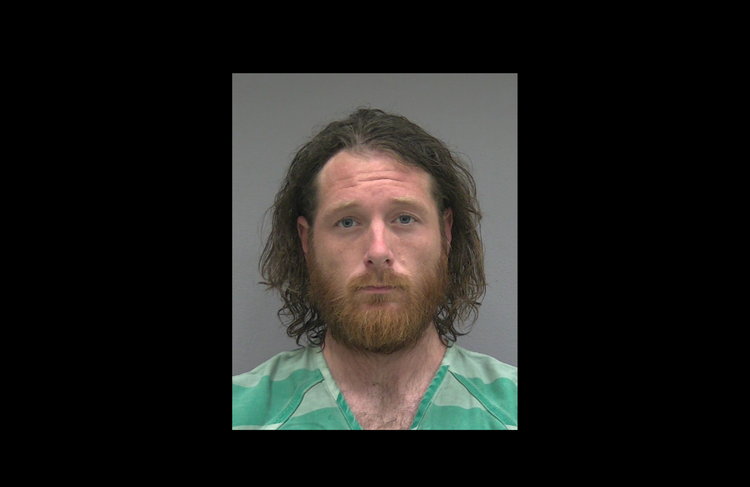
“The Claim Raised is Without Merit” Former School Bus Driver and Springhill Missionary Baptist Church Usher Plays Jailhouse Lawyer After Child Sexual Abuse Convictions
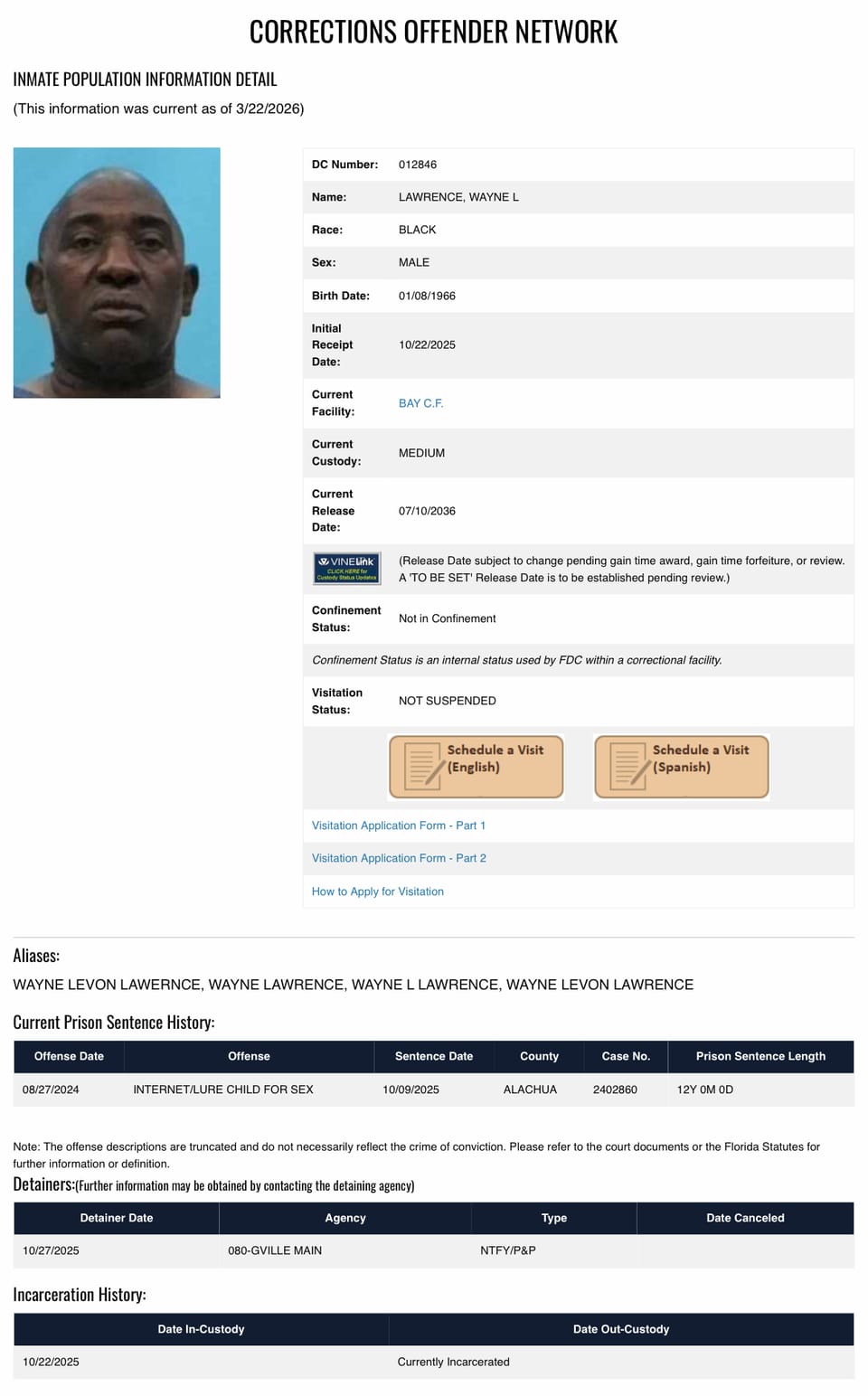
Editor’s Notes: Some quotes have been edited slightly from the court transcripts or court docs for grammar and to remove filler words (e.g., “um,” “like,” “you know”)
A convicted child sexual abuser is representing himself in Florida's Court of Appeals after a judge found there was no merit to his motion for post conviction relief.
Background and Charges
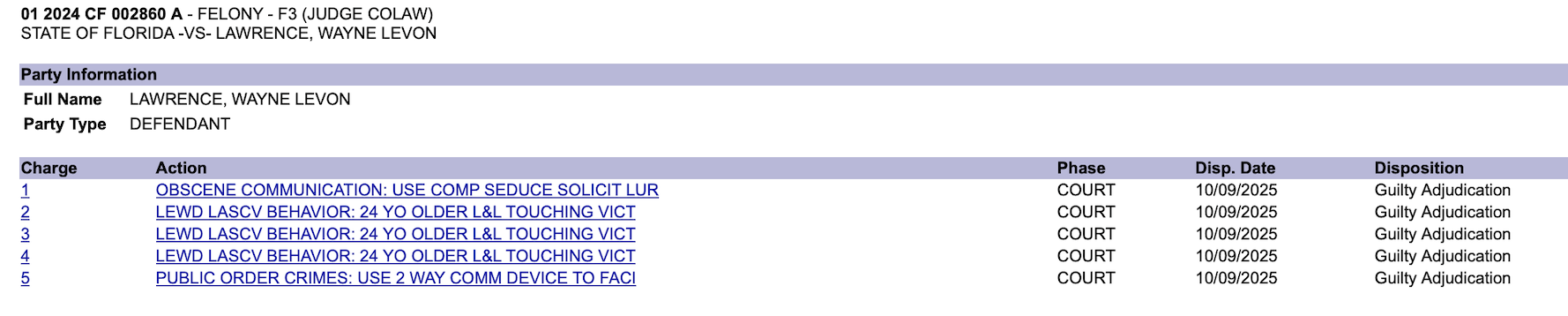
In October 2025, former Alachua County Schools bus driver Wayne Levon Lawrence, 60, who was also an usher at Springhill Missionary Baptist Church, was convicted of child sexual abuse charges and sentenced to 12 years in prison followed by five years of sex offender probation. He was given credit for roughly a year of time served and is currently housed in the Bay Correctional Facility.
Lawrence was initially arrested in August 2024.
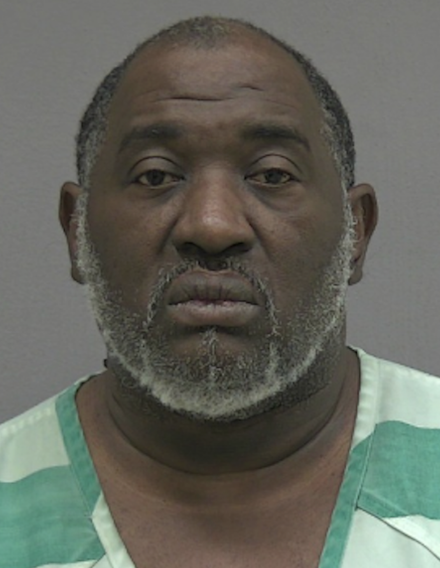
Lawrence committed multiple acts of sexual abuse against the victim, including grooming and molesation.
The Alachua Chronicle reported that Lawrence was an Alachua County school bus driver since 2018 and “drove Route 1028, which serves Hidden Oak Elementary School, Kanapaha Middle School, and Buchholz High School."
An old Gainesville Sun article from Crossing Guard Appreciation Day in 2014 shows Lawrence was a crossing guard at Littlewood Elementary School before becoming a bus driver.
Orietta Rose reported on Twitter that Lawrence has “worked on and off for the [Alachua County School] district since the 80’s.”
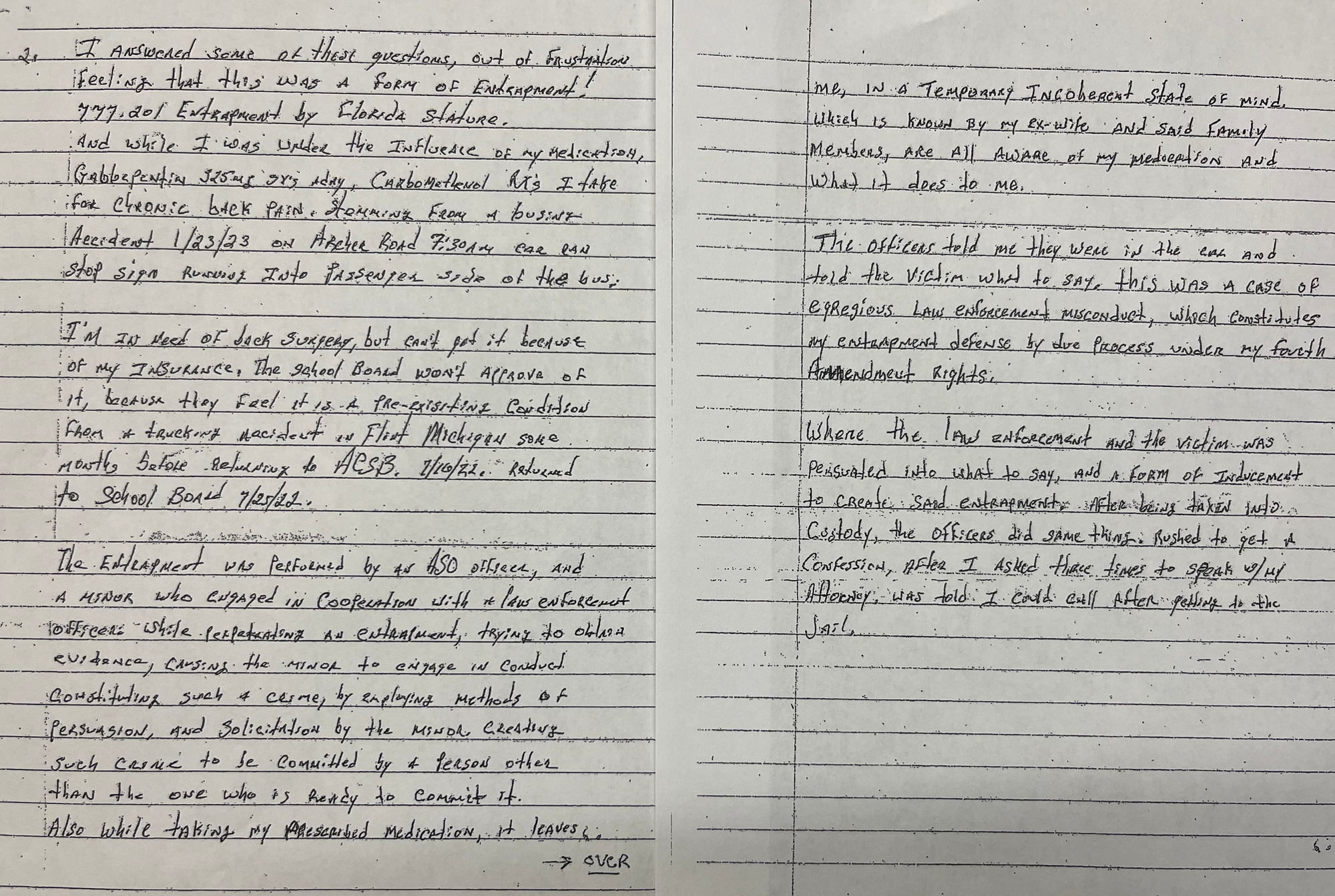
In a letter Lawrence wrote to the judge, he said, "While taking my prescribed medication, it leaves me in a temporary incoherent state of mind, which is known by my ex-wife and said family members are all aware of my medication and what it does to me."
The police report describes Lawrence sexually abusing the victim during an ongoing period of time, displaying thought-out grooming tactics.
According to the police report, after the victim came forward, he and deputies conducted a controlled call on Lawrence. Initially calling on his mother's phone, Lawrence asked the victim to switch to his own phone to be more discreet, reportedly offering to pay for the device. The following day, another controlled call was conducted where the victim used his own phone. During the call, Lawrence engaged in a sexually charged conversation with the victim, asking for a nude photo with instructions to delete it afterwards.
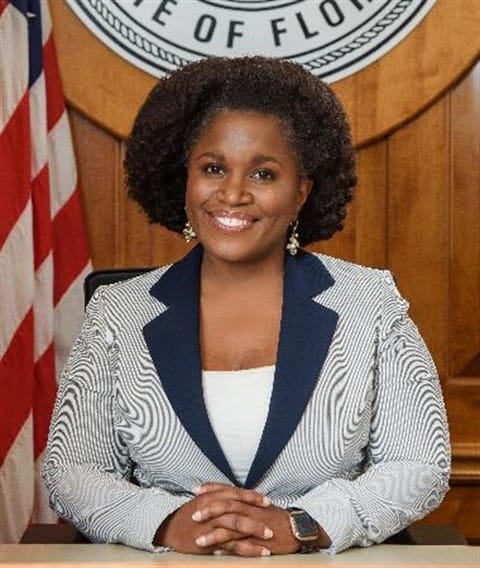
Letter by Gainesville City Commissioner Desmon Duncan-Walker
A few years ago, a columnist with the Wayne Stater wrote, “I know far too many people in my life who have been victims of sexual assault; almost of these people know someone who is still friends with their assailant… Why are we still making excuses for bad people? Sexual assault is not an offense that should be let go, let alone written off as not a big deal.”
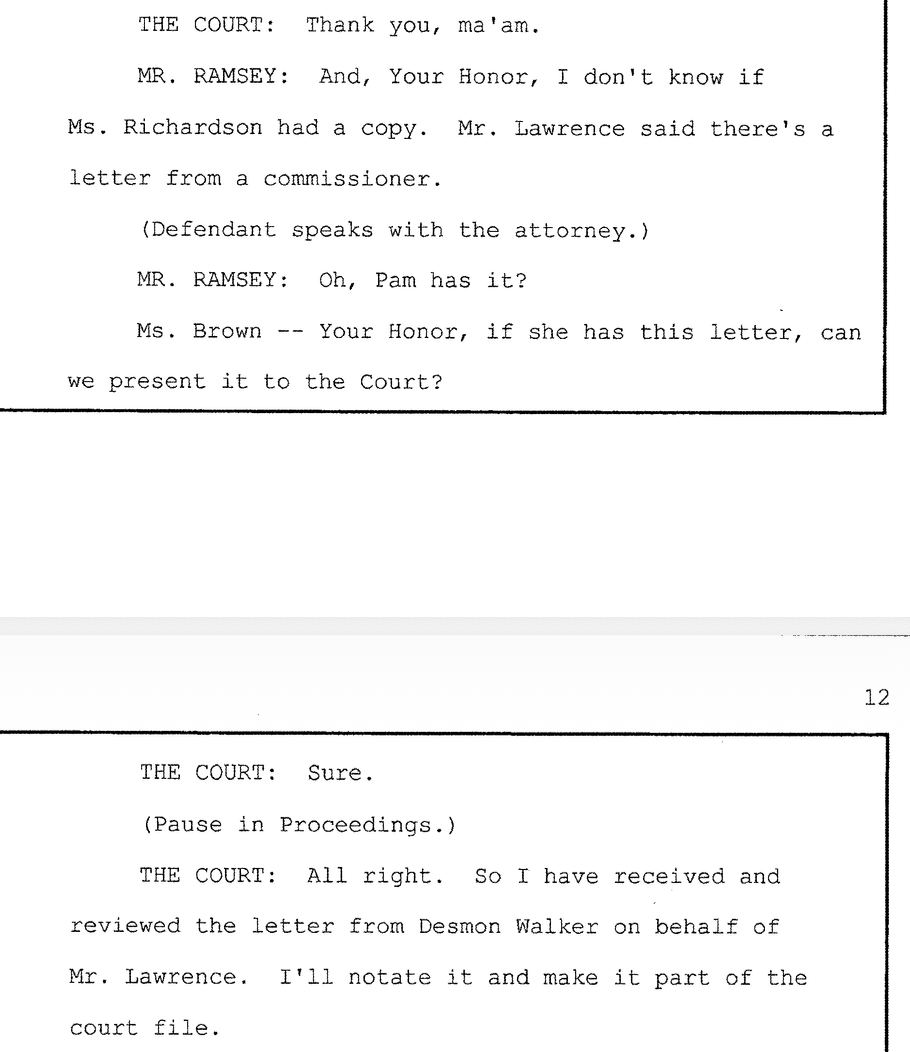
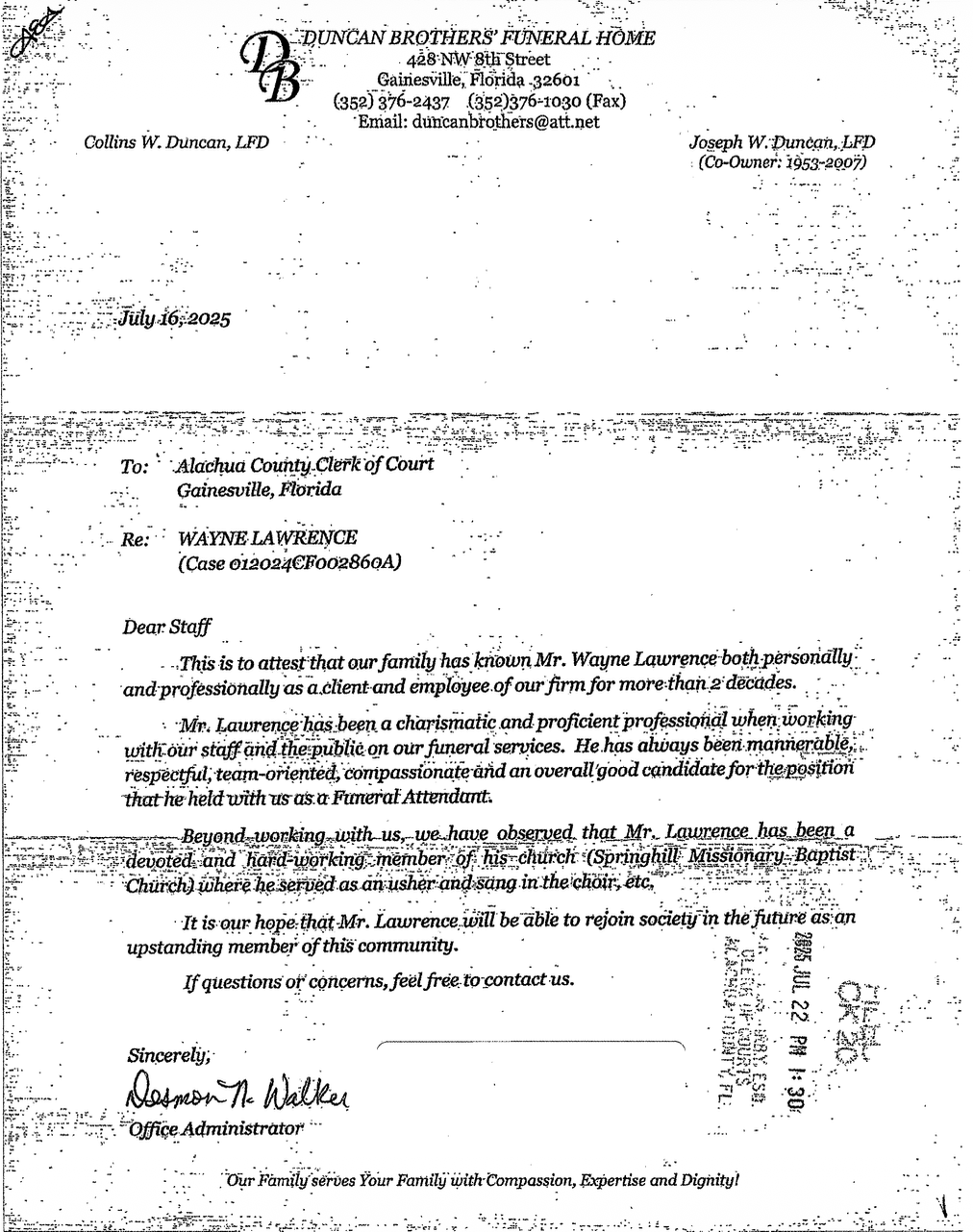
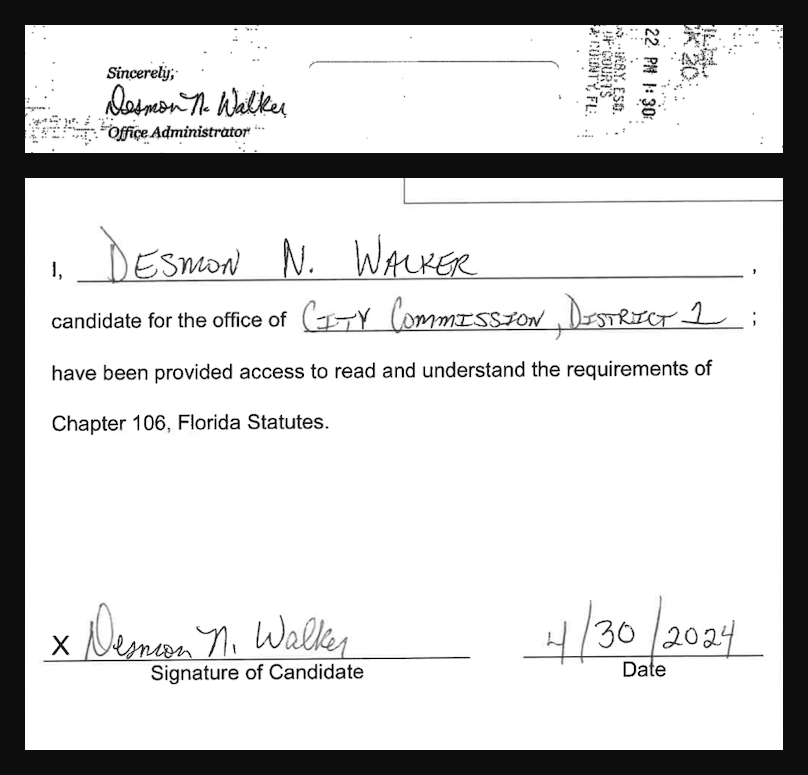
In July 2025, City Commissioner Desmon Duncan-Walker wrote a letter to the clerk’s office while working as the office administrator of Duncan Brothers Funeral Home.
The letter praised Lawrence's work with “staff and the public” as a funeral attendant, calling him a “devoted and hard-working member of his church, Springhill Missionary Baptist Church, where he served as an usher and sang in the choir.”
In the letter, Duncan-Walker appeared to be speaking for Duncan Brothers Funeral Home as a whole. The letter and her commissioner status were acknowledged in court at the sentencing hearing.
GnvInfo emailed Duncan-Walker for comment but received no response.
City of Gainesville Marketing and Communications Director Jennifer Smart said the city has no comment because "this matter involves actions taken as a private citizen."
Plea Change
On September 9, 2025, represented by Criminal Defense Attorney John Ramsey, Lawrence appeared in court for a change-of-plea hearing. Lawrence entered an open no contest plea, meaning he decided to not dispute the charges and gave Judge James Colaw discretion on sentencing.
Colaw asked Lawrence if he had any questions.
Lawrence replied, “The only thing that I was concerned about was if you, in fact, had a chance to view the evidence that we discussed the last time. Because I didn't have the funds to go forward with trial… the other thing was to do the open plea or try to see what your decision would be after viewing the evidence."
Colaw responded that he wanted to know if Lawrence understood he was waiving his right to a trial by entering a plea. "I'm just making sure you understand that," said Colaw. "By entering a plea, the only thing left to do is a sentence, which I would give each side an opportunity to make their arguments to me, tell me what you wanted to tell me, and then I would make a decision. But in terms of the right to trial and all those rights that are associated with the right to trial, you would be waiving and giving those up.”
Lawrence said that he understood. Colaw asked if it’s what he wanted.
“I feel like I have no other choice at this point,” replied Lawrence.
As the hearing continued, Colaw told Lawrence, “I know you say you don't have a choice. Maybe you feel that neither of those are good choices, and I understand that; I can appreciate that. Of the choices you have, do you think this is the one that's in your best interest?”
Lawrence responded, “Technically, no, but again, I have to go with this.”
Colaw asked Lawrence if he was “happy to go with this” and if the plea was what he wanted to do.
“Going to have to,” replied Lawrence, prompting Colaw to accept the plea.
Lawrence, who did not post bond as his case foregoed, was reprimanded back into jail pending a presentence investigation.
Sentencing Hearing
On October 9, 2025, Lawrence appeared for his sentencing hearing.
At the start of the hearing, Assistant State Attorney Brooke King asked Colaw to sentence Lawrence to 15 years in prison followed by ten years of sex offender probation.
The victim and their family were present in court to deliver impact statements. The victim wrote, “This experience has been traumatic in every sense of the word, traumatic for the simple reason for me being a child. Being pursued by a person that I considered to be a family member that was willing to take advantage of my innocence and use my weakness for his gain has been very disheartening, for myself and for my family. From this experience that I have had to endure, it has caused me to be more secluded, sheltered, and to have feelings of anxiety when in places where I see faces that resemble the defendant. Having feelings of anger, resentment, and numbness is not the feelings I wanted to grow up with, but these are the feelings that I have been left with. But these are not the feelings that I shall remain with. I have a great father, support system, and a mother that has helped me tremendously, through God, to show me that how it has begun is not the way it has to end, as this is just another chapter in my book to help someone else overcome trauma through sexual abuse.”
Addressing Lawrence directly, the victim wrote, “I am not what or who you thought I am. What you did to me was wrong… You exploited [your position] to your advantage. May you get the sentence that you deserve and get the time that I need to heal.”
The victim’s mother told Lawrence, “One thing I have come to understand and live by is God allows all things to work together for our good. And what the enemy allowed you to do to break our stance, God is going to use to build us stronger than ever. It will help us to help other youth to find their way of healing from sexual grief… May God's will be done.”
During Ramsey’s time to speak on his client’s behalf, he referred to the sexual abuse as “certainly… not sophisticated by any means,” but called it “certainly an isolated incident.” Based on the police report and the fact that Lawrence had multiple charges, it certainly was not.
Even after the victim’s testimony was delivered in court, individuals still defended Lawrence. Ms. Hamilton (first name unclear) claimed he was a “pillar of the community,” calling him a “churchgoing person” who “sings in the choir.” She asked Colaw for "leniency" and referred to Lawrence as an “outstanding man.”
Pamela Brown, a longtime friend and former colleague of Lawrence, said, “We work in the community with children and the neighborhood. Then he goes to work for the school board. I go to work for the school board. All I ever knew is him to have loved the children and guided them in the right way. So I don't know what happened, but I'm just asking for leniency… He's been around my children, my grands, or whatever… My students, we get together and shop for our students and do community things. So that's the person that I know. And if anything other, I don't know about.”
Lawrence’s sister, Josie Richardson, said, "I don't know what happened in that house, that night, or whatever day it was... I love my brother. I love the victim's family... I'm hoping for leniency for my brother because I just cannot believe that this happened. I can't say it did and I can't say it didn't. I don't believe it; I really don't. I want Wayne to know that whatever your decision is today, it's God's will."
Lawrence claimed he “wanted to give apologies to both sides of the family” shortly before mentioning a prior evidence suppression motion and claiming “this whole thing was entrapment.”
King said the sexual abuse was not isolated and “happened over the period of approximately a year…” “he physically touched the victim multiple times but also in the phone call asked the victim to essentially create [child sexual abuse material] and send it to him.”
“This certainly wasn't an isolated incident,” King said, “certainly wasn't unsophisticated because he admits that, while living in the home, he would essentially make it so that the victim was alone in a certain room at the house in order to be able to grope him or touch him.”
King said that Lawrence had taken the victim and their family into his home when they were experiencing homelessness, then abusing his position to commit the sexual abuse.
Colaw said, “These are very significant, horrendous offenses, and I'm just not persuaded that it would be appropriate, if there even has been any downward departure grounds established, I'm not persuaded it would be appropriate for me to downward depart from what the sentencing guidelines and the law says should be the framework of your sentence… As horrific as the choices that you made that have led you here, you also have made some choices that merit at least some consideration from the Court. You've come to the court. You've taken responsibility. And by taking responsibility, you have provided to your victim the ability to not have to go through the trial process.”
King said the victim had to give a deposition.
Regarding the sex offender probation, Colaw ordered, “Because of the nature of the offense, it may be that you'll be required to be on an electronic monitor for the entire period of your probation. But that will be squarely in the discretion of probation. If the law requires it or if, within their discretion, the law allows them to consider that and impose it, then I defer to probation as to whether you'll be on a monitor for that entire time, but you very well may be because of the nature of the charge. Within 45 days of your release from prison, you do have to go get a psychosexual evaluation and then follow through and successfully complete, on your first try, an approved sex offender treatment program.”
Colaw also ordered Lawrence to have no contact with the victim and their parents, and no unsupervised contact with any minor.
Attempt for Post Conviction Relief
On January 6, 2026, representing himself inside prison walls, Lawrence filed a motion for post conviction relief.
On January 15, 2026, Colaw denied the motion.
Colaw ordered, “[Lawrence] alleges that trial counsel was ineffective for ‘failing to competently move for and pursue dismissal of the charges prior to entry of the plea.’ The record reflects that counsel filed a motion to dismiss based on entrapment, to which the State filed a traverse… [Lawrence] was aware that he was giving up the right to have the court consider the motion by entering his plea. For this reason, [Lawrence] fails to show either error by counsel or prejudice. Accordingly, the claim raised is without merit.”
Lawrence claimed that Colaw errored in accepting his plea “without an extensive inquiry into the grounds presented for dismissal of the charges based on entrapment.”
“The claim raised is procedurally barred,” Colaw ordered.
Colaw continued, “[Lawrence] alleges that trial counsel was ineffective for ‘failing to suppress the statements made by Defendant to law enforcement, which were inadmissible, as he had not been properly Mirandarized…’ [Lawrence] was aware that he was giving up the right to have the court consider a motion to suppress challenging his confession to the charged offenses by entering his plea… For this reason, [Lawrence] fails to show either error by counsel or prejudice. Accordingly, the claim raised is without merit.”
Colaw ordered, “[Lawrence] alleges that trial counsel was ineffective for ‘failing to research a defense or raise mitigating factors for sentencing.’ According to [Lawrence], he had a viable defense of involuntary intoxication to the charged offenses… [Lawrence] was aware that he was giving up the right to have counsel investigate and pursue defenses by entering his plea… [Lawrence] fails to show either error by counsel or prejudice. Accordingly, the claim raised is without merit.”
Colaw noted that “there is not a reasonable probability that [Lawrence] would have foregone the plea and proceeded to trial based on a defense of involuntary intoxication. Had [Lawrence] presented that defense, he would have been required to have admitted that he committed the underlying acts which were charged; and [under case law] had ‘the burden to prove that the involuntary intoxication rendered him unable to understand what he was doing and to understand the consequences of his actions, or if he did understand, that he was unable to know that his actions were wrong…’ Here, had the State presented evidence consistent with the allegations contained in the arrest report, the State would have been able to show that Defendant was aware of what he was doing and that it was wrong.”
On January 28, 2026, Lawrence submitted a notice of appeal to Colaw’s decision. The appeal remains pending.