Traffic Stop Leads to Sheriff’s Office Sergeant Subduing Passenger with Taser
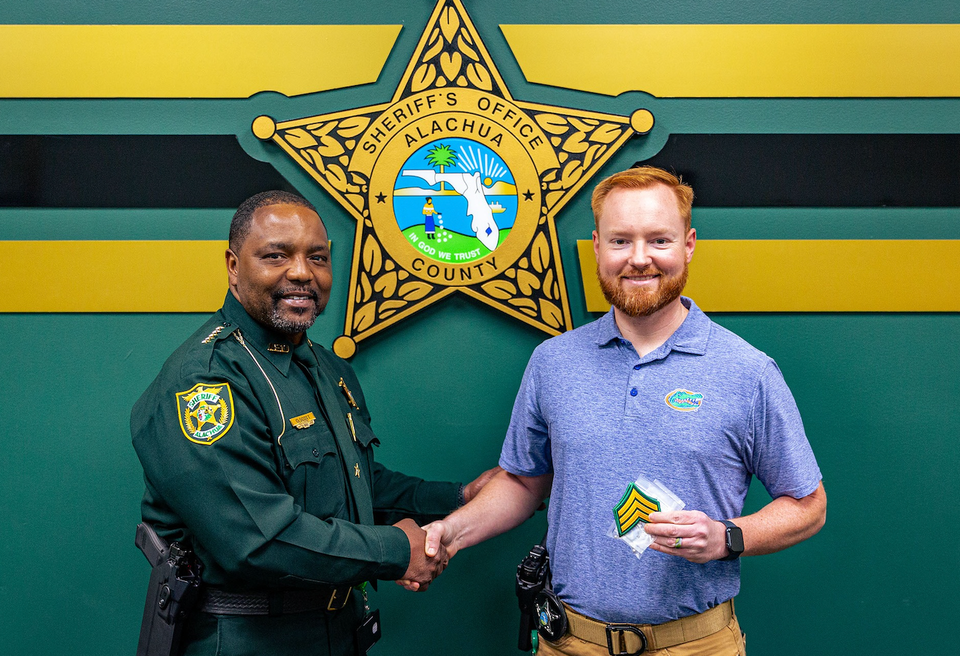
On January 28, around 3:15 p.m., Alachua County Sheriff’s Office Sergeant Christopher Dasher conducted a traffic stop in Micanopy on a vehicle bearing a Missouri license plate for tailgating a semi-truck.
Dasher approached the vehicle on the passenger side and made contact with the driver and Daniel Shoemaker who was in the passenger seat.
According to Dasher, Shoemaker was "immediately paranoid” and asked why a backup deputy was present.
Dasher learned the vehicle was a rental but its not specifically stated in his report whether the rental agreement was in the name of the driver or Shoemaker. The driver's identity is not stated in the report.
After Dasher requested the rental agreement, Shoemaker reportedly rummaged through the glove box, at one point handing him an owner's manual that was sealed in plastic.
Dasher had the driver step out of the vehicle to issue her a traffic infraction. Dasher reported that she was talking fast, missing teeth and lost weight compared to her driver’s license photo issued around four or five months ago. Dasher reported that Shoemaker had “scabbed over sores” and that he believed Shoemaker and the driver exhibited “factors [that] can be consistent with stimulant drug use such as methamphetamine and cocaine.”
Dasher asked the driver if she had guns, drugs or large amounts of money in the vehicle which she denied. Dasher asked to search the vehicle and she declined.
Dasher reported that his backup deputy asked Shoemaker to exit the vehicle so their K-9 could conduct an exterior sniff. Shoemaker did not want to get out of the vehicle, leading to an argument that Dasher stepped between.
Dasher’s report continues:
“The defendant continued to argue, asking for a supervisor. I explained I was a supervisor, and explained that the Florida Supreme Court allowed law enforcement officers to demand passengers exit the vehicle for the purposes of a canine sniff, per State v Benjamin (2024).
Despite numerous warnings that he would be arrested for resisting without violence, the defendant continued to refuse to follow lawful verbal commands. I drew my issued TASER, powered it on, and pointed at the defendant, warning him if he did not exit, I would discharge my TASER. He refused and turned around to reach back in the vehicle. At that point I discharged my first TASER cartridge which achieved minimal probe spread due to the close distance, striking him on the outside of the upper right arm. The defendant attempted to pull the probes out and [Deputy Sheriff] Litzkow pulled him out of the vehicle by his legs.
At this point, the driver ran over to our interaction and Litzkow had to disengage to control her. The defendant pushed himself away, continuing to attempt to pull out the probes. He was briefly on his stomach, and I took the opportunity to discharge my second TASER cartridge at contact distance in the small of his back, hoping for full neuromuscular incapacitation (NMI). This was also ineffective and the defendant continued fighting the TASER, rolling onto his back. At this time, I was preparing to drop onto the defendant to control him, but I noticed my TASER wires across his body while my TASER was still arcing. This action would have brought me into contact with the wires and prevented my control of the defendant. I attempted once again to place my TASER against the defendant's chest for a contact discharge, but the defendant kicked at me, attempted to grab my TASER with one hand, and pulled his other hand back as if to strike me. With no other less-lethal options available, and no other preferred target areas available due to our positioning, I struck the defendant on the left side of his head, using my TASER as an improvised impact weapon.
This immediately subdued the defendant, causing a laceration to his head. He complied with subsequent verbal commands and was placed under arrest in handcuffs by Litzkow. I immediately requested medical assistance for the defendant, and while waiting for the defendant, EMS, Litzkow applied hemostatic gauze and direct pressure to his head to help stop the bleeding. Once the defendant was transported to a medical facility, GPD Cpl. J. Salafrio deployed his narcotics detection canine partner Duke for an exterior sniff of the Mazda. Cpl. Salafrio informed the driver that Duke alerted to the odor of narcotics in the vehicle."
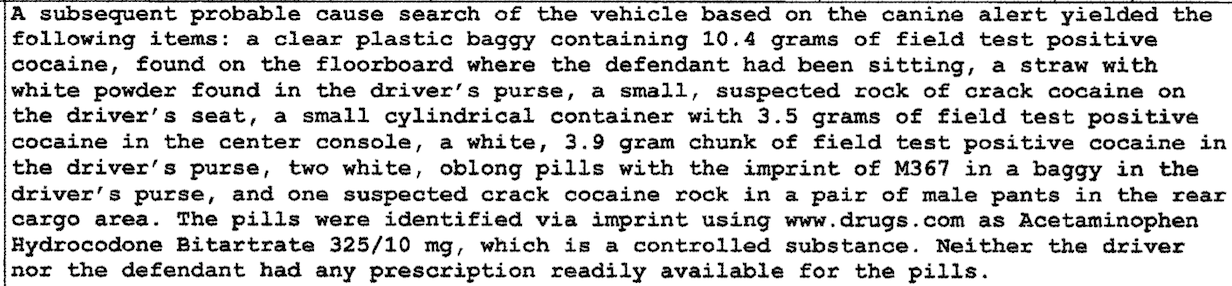
Officers reportedly found crack cocaine in the vehicle, among other substances, some of which was reportedly on the floor near where Shoemaker was sitting.
Shoemaker was charged with resisting an officer without violence and cocaine possession.
Judge Meshon Rawls set the bond at $30,000 and Shoemaker was released from jail after posting it.