Civil Rights Trailblazer, First Black Person to get Public Library Card in Gainesville, Passes Away at 93
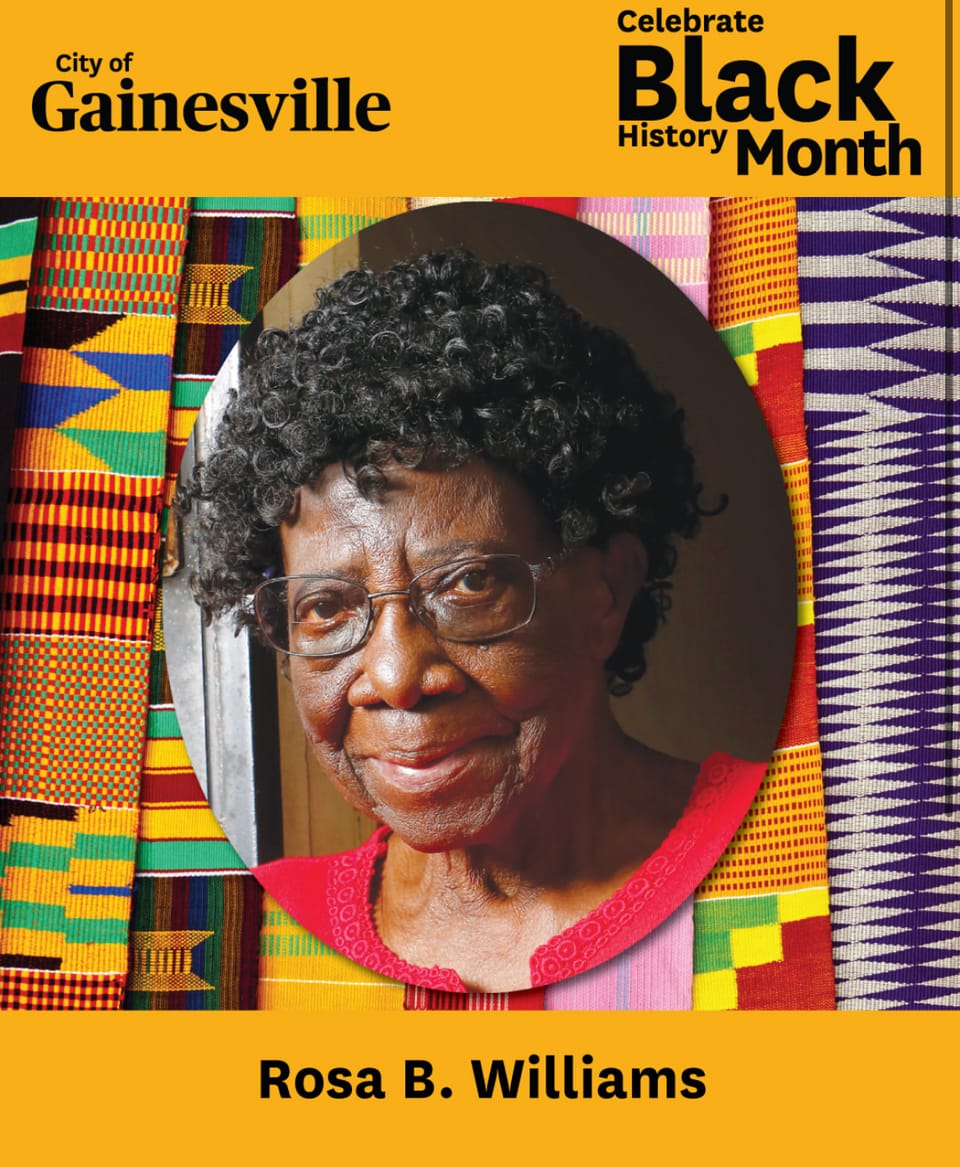
A longtime Black civil rights activist, Rosa B. Williams, passed away at 93 on Thursday.
Williams was born in 1933 to Katherine Baker and Lucius Williams.
According to a 2013 Gainesville Sun article, Williams lived in Alachua County in the 50s when racial segregation was pervasive. Back then, Black Gainesville residents had to go to what was referred to as the “negro library,” where the bookshelves were filled with books that had missing pages or coloring in the margins.
“I refused to go down there,” Williams told the Sun. “I wanted to go downtown like everybody else.”
The Sun indicated that Williams received her Gainesville library card, the first Black resident to do so, in the 1950s. However, somewhere between then and now this got misconstrued into her not obtaining the card until the early 70s, as reported by the City of Gainesville upon Williams' death.
GnvInfo asked the City of Gainesville Public Information Office about the discrepancy, prompting Communications Director Jennifer Smart to check the transcripts from Williams' interviews dating back to 1983 and 1992 with the Samuel Proctor Oral History Program at the University of Florida (UF). The transcripts showed she did in-fact obtain her library card in the 1950s.
The Sun reported that Williams obtained her library card in the late 1950s, while her 1992 interview indicates it may have been earlier in the decade.
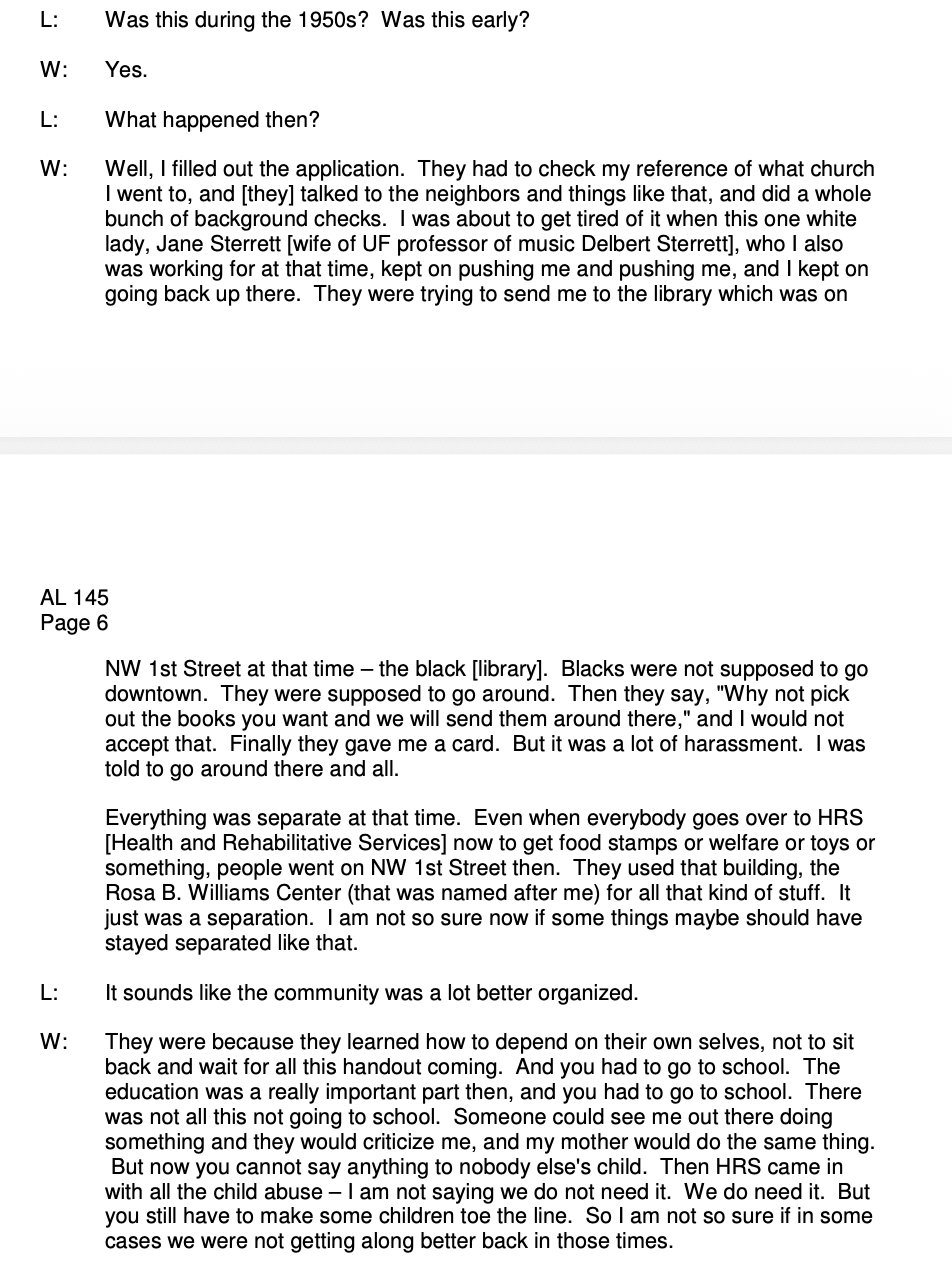
Recounting local racial segregation in her 90s interview, Williams said, "Here in Gainesville, registering to vote, being able to go into a restaurant to eat, and being able to go into some motel to sleep was not as hard, say, as Ocala or Palatka, as some of those places were. The thing that we had a hard time with was the most important part: for our kids to be able to participate equally in the Boys' Club and things like that, or for people to get a good job. You would go to the Florida State Employment Office, and if you were black the only thing they would refer you to, as we would say, was cleaning somebody's bathroom. They would not look at you for anything else. They would not even look during those times for a good cook job in a restaurant."
A pioneer for Black rights, Williams held criticism for the Feminist Movement, saying, "Those white ladies were feminists because they chose to be. If they choose to sit home and not work and get bored, that was them, but I did not have any other choice. I had to get out there and work. So some of their complaints that they had just did not interest me any at all, because I figured that they had those complaints by choice, that they wanted to have them... Yes. I am not against women getting equal pay, and I am not against women being treated as equal as a man. But even now if I had a choice of going to a feminist meeting on something about women's rights and going over here and working with a group helping somebody, I think I would choose that group. I am not saying that women do not have a legitimate reason to have equal rights. But sometimes there is always going to be some other group that is centered around its own self and what [has] happened to them. They are not concerned about the whole issue, just something about what has happened to them, and they make an issue out of that. I do not want to do that. I have more important things to do. If I am going to fight for somebody, it is going to be for something that I can see what is right."
Williams recalled how racism affected local law enforcement, saying, "There were lots of white females and white males down all over the black community. Of course, the police department [of] whites did not like that... When they would see a white female talking to a black male, then that is when the hell came in. The policemen got into it, the battle, trying to run – They first started picking on the white females, trying to run them out of the black community. Then one of the girls – I never got the full explanation of this – had some kind of really rich parents somewhere up in New York, and the police picked her up from 5th Avenue and 6th Street – they were going door to door for something – and took her back to the University of Florida campus and dropped her off. She called her parents, and her parents came down here, and they made a big old issue about it that they were picking only on the white females, not the white males. So then they started looking at the white males. And here we go again; I cannot remember just what happened to make them turn around."
Williams continued, "I do not think any of the students ever got hit around here, but I know of one incident where a black [was beat up]. We were picketing – not the Walker house, but I forgot this place's name. It was down on University; it is torn down now. We told everybody not to ever go up there by themselves but always to go in a group. But this one black guy, I guess, made up in his mind to go. He went up there. They told him to come on in, to sit there by himself and have some coffee or something. When he got in they put out the lights, and they beat him up pretty badly. That is about the only incident we had around here. I cannot remember one with the police. I am not saying that [didn't] happen, but we just did not know about it."
Williams told the Sun that her mother kicked her out when she was 19 but said it had a positive effect on her, saying it hurt her mom more than it hurt her. She said she had really good parents.
Williams told UF Historian Joel Buchanan in 1983, "My mother was having a real hard time raising us and we were staying in the house with one of my mother's sisters and her children. My oldest auntie came down here and we were having a really hard time until I met my daddy, Roosevelt Hayes. He's not my daddy in blood, but he is my real daddy... We were having a really hard time until we met him and then things changed a lot."
Williams attended schooling in Gainesville and Williston, and worked her first job running the elevator at the now-shut down Alachua General Hospital. She met Jane and Deborah Stearic while employed as their housekeeper, and they encouraged her to join them at meetings to help the Black community, leading to her meeting Jean Chalmers, former Gainesville mayor.
The Sun reported that Williams “quickly became the voice of Gainesville’s poorer neighborhoods, working with the Community Action Agency to provide cooking classes, tutoring and other programs for Gainesville’s youth and senior citizens… When Williams told the community how to vote, Chalmers said, they would listen.”
For many years, local political candidates sat down with Williams when throwing their hat into an election, with her support reportedly being imperative to their success.
Williams told Buchanan about her picketing techniques and how racism seeped into Gainesville politics, saying, "We would send a black to apply for a job and they told us that job was taken or there wasn't a job. Then one of the whites would go in and they would get the job. We would start picketing that place to see what we could do about it. We did not bother with anybody who was out there for foolishness or to fight because we were serious. If the University of Florida professors and their wives had not come out to help us, I don't know what we would have done. We were on the picket lines together... Byron Winn, at that time ran for city commission, and he decided to integrate the Primrose. When he did that, the white businessmen up town told him they would break his back for that, which they really did. You know, they ruined him here in this town... They never forgave him for that integration. He won a seat with the black votes the night of the city election. He was up there with us because whites were so mad when the University of Florida helped us. Some blacks don't understand that because black people have good jobs these days and nice homes with cars and all that—they think everything is fine. In a way, it's worse now than it was before. During that time, we were looking for things and we were more aware of things. People tend to sit down and forget about the other person but during that time everybody was out there fighting for everybody."
Williams said that she was never formally arrested but was taken to jail with many others during a rally after Dr. Martin Luther King Jr. was killed. However, the police let many go, including Williams, after not having enough room in jail. Williams said they wouldn't leave until the others were released.
Buchanan asked Williams how Black people were treated in the 40s and 50s.
Williams replied, "As long as you said, 'Yes Ma'am' and 'No Ma'am,' to certain whites you were okay. But if you questioned anything, that's when the hell started to fly. You were one of them, 'uppity [n-words]."
"You were considered one of the uppity [n-words]," Buchanan asked without censor.
Williams said, "At that time, yes. Here's a way that you can always get around that. Just go ahead and ignore it... We had the right community from the University of Florida behind us... Everything we have gained here we owe to the faculty, the staff and their wives... I've seen a change in the way things were around here. Integration opened up the water fountains, restaurants, motels and the movies. Things have gotten a little bit worse than it was back in those days because you knew where the people stood. Nowadays you don't. They write about the poor and this is so beautiful. Behind the scenes, it's worse."
Williams told Buchanan that when she joined the Gainesville Women for Equal Rights, some of the Black women members were cold towards her, only changing their tune when "they saw that I had the respect of the whites from that group," as Williams put it.
Buchanan indicated that Williams received pushback for supporting a certain sheriff and she defended her position, saying, "During the civil rights movement, Lou Hendry was one of the deputy sheriffs who arrested people that Sunday at the courthouse. After Lou got to be sheriff, he made a complete turnabout. Lou Hendry has always been fair to me since that time and to blacks. I know warrants have been issued for people and Lou would have his men call me if he thought I knew them and tell them to turn themself in. Anybody who works with me like that is good enough for me to support."
When asked if she would run for office herself, Williams replied, "No. Not even a dog catcher... My patience is too short and I don't like the campaigning. During football season my opponent would be campaigning and I would be watching TV."
Buchanan asked Williams to share advise for young Black people, and she replied, "Get up off their duff, stay off street corners and off of dope. Get an education in their head and stop thinking about parties, dancing and shooting pool. Do something for themselves, even if it is nothing more than [going] to the library and [reading]. Learn something about their community... Not to get hung up on dope and have all these babies. Young girls and young guys need to keep their lives clean because prisons are full of young black people. Stay out of trouble. Trouble is easy to get into."
Williams described her neighborhood near 5th Ave. as safe but said if one went looking for trouble they would find it. "Those riots down on Fifth Avenue. Those reporters that got hurt knew they should not have gone down there," Williams said. "I went down there myself but I was on shaky ground. I went because I had a duty to go. Any white had no business going down there in the first place."
"You're not going to see any changes until the people in Gainesville realize that not everything is rosey and peachy-peachy," said Williams.
Williams was the first vice president for Gainesville’s chapter of the National Association for the Advancement of Colored People and served as chair on the Black-on-Black Crime Task Force. She served on the Board of Directors at Planned Parenthood and the Hippodrome Theater. She also chaired the Concerned Citizens for Juvenile Justice, and held many more prominent positions in many other community organizations.
Public Announcement from City of Gainesville
“We are saddened to share the passing of Rosa B. Williams, a fearless community leader and advocate for justice. Born in 1933, Miss Rosa dedicated her life to equality and opportunity for all and leaves behind a legacy etched in the heart of Gainesville and beyond.
Miss Rosa’s activism began during the Civil Rights Movement, participating in sit-ins and voter registration drives. She exposed discriminatory hiring practices by applying for jobs alongside white counterparts. In the [1950s], she became the first Black person in Gainesville to obtain a public library card. As she recounted later, the process took weeks and required her to navigate a maze of intrusive requirements, including detailed personal information, church affiliations, and even neighbor references. She persisted, as she always did, not only for herself, but for those who would follow.
This determination to build a community that is just and fair extended to Miss Rosa’s work protecting and uplifting the next generation. In 1987, she co-founded the Reichert House Youth Academy alongside Richard Baxter and former Gainesville Police Chief Tony Jones, creating a safe haven and pathway forward for young men facing systemic barriers. She also served as a vital member of the Black-on-Black Crime Task Force, continuously working to address the root causes of violence and inequality in the community she loved.
Throughout her extraordinary life, Rosa Williams was honored with over 40 awards for her unwavering commitment to social justice and community service. But perhaps the most enduring tribute is the Rosa B. Williams Center, located at 524 NW First St. Named in her honor, the center stands as a vibrant hub of culture and empowerment, with spaces for art, dance and learning. It occupies the historic grounds of the Union Academy, one of the first African American schools in the area—a fitting continuation of Miss Rosa’s lifelong dedication to education, legacy and community.
Rosa B. Williams will be remembered not only for the barriers she broke and the battles she fought, but for the countless lives she touched along the way. May she rest in power.”
Disclaimer: The transcripts include the use of the n-word without censor.