High Springs Officials Discuss Fire Cuts; Years Old Sewer Invoice Leads to Heated Discussion
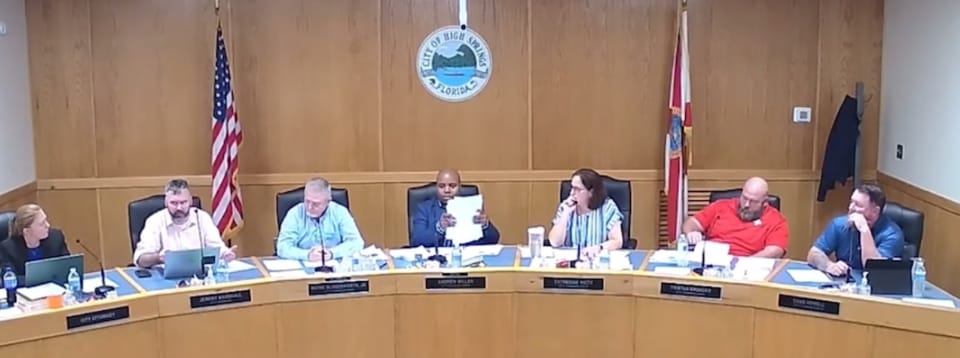
The High Springs City Commission met for the first time this year on Thursday.
Police and Fire Update
The commission heard an update on the budget for their police and fire departments.
City Manager Jeremy Marshall said, “We're going to have one time savings from the police. We're going to have recurring savings from the fire. We had vacancies over at the police. We decided to hold them off for 90 days. Chief said we can hold off for 90 days. We held off 90 days for each vacancy that was out… That saved us $47,759… and Chief Sheppard is looking at some other cost-saving measures. Fire has taken the brunt of this. We reduced the staffing from five to four per shift.”
Marshall said they were able to lose two firefighters through “natural attrition,” which is when employees leave for reasons such as retirement or relocation. He said they were able to lose another firefighter through a “voluntary layoff,” which is when an employer encourages an employee to resign, generally in exchange for a severance package, which Marshall indicated includes insurance through the end of the month and a waiver of paramedic school repayment.
Marshall said they've made changes to paid time off (PTO), which include getting rid of Kelly days, which is a designated day off for a firefighter, designed for a city to reduce overtime (OT) hours. The change begins February 1.
Marshall said, "The way they do the leave–the PTO over there is when they take leave they get charged so many hours out of the day and then the rest of the day they accrue at a different rate; they spend it at a different rate, different from the rest of the city. So we are looking at the accrual... because the fire department works 24 hours so they should accrue throughout the full 24-hour shift. So with that, when they take 24 hours, we're going to charge them a full 24 hours. So the leave just it's on par for the rest of the city. So, the fire department, without the leave because that hasn't taken effect yet, is saving a recurring cost of $171,350." He added that the "PTO costs which has not taken effect would add another $44,500 in savings," and said, "Don't hold my feet to the fire on this number because we don't know how the reduction in staff will effect overtime yet.
Marshall said High Springs Fire Chief Joseph Peters “walked into a bad situation” and that he “made some tough decisions.” Marshall said Peters “rightfully” “pushed back on this a little bit” and was “trying to do what’s best for his staff.”
Marshall said the staffing cuts would go into effect February 2, but Peters chimed in that “it’s basically in effect right now.” Marshall added that the firefighter who was voluntarily laid off is “burning up a bunch of his leave.”
Regarding the fire department resignations, Finance Director Diane Wilson said, “We’re assuming nine months for two of those three positions and seven months for one of them. None of the savings have been experienced on any of these yet. Even with the police department, those are kind of going from December to March.”
Chief J. Antoine Sheppard corrected Wilson, saying one of their vacancies is in full effect and another is processing.
Wilson said, “None of these numbers are based on actuals whatsoever… I mean, a little bit of police is, but they’re definitely not actual numbers, just to manage expectations.”
Mayor Andrew Miller said, “We always say we don’t have actuals,” and suggested they estimate the average overtime they’d do so they’re not just throwing out numbers.
Marshall said they “can’t really estimate the overtime costs” because it happens as calls come in or employees get sick or go on vacation.
Peters said that with only four firefighters on a shift, they have to have someone come in if someone else calls out, referencing their contract with Alachua County, where they must have a minimum of four employees for the county to pay them. Peters said they could “look at modifications,” but that he doesn’t want to because having three would prevent them from responding to two calls at once. He said there are ten part-time shifts budgeted per month.
Peters said, “When it comes to officers, I've only got three officers. If an officer takes off, another officer has to work. If that other officer can't work, guess who's going to be working? Me, because I am committed to making sure that our overtime budget doesn't go crazy. However, I can only work so many shifts, and I have no problem doing that because I want to make sure our residents are protected. But in the long run, I don't know how sustainable that will be, having four... It kind of jeopardizes safety for both our residents and our staffing."
Peters went on to say that he believes “we’re at the bottom,” but “much like the phoenix rises from the ashes, as things get better in the city and we start to be more financially secure, my goal is to bring us back up to where we need to be. I don't know if that's the answer you wanted, but that's the answer I have.”
Grunder asked when they will talk about how to move forward next year with the fire assessment, which is the annual billing for fire services. “I know we're gonna have to raise it again,” he said.
“I haven’t even thought about it,” replied Marshall.
Grunder said they should have the conversation soon because he foresees “quite the jump,” saying he wants residents to have information early on.
Weitz asked for an update on the current fiscal year, which began October 1, 2025, and Peters said they got $98,000 from Alachua County in the first quarter. He said they got $72,000 in the last quarter of the previous fiscal year.
Commission Comments and Concerns
Although it wasn't on the agenda, the missed purchase order of roughly $900,000 from Evoqua Water Technologies (EWT) for a sewer project took up a large part of the meeting. The bill didn't come into discussion until a meeting in November 2025 despite being two years and nine months old at the time.
Grunder asked if there has been any steps to figure out how they missed the purchase order.
Marshall attributed the issue to their system, Springbrook, not tracking revenue and having multiple items on the same purchase order.
Marshall offers an explanation for the bill (High Springs)
Marshall described Springbrook as "old," and Grunder asked how long they’ve used it.
Wilson said she doesn’t remember and said they can’t use it for payroll because they don’t have the cloud version.
Grunder asked what it would cost to get a different system, and Marshall said he and Wilson are getting into contact with Eric May, a former High Springs commissioner, and that they’ll look at vendor options. Marshall said they can’t afford a more modern system due to the high cost.
Weitz asked if their auditors were able to explain why they didn’t find the bill. Wilson said it wouldn’t have been within their auditors’ scope.
Weitz expressed concern that the project could go over budget due to cost-related measures, including workers who’ve been dealing with a lot of sinkholes. Marshall said city staff has made sure there aren't any outstanding purchase orders and that they're "pretty confident with that," but clarified the project is not complete and they haven’t received the final invoices.
Wilson said, “I made a list of every single invoice on the project, when it was paid, what it was for… I've sent it to them to look at to make sure there's nothing. We paid $1.98 million, I believe, out of pocket upfront in the project. There's approximately $450,000 remaining on the reimbursements. We still have another—I don't know—probably [$250,000] we think to be built on that. We also have liquidated damages and excess hauling expenses that we had because of delays in the project. So that's another $230,000 that's sitting kind of in a holding pattern.”
Weitz told Wilson she did not understand what she was talking about in terms of liquidated damages.
Wilson said, “We have approximately $230,000 being held back on their contract right now while that’s being evaluated.”
Weitz said the city had “no contingency” built into the budget and asked, “What if when we get all the final invoices we find that we’re [$400,000] or $500,000 over budget? Is the state going to cover that? Is the grant money gonna cover that?”
Wilson said Weitz’s question was a legal question to be asked with the contractor. She went on to say. “We asked Jarrod [Petrohovich, project engineer] quite a few times about whether we're going over budget, and he said no.”
At the November meeting, the former mayor of High Springs, Sue Weller, broke down a timeline of the sewer project, and Grunder asked, “Is there a reason she has more information about this than I do?”
Weitz brought up the prior comment at the current meeting, saying she saw it referenced that Grunder said Weller had more information than “we” did, interpreting his comment as referring to the entire commission. Weitz said she met with Marshall before the meeting and that she assumed Grunder attended with the rest of the commission. Grunder confirmed he attended the meeting but stood by his comment that Weller had information he didn't have at the time, which he said included “a couple emails and a couple other things in there.”
Grunder went on to say, “I still have concerns about how this all came out and about how everything went down. I still will tell you, I will tell every citizen out here, and I will tell you on record that I am still concerned that there are things that we don't know.”
Clip from City Commission meeting (High Springs)
Miller said he was told in the office that Wilson “had no knowledge” of the purchase order, and said, “Diane sat here, and she said that ‘it probably did run through my desk.’ And see that that's the type of stuff that make you go ‘hmm,’ you know, cause you just said she didn't know anything and then you said you probably did have some knowledge of it. So I think the extent of knowledge was not there initially in his presentation in the office, and that's probably where Commissioner Grunder is saying the extent of information wasn't there.”
Wilson said the submission of purchase orders is a "standard thing” and that her involvement entails going on a computer and pressing a button that says “commit.” She said, “Keep in mind I’ve been here about six months at that time, and I’m still figuring out how the system works. I was not involved in this construction project one bit.”
Wilson said, “The fact that a purchase order came in, it was put under the specifications of the assistant city manager, which is perfectly normal, and I approved it so it could go through the process. There's nothing extraordinary about that. It wasn't anything I would have remembered or thought about because we do dozens of these every day, and there wasn't anything exceptional about it… It's not that I'm saying I didn't know but I knew or whatever. It's a completely routine process to approve a purchase order.”
“There’s no big secret. No one's hiding anything. No one did anything wrong... It was a very long time ago. I was still very new to it, and Bruce was managing that project,” Wilson said, referring to Bruce Gillingham, the former assistant city manager of High Springs.
“That’s unacceptable,” said Grunder. “That doesn't fly with the way things should be done. I understand missing things. I do. I think we all do. I think all the citizens can get down with that too, but a million dollars?”
Wilson tried to interject, but Gurder continued talking. “I feel like we have brushed this, and I feel like we have just made it okay and kind of gotten by it because it's uncomfortable, and that is unacceptable. The way we're behaving on this is grounds for this happening again and again and again. We've blamed systems. We've blamed being at home… We've said all these things. What we have done is absolutely drained this city at this point, and that is factually correct. The fact that we keep minimizing it is infuriating. The fact that we've had citizens concerned about written reports… I am extremely upset with the way this has gone down. I'm extremely upset with the things I have heard from staff members. I am just—I am not very confident at this point, and I know a lot of citizens who aren't either. So that's where I stand currently on this, and that only adds to it.”
“I had zero control over this purchase order being closed,” said Wilson. “I was not here. I was sent home because I reported—”
Grunder interjected, saying they’re not gonna have an argument, and Wilson said she won’t let Grunder discredit her. “I had been sent home for submitting a report to the commission about my concerns,” she said.
“We’re not having an argument; like I just said, we’re not doing that. That’s not appropriate for right now,” responded Grunder.
Wilson said, “It’s not appropriate for you to say things about me when I wasn’t here—”
Grunder interjected, “It’s appropriate for me to want people to be held accountable. That’s what I was voted in for.” Wilson replied that she was in 100% agreement.
Marshall stepped in between the argument, saying, “Diane, we’re done. We’re not gonna argue about this in public.”
Commissioners took a moment and discussed another topic before Commissioner Wayne Bloodsworth told Grunder, “I wish you wouldn’t have gone that far. You were basically getting in on her, but you weren’t giving her the due diligence to stand up for herself if you're insinuating that she did any wrong.”
Grunder said that Wilson has “defended herself numerous times” and that he isn’t “saying that she’s the entire problem here.” "I wish that you guys wouldn't make it about one single person," he said. "I wish that we would be more honest and open and we would have to actually be willing to have the conversation. I understand people have defended themselves quite often. In fact, at every meeting there's quite a bit of defense going on.”
Bloodsworth told Marshall, “I was under the impression when we had these one-on-one meetings with you in your office, we asked questions and you were going to investigate in finding out where this went. Why do we need to keep digging this up till you bring back evidence or information that we can use that you can share with us how this went down and before we get into this kind of discussion?”
Marshall said that commissioners get the same information in their one-on-one meetings with him, with the only differences coming from what commissioners have questions about.
Marshall went on to say, “Each of you has different strengths. So I call on you for the different strengths. I use Commissioner Howell and Grunder for first responder. How do I look into this? I've called them both for advice. When it comes to geology, I call Katherine Weitz. When I come to small businesses and community, I go to Mayor Miller. When I want to know about the history… I go to Vice Mayor Bloodsworth. You all have different things I come to. But everybody, when I put information out to the commissioners, I am very big about unbiased information. You may not like the information, but I'm giving you unbiased information. Everybody in the one-on-ones, and when you're in my office looking at the whiteboard, everybody gets the exact same information.”
Miller said, “I'm not saying that you were giving different information, but just like you just said about the questions. So that way when Commissioner Weitz asks that question, even though you might not think that Commissioner Howell cares, he might do care, and he might need to hear that so that way we'll know that all as one, because you may think that that is that person's only strength, but they might have another strength that you just never knew about.”
Marshall replied, “I would spend all day on one-on-ones. I have a method to everything I do. The way I call you when I do one-on-ones or if there's information I got to put out is I call the mayor first. I call the vice mayor second. I call from then the other three commissioners from seniority. Commissioner Howell is always the last one I call. It's just the way it is.”
Marshall said, “When I first started here, there were some things that I struggled to grasp... The mayor on this board is nothing more than the person that does the meeting, but with that, I hold it to a certain thing. I talk to Andrew now; I did it when Commissioner Grunder was mayor. I did it when Commissioner Weitz was mayor. I talked to you guys before every meeting… There’s a method to it.”
Marshall said, “The only reason I treat the mayor a little differently—it happened with the three—is you’re elected by the body, and I’m gonna give you a weekly update.”
Throughout the meeting, Commissioner Chad Howell suggested they have a workshop meeting with members of the public, emphasizing there wouldn't a set agenda and the meeting would be open to discussion.
Miller said he understands why Howell is asking for a workshop. "That way, whatever questions come up, we all hear," he said.