UF Students Mourn, Mark the Anniversary of October 7
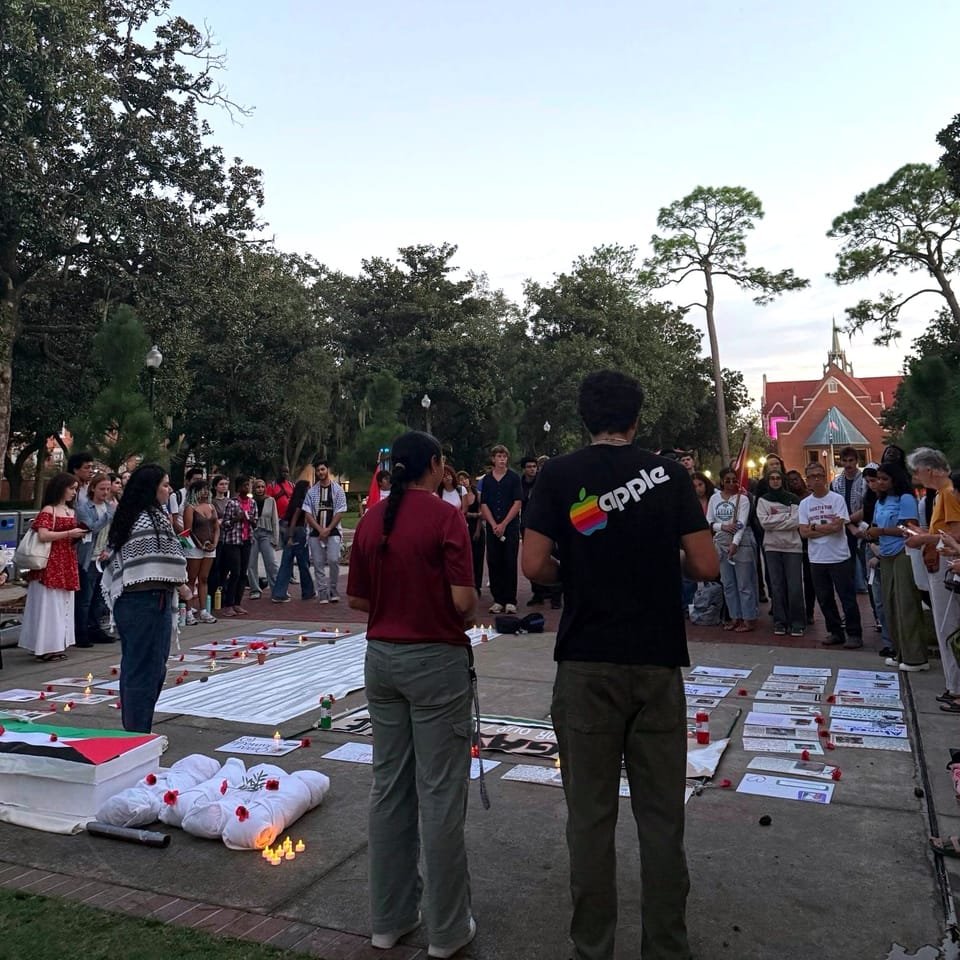
On Tuesday, October 7, 2025, in mourning for Gaza’s sons and daughters, University of Florida (UF) Students for Justice in Palestine (SJP) met to organize an all-day memorial. Across the halls and lawns of Turlington Hall and the Plaza of the Americas, students and community members gathered, compelled by grief and conscience, to give voice to those silenced beneath the rubble.
Approximately two years earlier, Palestinians everywhere watched as resistance fighters broke the siege on Gaza, charging through its fenced borders for the first time into the settlements of the Gaza envelope— the lands from which their families had been displaced generations earlier. Yet even amid the vindication of long-suppressed liberation, fear and anticipation hung heavy in the air, uncertain of how Israel would respond.
Now, as Gaza endures unprecedented devastation, more than fifty students assembled to mark the anniversary. In the time between October 7, 2023 and today, Israel has imposed sweeping collective punishment on the Gaza Strip, flattening its landscape and decimating its population. According to Gaza’s Health Ministry, the death toll has exceeded 67,000. Some independent studies and reports, including data-driven spatial mapping research associated with The Lancet, Harvard, and other institutions, suggest that as many as 400,000 people have been killed or disappeared by Israeli forces.
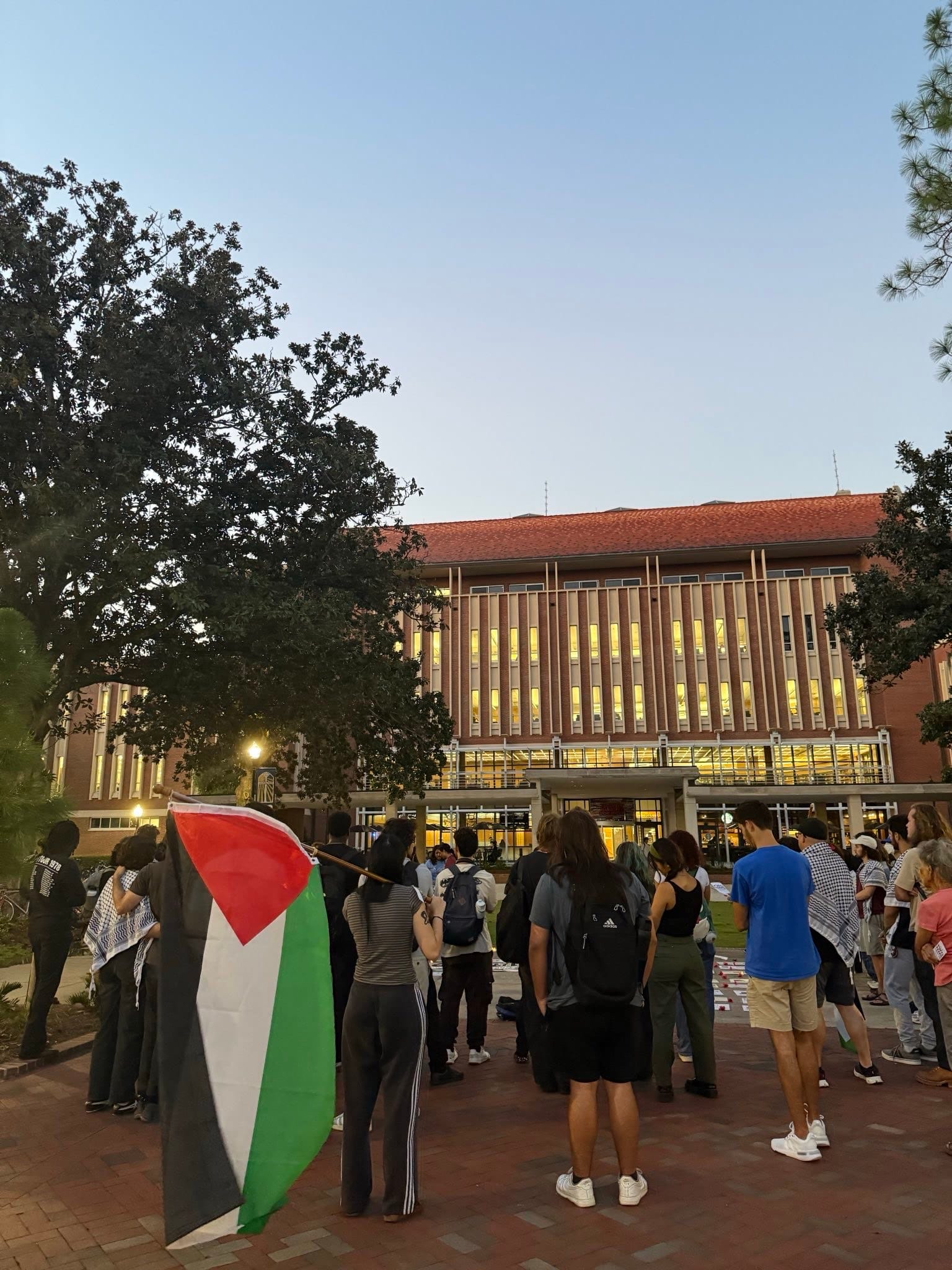
Through the sacrifices of its journalists, Gaza’s suffering reverberated far beyond its borders. Around the world, university campuses became spaces of grief, solidarity, and resistance. At UF, students joined a growing movement demanding accountability and awareness, organizing demonstrations, fundraisers, teach-ins, and vigils to expose the human toll of the assault on Gaza.
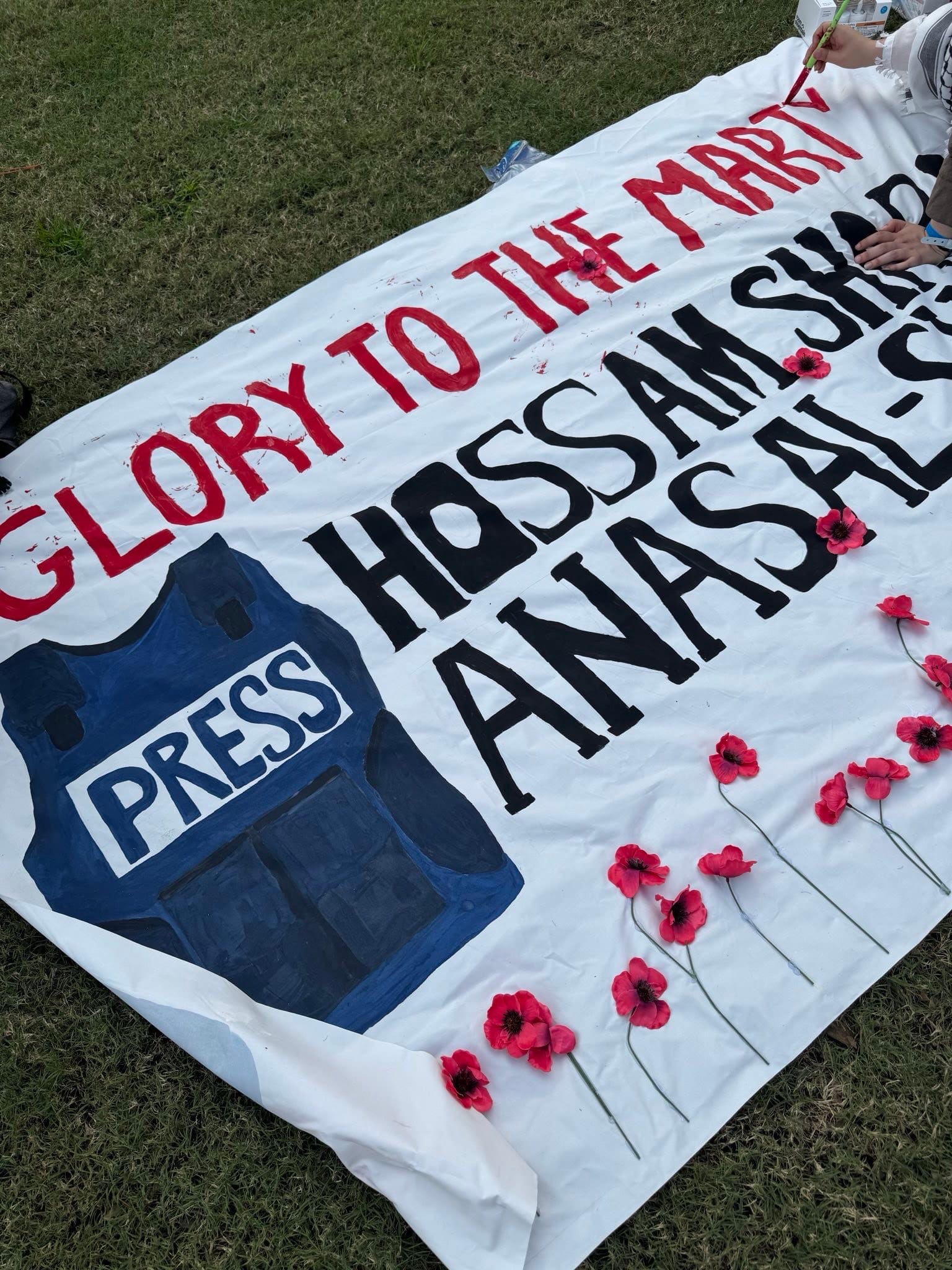
The day began outside Turlington Hall, where SJP members arranged tables covered with crafts, markers, and poster boards, inviting passersby to create artwork commemorating Palestinian martyrs, many of them children, medics, and journalists.
“We wanted people to pause and see the faces behind the numbers,” one SJP organizer said. “Every drawing and every name carries a story that deserves to be remembered.”
After two hours, the group moved to the Plaza of the Americas, lining the grass with posters and banners handmade by students and community allies. The lawn filled with color and remembrance as students painted images of poppies, watermelons, and Palestinian flags. SJP organizers also passed out small clay pots, brushes, and seeds for planting.
“Poppies are the national flower of Palestine,” an SJP organizer explained to the crowd. “They bloom red, symbolizing the martyrs whose lives were taken for their land.”
Many students decorated their pots with traditional Palestinian motifs and attached handwritten labels to the soil.
“Each seed we plant carries a story,” another participant said. “It represents a Palestinian martyred in Gaza.”
Student-made signs sharing the stories of children killed by Israeli forces in Gaza.
As the activity continued, a small group of Israeli and Jewish students gathered nearby, sparking tense but mostly civil debate about October 7 for over an hour. Some challenged SJP members, accusing Palestinian students of supporting terrorism and dismissing the memorial as political provocation. SJP organizers responded that the event was an act of mourning and education rather than confrontation, emphasizing their focus on honoring lives lost and raising awareness about ongoing violence in Gaza.
As the sunlight faded, participants slowly stepped away from the debate, and the vigil took on a quieter, mournful tone. When the sprinklers came on, drenching the signs that decorated the lawn, SJP members quickly gathered them and laid them on the concrete beside candles, poppy flowers, banners, and shrouds. They then opened the floor for attendees to share reflections, stories, and personal testimonies of friends and relatives affected by Israel’s attacks on Palestine, Syria, Lebanon, Yemen, and Iran. Some spoke of loss, others of resilience and faith, but all affirmed the shared struggle for justice and remembrance.
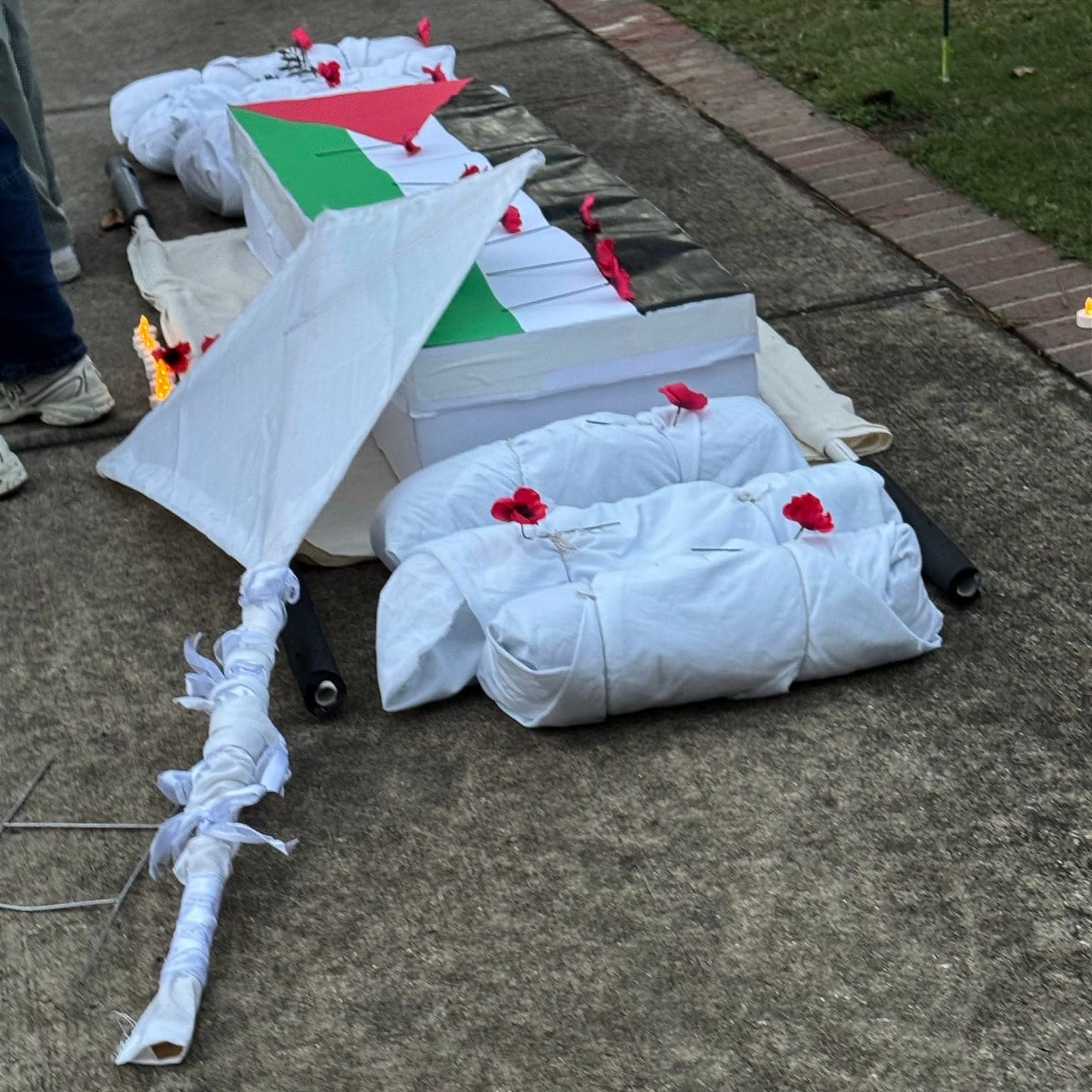
“As important as it is to remember their stories, we must also remember the living, and the tangible things we can do to get closer to liberation,” an SJP member said.
The October 7 vigil came after nearly two years of student organizing at UF. Over a year after the month-long university encampment for Palestine known as the Liberation Zone, students continue to demand accountability and divestment from companies complicit in the war on Gaza.
Since last week, Israel and Hamas have agreed to a ceasefire brokered by President Trump. While the agreement has halted large-scale bombardments for now, key terms of the deal remain unsettled. Negotiations continue over Hamas' surrender of arms, the withdrawal of Israeli forces from parts of Gaza, and the entry of humanitarian aid. Many Palestinians and observers have cautioned that the ceasefire, though a temporary reprieve, does not address the root causes of the conflict or guarantee lasting peace.
"We must be mindful that a ceasefire is not a free Palestine. A ceasefire does not rebuild the devastation, heal our wounded, or free the political prisoners. And we have seen Israel break ceasefires before," an SJP organizer said.
SJP members emphasized that their work is ongoing. With each action, they aim to raise awareness, provide direct support to Palestinians in need, and pressure the university to divest from corporations that profit from occupation and war.